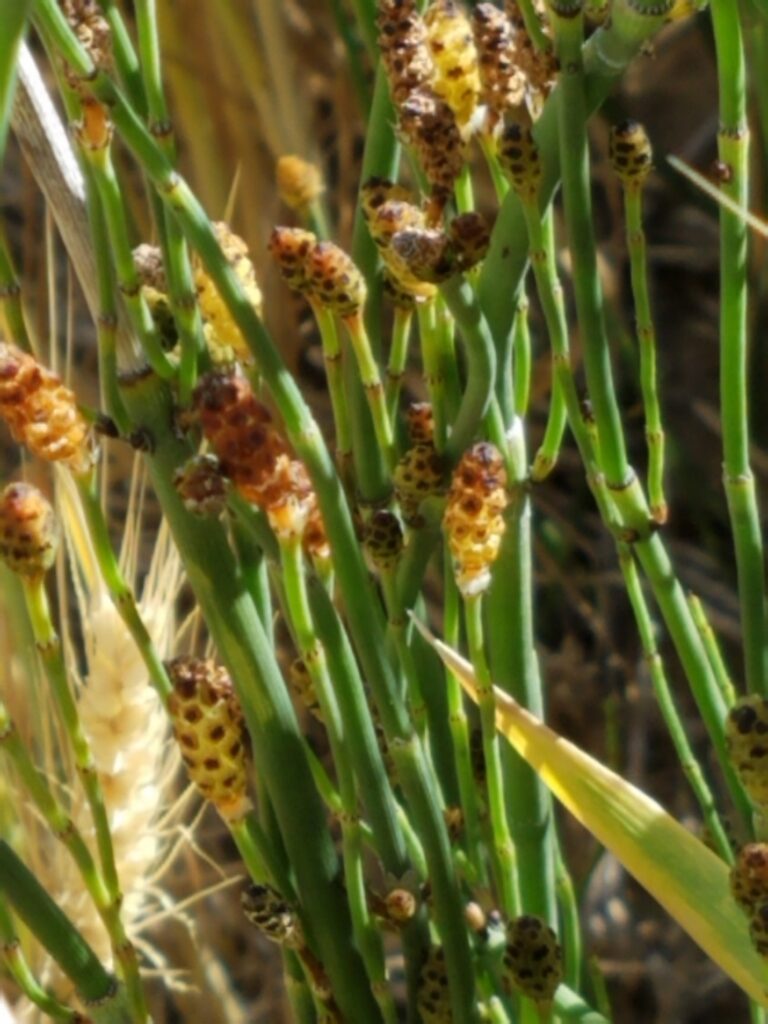
A new WSU Extension factsheet (FS405E), titled ‘Managing Smooth Scouringrush and Field Horsetail in Dryland Cropping Systems’ is now available on the WSU Wheat and Small Grains website. Smooth scouringrush and field horsetail are members of an ancient, spore-bearing vascular plant group that arose about 400 million years ago. They are perennial plants that can be troublesome in no-till, dryland cropping systems. This publication discusses the biology and management of these two Equisetum species in dryland cropping systems of eastern Washington.
Smooth scouringrush is the Equisetum species that infests the most cropland in eastern Washington. In addition to being found in low lying wet areas of fields, it is also commonly seen growing on dry hillsides and upper portions of fields. It is suspected, although not confirmed, that the extensive and deep rhizome system is able to access water from perched water tables in these apparently dry areas of the field. The publication draws on research that my research team and I have conducted over the past decade on smooth scouringrush in Eastern Washington.
Field horsetail tolerates wet soil conditions and may be spread by flooding, which favors its establishment in areas that are frequently flooded, such as roadside ditches and low-lying flats. In addition to an extensive rhizome system, field horsetail also produces tubers, which contribute to its abiotic stress tolerance.
If either of these two weed species are a problem for your dryland farming operation, you may want to download and read this new publication from WSU Extension.

For questions or comments, contact Drew Lyon via email at drew.lyon@wsu.edu or phone at 509-335-2961.