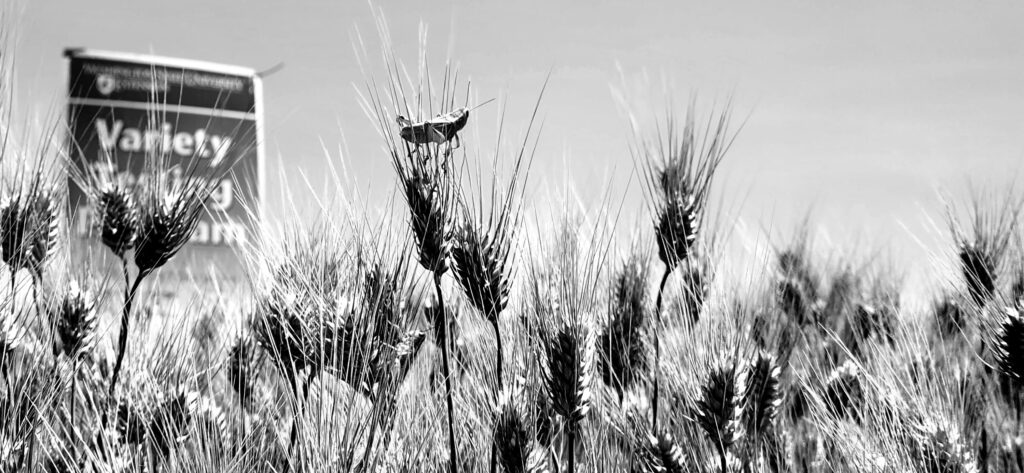
Multi-location data summaries
The 2025 multi-location data summaries, for both spring and winter crops, are now available on the WSU Small Grains website. Variety testing data are intended to provide wheat and barley growers with unbiased information on variety performance and relevant traits to help support optimal on-farm production, provide samples for rigorous end-use quality evaluation, allow comparison to new and up-and-coming variety candidates, and support market class production decisions.
Winter wheat variety trials
We are well into the 2026 winter wheat season, yet a lot can still happen to the wheat crop during the remainder of this growing season. This was evident in the results of the 2025 WSU winter wheat variety trials. Dry weather during planting in the fall of 2024 impacted emergence at Lind and Almira. Snow mold left us little to look at in Douglas, which was ultimately abandoned due to poor stand. A sudden cold snap in Feb. 2025 severely damaged some varieties, especially at Harrington, Ritzville, and Walla Walla. The hot, dry July terminated grain fill at Pullman which resulted in shriveled grain, with low test weight and high protein at harvest. In total, over 35 separate winter wheat yield trials were conducted throughout Eastern Washington. The soft winter wheat varieties and experimental lines were divided into low (<16 inches) and high (>16 inches) annual rainfall zones. Entries were grown in their most representative zones.
For the SWW trials, average grain yields were 64 bu/ac in the low rainfall trials, but almost double at 122 bu/ac in the high rainfall trials. The averages of protein and test weight were similar across the rainfall zones. As with soft white wheat, the average yields of the high rainfall CLOAX trials were double that of the low rainfall trials. The average test weight of the CLOAX lines was slightly low in the low rainfall trials, while the average protein was slightly high in the high rainfall trials. For the hard winter wheat trials, the average yield was better than the state average yield at 75 bu/ac, protein averaged 12%, and test weight averaged 61.6 lbs/bu. Several of the new experimental hard wheat lines had competitive grain yields in all trials.
Spring wheat variety trials
Washington’s spring cereal grain production in 2025 was once again dominated by the seasonal timing of high temperatures and an unreliable precipitation during the growing season. The WSU Variety Testing Program conducted successful spring wheat trials at 12 locations across Eastern Washington in 2025. Variable production conditions limited our ability to use results from five additional locations where yield data were not sufficiently reliable, mostly in lower precipitation areas that were strongly affected by low rainfall and untimely heat. Yields averaged 42 bu/ac and milling quality specifications were generally good with stable test weights and reasonable protein considering the noted lack of moisture through most of the growing season.
The rankings of top performing soft white spring varieties in each precipitation zone were consistent with performance in 2024 and prior years. Performance of hard red spring varieties was more variable, with no clear statistical separation in variety performance, though MT Ubet and MT Dutton trended higher yielding across precipitation zones. LCS Hammer AX (HRS) was the only CoAxium spring wheat in the Variety Testing Program trials.
Spring barley variety trials
Spring barley yields were sharply lower in 2025, with a NASS estimate of 49 bu/acre in Washington, with seasonal drought and temperature effects clearly impacting the crop. Like hard red spring wheat, compressed yields and challenging environmental conditions led to few statistically significant differences among variety yields, though LG Slovan, KWS Thalis, Carleton, Claymore, LG Caruso, and KWS Enduris trended toward the top of yield performance.
For more information
We always encourage growers to spend more time looking at multi-year data for a better representation of variety performance when available. Full results for all 2025 trials are posted on the WSU Small Grains website, including data for each specific variety and location. You can also use the beta version of the new Variety Selection Tool.
Maps and GPS coordinates for all 2026 trials, as well as archived data is also available on the site. We encourage you to join the Variety Trial PrelimData listserv to receive 2026 yield data via email within a week of harvest.
For questions about 2025 winter data or current 2026 winter trials, please reach out to Tricia DeMacon or Kim Campbell. For questions on 2025 spring data or current 2026 spring trials, please reach out to Vadim Jitkov or Mike Pumphrey. You can also email the WSU Dryland Cropping Systems Team to get connected to the appropriate researcher.
Contributed by Tricia DeMacon, Lead Field Technician, Club Wheat Breeding Program, Washington State University.