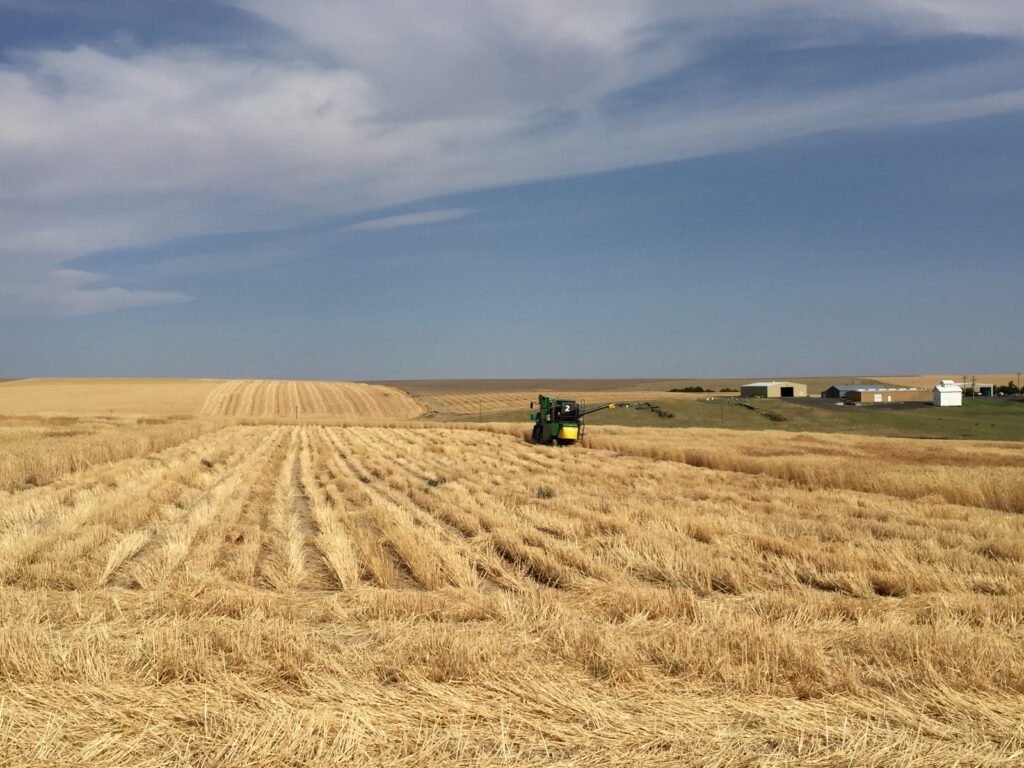
It has been a tough harvest season for many this year. I have heard reports of over 25 field fires this year with probably more that I have not heard of. I know how concerning and devastating these can be with much of my breeding program being lost to a field fire outside of Pullman. There have been reports that some fires started due to powdery mildew in pea fields. I have been hearing rumors that once fires started in the wheat fields, it was also being attributed to powdery mildew. With the numerous questions I have been getting about powdery mildew in wheat, I thought it best to share some information about the subject.
In my 20 years working in wheat in Idaho and Washington, I have only seen powdery mildew in one field in a very high production and wet year. We seldom get powdery mildew in Washington, even under irrigation. There is very little inoculum for it and the low humidity keeps it away. Many growers have asked me about the susceptibility of varieties to powdery mildew. I don’t know the answer to that question. To my knowledge, we have never tested any of the varieties grown in Washington for powdery mildew resistance. Because it is a disease we seldom see, we don’t test for it. Without this testing, there is no evidence to suggest one cultivar is any more susceptible than another.
I have been in contact with the Plant Pest Diagnostic Clinic at WSU. I have submitted my own samples of Piranha CL+ to the Clinic and have seen the results of multiple other samples submitted of other wheat cultivars. None of the samples had powdery mildew on them. These samples came in from multiple parts of the state and no powdery mildew was observed on any of the samples. Given our weather conditions this year, I would agree that it was not a year to see this disease show up. Powdery mildew in wheat is seldom a cause for fire, does not impact yield except in the most severe of conditions, and does not cause sticky stems or leaves.
While I know field fires are tough and a concern for all, there is no evidence to suggest that these fires are caused by powdery mildew in the wheat fields or that any one cultivar is more susceptible to the disease than another. Given these fires have started in different parts of the state, from north to south and east to west, in different fields with different cultivars, and from different types and brands of equipment, it is hard to find any correlation or causations of the increased fires this year. With the dry conditions, growers have commented, and I have seen, the straw getting broken up more as it passes through the combine with more small particles (which looks like dust) coming off during harvest. This condition would be more prone to fire conditions than any foliar disease.
As always, if you have any questions about varieties, feel free to give me a call and I am always happy to discuss answers with you. I hope you all have a successful and safe rest of the harvest season!
Contributed by Dr. Arron Carter, Winter Wheat Breeding Program Professor and O.A. Vogel Endowed Chair of Wheat Breeding and Genetics, ahcarter@wsu.edu, 509-335-6198