Metalaxyl is the active ingredient in fungicides such as Ridomil, Apron, Subdue, and others used to prevent root rots and seedling diseases caused by the fungus-like organisms of the Pythium species. Mefenoxam is another name for the same active ingredient, an isomer of metalaxyl, but that has the same mode of action. Called Oomycetes, these fungus-like organisms prefer wet soil conditions and are more closely related to brown algae than to true fungi like stripe rust. Other common oomycetes are the downy mildew and the late blight pathogen on potato. Pythium species are soilborne pathogens present in most agricultural soils that are able to attack a diversity of crops grown in the PNW including wheat, chickpeas (Chen and Van Vleet, 2016), lentils, canola, potatoes (Porter, et. al, 2009), other vegetables, and even tree fruit. Because Pythium is not a true fungus, only certain fungicides can be used to protect a crop, with metalaxyl being most frequently used, most often in the form of a seed treatment.
Unfortunately, in both potato-producing regions and in chickpea production in the Palouse, metalaxyl-resistant Pythium species have been found. These resistant Pythium species are able to cause damping-off, stand and crop loss, and leak (in potatoes) despite the seed treatments with metalaxyl. The fungicides ethaboxam and picarbutrazox are proposed as an alternative for managing metalaxyl resistant Pythium populations. As metalaxyl is our main weapon against Pythium and other oomycetes, it is vital that we be aware of developing resistance so that we can manage these populations and slow further development. Changes in management practices that encourage the rapid emergence of seedlings and reduce cool, wet soil conditions until plants are robust enough to withstand minor damage can also help reduce the impact of Pythium. Planting spring crops when the soil temperature is above 50 F will reduce infection by Pythium.
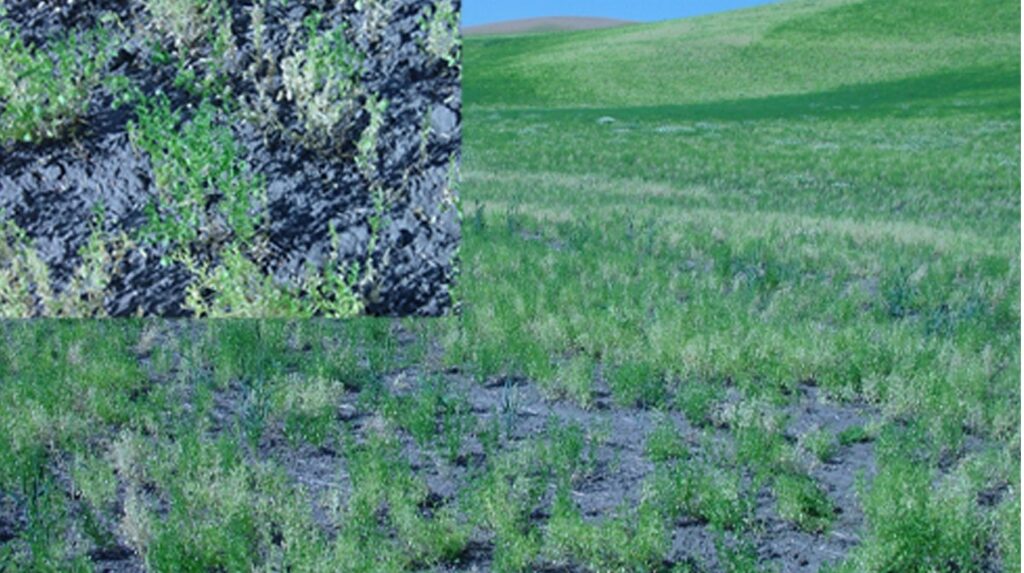

The bottom panel presents a broader perspective, showing groups of lentil plants laid out on a surface. On the left, a cluster of vibrant green plants represents healthy growth. Progressing to the right, the plants display a gradient of disease severity. The middle group shows significant yellowing and wilting of the foliage, indicating a decline in health. The group on the far right exhibits severe browning and desiccation, suggesting advanced stages of disease or stress.
If you suspect that you may have metalaxyl resistant Pythium, you are encouraged to submit a soil or plant sample to the Plant Pest Diagnostic Clinic in Pullman for testing.
For more information:
Weidong Chen and Steve Van Vleet. Chickpea damping-of due to metalaxyl-resistant Pythium: an emerging disease in the Palouse. 2016. http://hdl.handle.net/2376/6273
References:
Cook, R.J. and B.X. Zhang. 1985. Degrees of sensitivity to metalaxyl within the Pythium spp. pathogenic to wheat in the Pacific Northwest. Plant Disease 69: 686-688.
Porter, L.D., P.B. Hamm, N.L. David, S.L. Gieck, J.S. Miller, B. Gundersen, and D.A. Inglis. 2009. Metalaxyl-M-resistant Pythium species in potato production area of the Pacific Northwest of the U.S.A. American Journal of Potato Research 86: 315-326.
Co-authored with Tim Paulitz and Weidong Chen, both of USDA-ARS.