Pea Weevil
Introduction
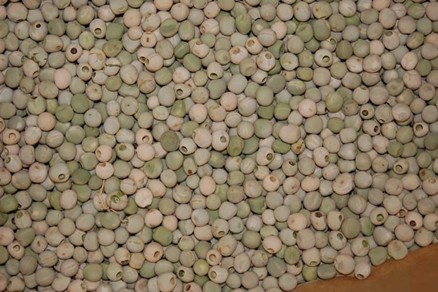
The pea weevil, Bruchus pisorum (L.), is considered one of the most widely distributed species in the world and will attack both winter and spring peas. Heavy infestations of this key pest can reduce the pea seed to empty shells, severely impacting yields. A survey in Washington state showed a wide degree of pest numbers with populations reaching 71 weevils in 100 net-sweeps. The Action Threshold for this pest is four weevils in 100 net-sweeps.
Identification
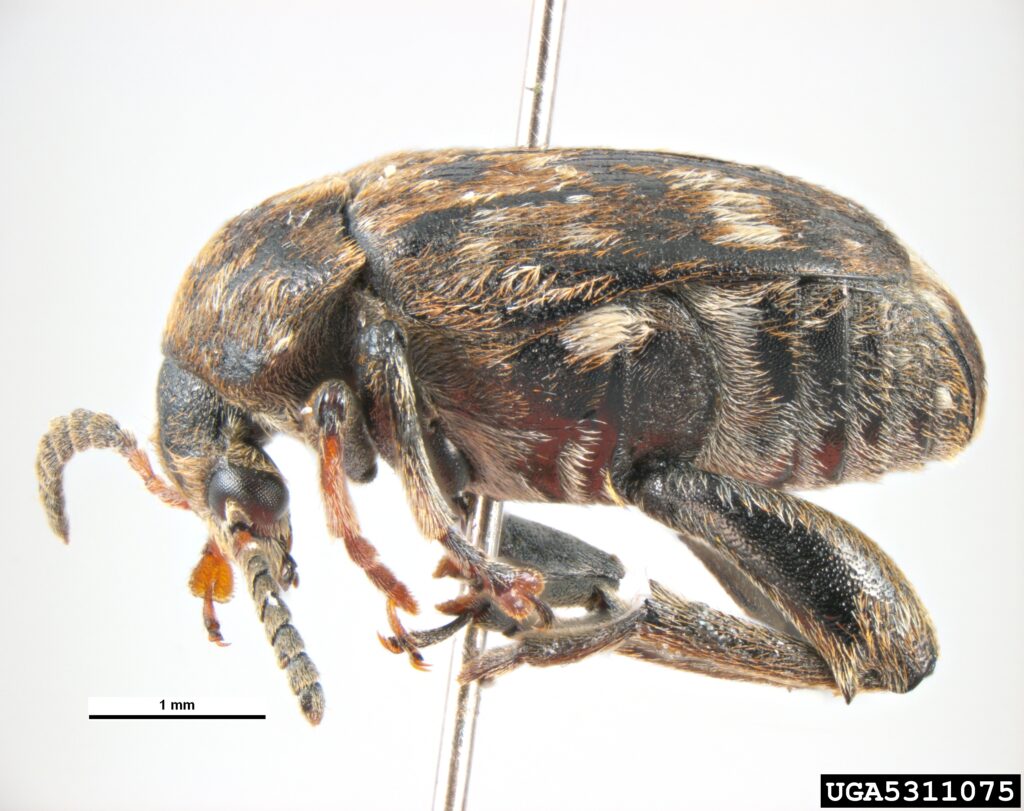
Adult pea weevils are relatively small, with a body length of 3.9–4.9 mm and a width of 2.3–2.8 mm. These insects are globular in shape and have black, yellowish-brown, and white patches of setae (hair) on their bodies; a white scutellum (triangular structure just below the thorax); and a row of white diagonal spots separated by dark brown patches on the short elytra (hard-wing coverings). The lower parts of the long legs are reddish orange (Kingsolver 2004).
Scouting
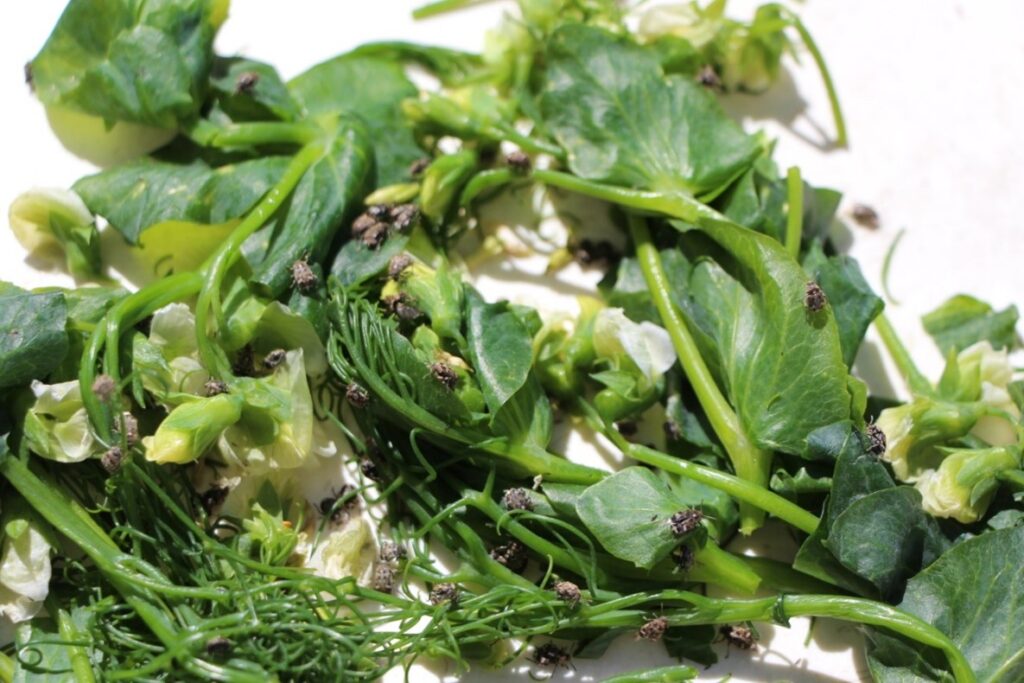
The economic threshold for pea weevil in the Pacific Northwest (Washington, Idaho, and Oregon) is 1 weevil in every 25 sweeps (Reddy et al. 2018). Sampling for adults is recommended when adult female pea weevils are actively feeding on pollen, right as plants begin to produce flowers. Repeat sampling every three to seven days from that point forward (Clement 1992). Both field borders and interior parts should be sampled using a canvas-type sweep net starting midday. Adults are known to rapidly recover and take flight after being collected; therefore, care must be taken to accurately record pest numbers.
Management
The simplest and most effective form of management is to avoid buying or planting unfumigated seeds. Volunteer plants can harbor insect pests and therefore should be controlled to limit their potential to infest the next season of crops.
Insecticide treatment is recommended if 1 adult weevil per 25 sweeps is collected to prevent populations from reaching the economic injury level. Examples of insecticide products registered for pea weevil control are Acetamiprid (Assail 70WP), Alpha-Cypermethrin (Fastac CS), Azadirachtin (Molt-X), Bifenthrin (Discipline 2EC), Chlorantraniliprole, Lamda-Cyhalothrin (Beseige), Cyhalothrin Gamma (Declare), Imidacloprid (Resonate 600 ST), Lamda-Cyhalothrin (Lamcap II), Malathion (Fyfanon 57% EC), Phosmet (Imidan 70-W AG), and Zeta-Cypermethrin (Mustang Maxx). To optimize the effectiveness of foliar-applied insecticides, it is important to target adults before egg laying and before small pods become visible. If crops are treated, recheck fields ten days after the treatment date and reapply insecticide treatment if action thresholds are again met. If pea weevils are found at the time of harvest, treat silos or storage areas with fumigants, like Diacon, or aluminum phosphides, such as Fumitoxin and Phostoxin. Refer to the PNW Insect Management Guide or Pesticide Information Center OnLine (PICOL) Database.
Note – ALWAYS CONSULT THE INSECTICIDE LABEL BEFORE APPLYING ANY INSECTICIDE
When spraying insecticides, always be mindful of pollinators see (I Need to Spray for Insect Pests, But I Am Concerned About All the Bees) and other beneficial insects.
Publications
Pea Weevil Management in Winter Peas
Use pesticides with care. Apply them only to plants, animals, or sites as listed on the label. When mixing or applying insecticides, follow all label precautions to protect yourself and others around you. It is a violation of the law to disregard label directions. If pesticides are spilled on skin or clothing, remove clothing and wash skin thoroughly. Store pesticides in their original containers and keep them out of the reach of children, pets, and livestock. Refer to the online version of the Pacific Northwest Insect Management Handbook for additional information regarding pesticide use and specific insecticide recommendations and application rates for Hessian fly (Hollingsworth 2019). The handbook is also available at Extension offices in Washington, Oregon, and Idaho.