Grasshoppers
Introduction
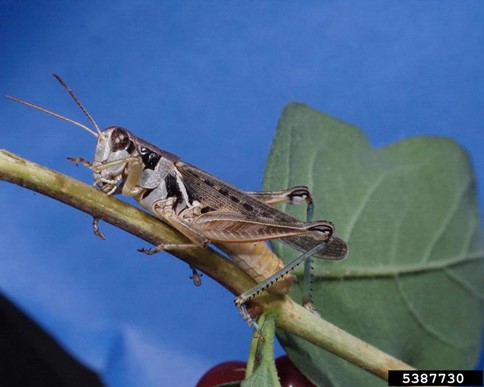
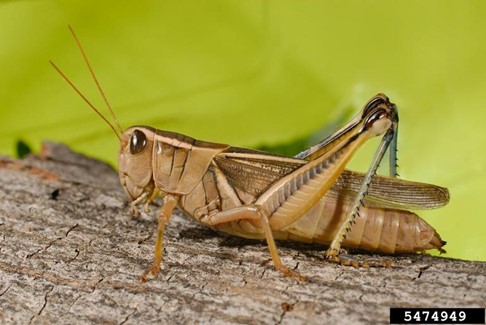
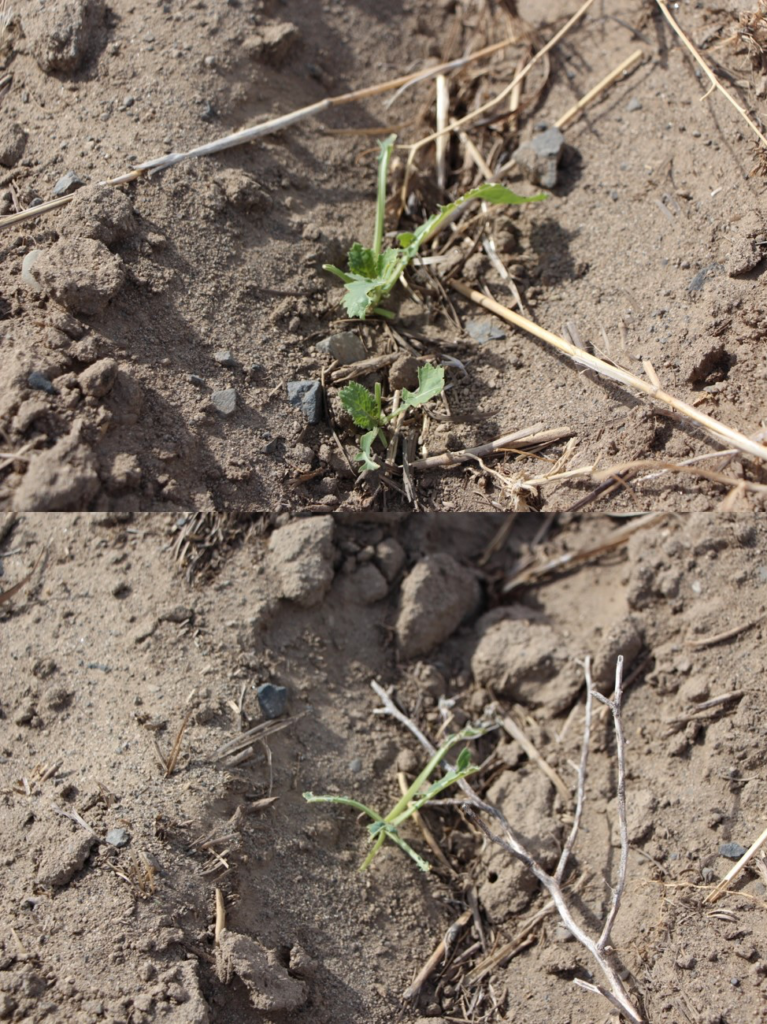
Grasshoppers are generalist feeders and will attack an array of plants. They may become more abundant in years when conditions are hot and dry. A reduction in natural vegetation can oftentimes make cultivated crops more appealing, such as canola. Both nymphs and adults can cause significant feeding damage, especially when feeding occurs on the developing or ripening pods. The Two-striped and Migratory grasshoppers (Melanoplus sanguinipes) are the species most often encountered.
Identification
Prototypical grasshoppers have large hindwings for jumping and the ability to fly when mature.
Scouting
Monitoring and getting an accurate count of grasshoppers can be difficult as they are prone to jumping and flying when disturbed. Therefore, the Canola Council of Canada has developed the following monitoring protocol taken from the Prairie Pest Monitoring Network.
- Measure off 50 meters (164 feet) on the level road surface and mark both starting and finishing points using markers or specific posts on the field margin.
- Starting at one end, either in the field or the roadside, walk toward the other end of the 50 meters, making some disturbance with your feet to encourage any grasshoppers to jump.
- Grasshoppers that jump/fly through the field of view within a one-meter (3.28 feet) width in front of the observer are counted. (A meter stick can be carried as a visual tool to give perspective for a one-meter width. However, after a few stops one can often visualize the necessary width and a meter stick may not be required. Also, a hand-held counter can be useful in counting while the observer counts off the required distance.)
- At the endpoint, the total number of grasshoppers is divided by 50 to give an average per square meter.
- Compare counts to the following damage levels associated with pest species of grasshoppers:
- 0-2 per m² – None to very light damage
- 2-4 per m² – Very light damage
- 4-8 per m² – Light damage
- 8-12 per m² – Action threshold in cereals and canola
- 12-24 per m² – Severe damage
- >24 per m² – Very severe damage
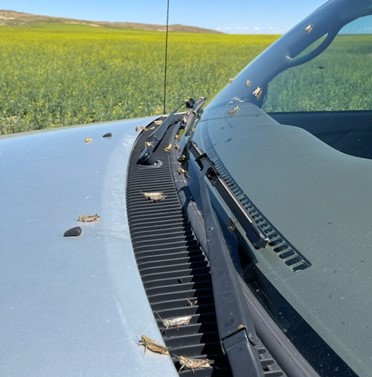
Grasshoppers will likely be the most abundant along field borders and it is recommended to try and treat them when they are 3rd or 4th instars (yet to have mature wings) and thus are not flying from field to field.
Management
The action threshold for grasshoppers is 8 to 12 per square meter. If an insecticide application is warranted, products containing BIFENTHRIN (such as Discipline 2ec), CHLORANTRANILIPROLE (such as Coragen Insect Control), CYANTRANILIPROLE (such as Exirel Insect Control), DELTAMETHRIN (such as Delta Gold 1.5EC), LAMBDA-CYHALOTHRIN (such as Lamdastar) and ZETA-CYPERMETHRIN (such as Mustang Maxx) are all registered for canola. For a complete list consult the PNW Insect Management Guide or Pesticide Information Center OnLine (PICOL) Database.
Note – ALWAYS CONSULT THE INSECTICIDE LABEL BEFORE APPLYING ANY INSECTICIDE
When spraying insecticides, always be mindful of pollinators see (I Need to Spray for Insect Pests, But I Am Concerned About All the Bees) and other beneficial insects.
Archived Resources
Use pesticides with care. Apply them only to plants, animals, or sites as listed on the label. When mixing or applying insecticides, follow all label precautions to protect yourself and others around you. It is a violation of the law to disregard label directions. If pesticides are spilled on skin or clothing, remove clothing and wash skin thoroughly. Store pesticides in their original containers and keep them out of the reach of children, pets, and livestock. Refer to the online version of the Pacific Northwest Insect Management Handbook for additional information regarding pesticide use and specific insecticide recommendations and application rates for Hessian fly (Hollingsworth 2019). The handbook is also available at Extension offices in Washington, Oregon, and Idaho.