Written by Anna Carroll
The Foundation for Food and Agricultural Research (FFAR) funds “bold science” by combining industry and federal funding. Since 2023, a team of scientists and industry professionals spanning coast-to-coast has been working on a grant from FFAR to better understand issues that cause low falling number (FN) in wheat and to develop a new testing method to predict FN.
As part of this hugely collaborative effort with our industry partner Envirologix, we have developed and are now validating a new rapid test that measures enzyme activity in wheat. The test behaves similar to a Covid test or pregnancy test and functions as a fast and accurate supplement to the Hagberg-Perten Falling Number method. The test consists of a dipstick that is read by a digital scanner. The QuickScan reader is calibrated across a range of falling numbers and can calculate a predicted FN–it reads the test strips and reports an “immuno-FN.”
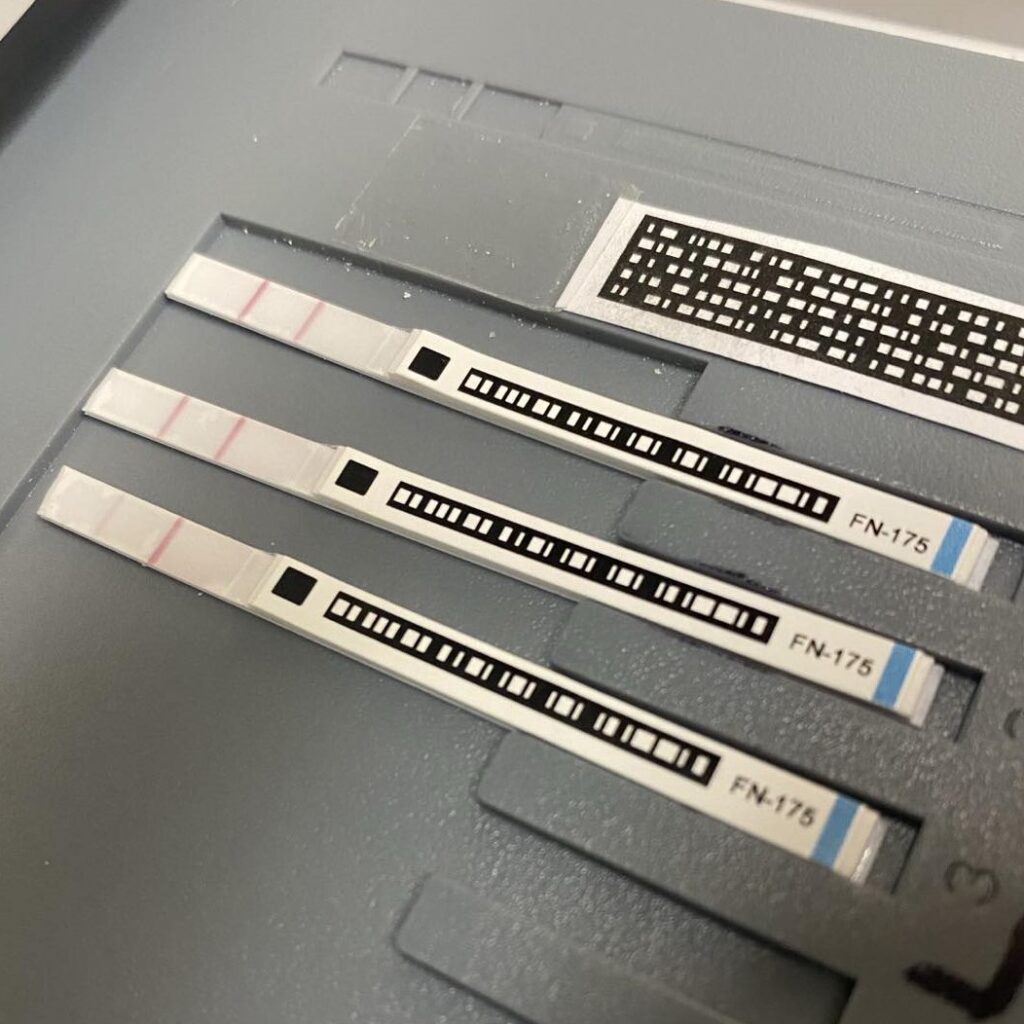
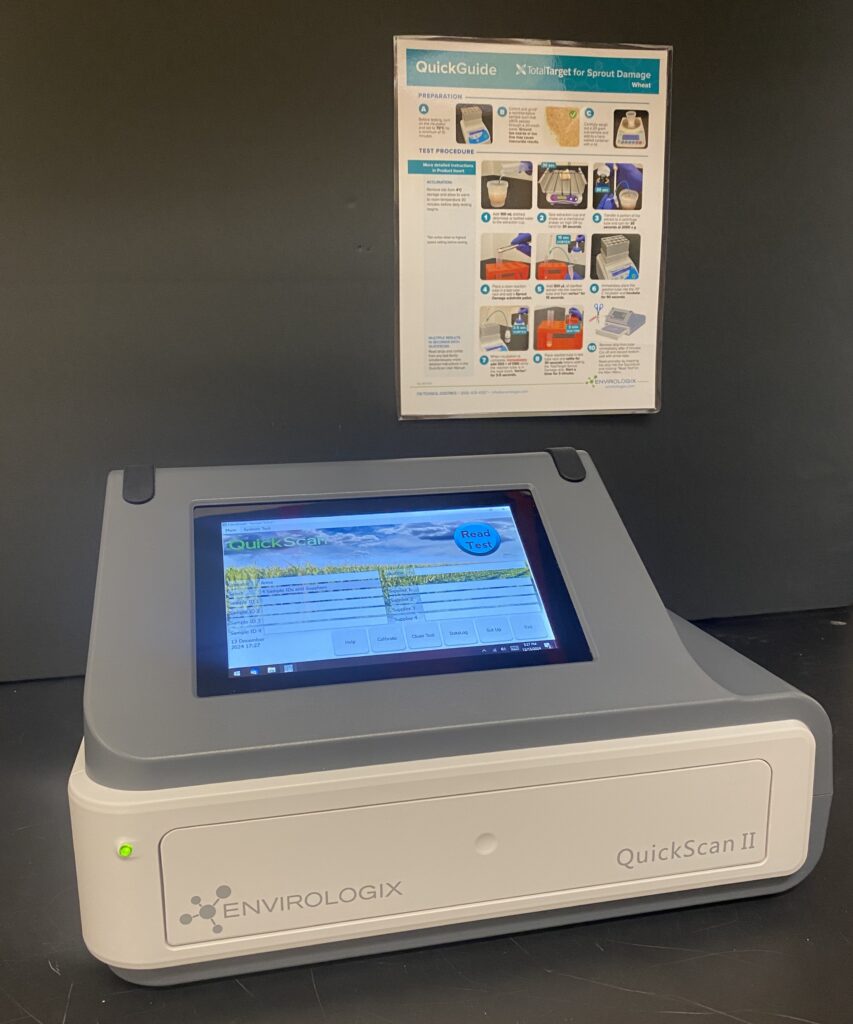
The new test has officially gone through its first field season of testing across the US. In the Pacific Northwest, more than 2,000 tests have been run between Washington State University (WSU), the Wheat Marketing Center, and the Highline Grain Growers elevator. Collaborators who provided samples included:
- Drs. Steber, Biak, and Thompson with USDA-ARS
- Dr. Clark Neely, Alex McGregor, and Cat Salios with the WSU and McGregor Company variety trials
Collaborators who helped with testing included:
- Dr. Jayne Bock, Liman Liu, and Andrew Choi with the Wheat Marketing Center in Portland, Oregon
- Paul Katovich, Kevin Coffman, and Kirk Freeman with the Highline Grain Growers elevator in Coulee City, Washington
- Dr. Hauvermale, John Kelly, Dru Mattei, and Anna Carroll at WSU
All wheat samples were tested using both the traditional Hagberg-Perten FN method and the new QuickScan rapid tests. The results were compared to see how well the rapid test predicts FN. All findings were reported back to Envirologix as they continue to refine their calibration curves to produce a more accurate result. Together, we have begun looking for trends in samples that do not fit our expectations and investigating possible reasons behind the deviations. Currently, we are working on evaluating the impact that protein content has on FN and how to account for it in the rapid test. The commercial launch of the new test is expected to occur sometime in early 2025.
The new reader was demonstrated at the WSU Wheat Academy on Wednesday, December 11. If you did not attend this year’s Wheat Academy, you can reach out to us directly to arrange a demonstration. A video demonstration is planned for early 2025 and will be available on our webpage (coming very soon.)