Flea Beetle
Introduction
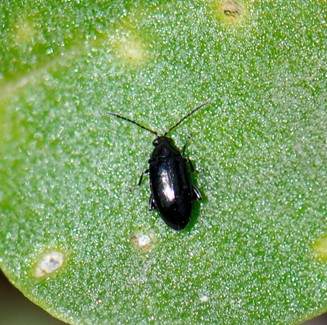
Flea beetles are usually not a problem in winter canola unless 1) the crop is planted very early, 2) plants are stressed, and/or 3) spring canola is in a nearby field and maturing. If young winter canola seedlings are the only green material for flea beetles to feed on, they can quickly move from a neighboring field with a mature crop into a winter canola field and cause damage. The Crucifer flea beetle is the primary species observed in canola in the PNW, although the striped flea beetle is becoming more prevalent in parts of Montana. In spring canola, flea beetles are one of the major pests that can cause economic damage to canola in the PNW.
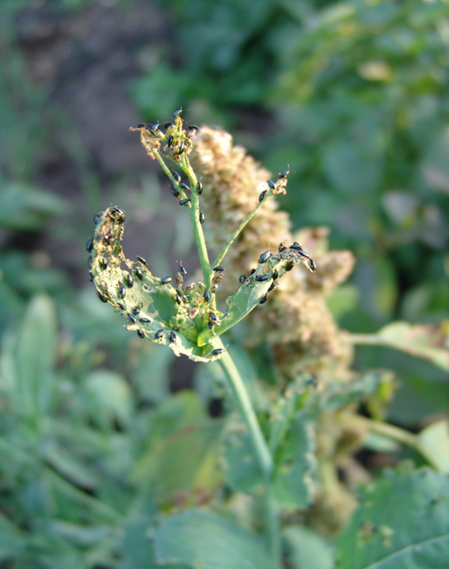
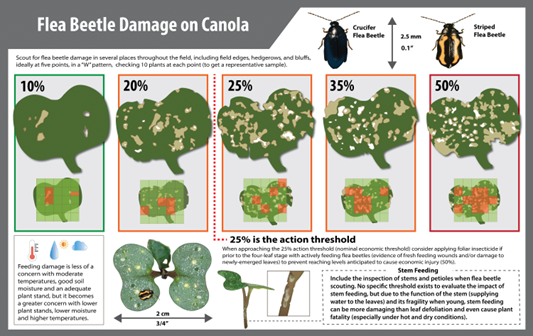
Flea beetles overwinter as adults in fencerows, ditches, and forested areas. Once temperatures reach 55-60ºF the adults become active, flying to canola fields just as seedlings are emerging in the spring. The Striped flea beetle becomes active before the crucifer flea beetle. The beetles will also feed on mustard, mustard weeds, and alfalfa. Once feeding begins, the beetles release a pheromone that attracts more beetles, so frequent scouting and timely control measures are key to catching damage before it is widespread. Adult beetles feed on cotyledons shortly after seedling emergence. The first symptoms of feeding injury are holes or small pits in the true leaves and cotyledons and can also include stem damage. Feeding injury can result in plant death and significant stand loss, especially in hot, dry weather when the beetles are most active. After the crop is beyond the 4-leaf stage and the first true leaves are fully extended, serious damage usually does not occur. By mid-June, adult flea beetles decrease in number.
Identification
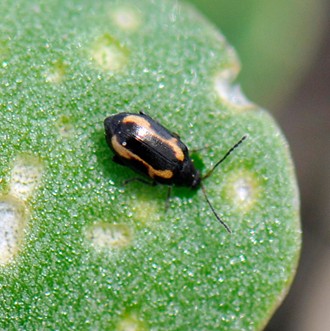
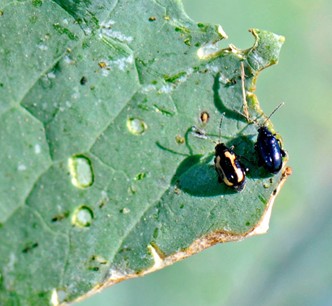
Adults are about ⅛ inch long and shiny black (Crucifer) or black with two yellow lengthwise stripes (Striped). They have enlarged hind legs that allow them to jump like a “flea” hence the name. Larvae are whitish, cylindrical and worm-like with small legs and a brownish head.
Scouting
Like the cabbage seedpod weevil, the presence and activity of the flea beetle will first appear on field margins. One can use a sweep or visual sampling to determine adults and damage.
It is advised to carefully scout again in the spring, including neighboring fields, if flea beetle observations are made in the fall. The adult beetles may have overwintered, making them hungry for the first canola to emerge.
Management
The first and most effective line of defense for flea beetles is insecticidal seed treatment, and the next step is regular scouting of the canola following emergence. The action threshold for control is 25% defoliation of leaf area and stem feeding damage, while the economic threshold is 50% (NOTE: that damage can go from 25 to 50% in a hurry, so be certain that treatment options are available and ready for application when necessary). Flea beetle damage is most severe around the outside of canola fields. Crop rotation is not effective as a means of control as the adults can fly between fields. Similarly, delaying seeding to combat potential flea beetle damage is not effective either. The University of Idaho conducted a foliar treatment study with three planting dates and five cultivars. The foliar spray increased yield by 212 pounds/acre, while the seeding date impacted yield more significantly with the later dates resulting in lower yields.
Gaucho 600F and Gaucho 480 can be applied as a seed treatment. Seed treatment products provide suppression only. Refer to the online version of the Pacific Northwest Insect Management Handbook for specific insecticide recommendations and application rates for flea beetles. The handbook is also available at Extension offices in Washington, Oregon, and Idaho. Be sure and read and follow the pesticide label instructions before use.
Use pesticides with care. Apply them only to plants, animals, or sites as listed on the label. When mixing or applying insecticides, follow all label precautions to protect yourself and others around you. It is a violation of the law to disregard label directions. If pesticides are spilled on skin or clothing, remove clothing and wash skin thoroughly. Store pesticides in their original containers and keep them out of the reach of children, pets, and livestock. Refer to the online version of the Pacific Northwest Insect Management Handbook for additional information regarding pesticide use and specific insecticide recommendations and application rates for Hessian fly (Hollingsworth 2019). The handbook is also available at Extension offices in Washington, Oregon, and Idaho.