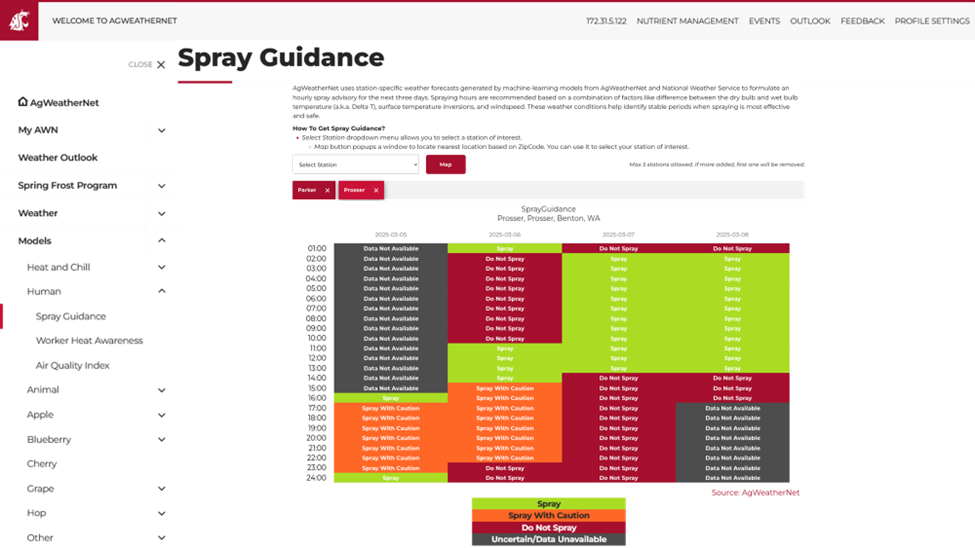
AgWeatherNet (AWN) has launched the AWN Spray Guidance—a decision support tool designed to help growers and the farming community in general to optimize spray applications. Using this tool, farmers and applicators can identify and plan the best time-windows for efficient crop protection and weed management (via herbicide applications). Favorable spray timings also help reduce off‐target chemical drift and associated human exposure issues. Spraying hours are recommended based on a combination of factors like difference between the dry bulb and wet bulb temperature (i.e., Delta T), surface temperature inversions (Tz), and windspeed (WS). These weather conditions help identify stable periods when spraying is most effective and safe. The tool uses AWN weather station specific real‐time observations as well as station specific forecasts, to provide guidance on best time-windows for operating sprayers to realize on-target applications.
How the tool works
The tool integrates observed and forecasted weather data to provide an hourly spray advisory for the next 72 hours for over 360 weather stations across the state of Washington. It classifies spraying conditions into four categories:
 | Spray – Favorable conditions. |
 | Spray with caution – Marginal conditions. |
 | Do not spray– High risk of drift or poor application effectiveness. |
 | Data unavailable – Insufficient weather data. |
The table below depicts the logic implemented to realize this tool. This tool determines spraying conditions using three key inputs, i.e., temperature inversion (Tz), Delta T (ΔT) and wind speed (WS).
- Temperature Inversion is determined as the difference between air temperatures measured at 30 ft (9 m) and 6 ft (1.8 m) above ground by AWN Tower stations. When cooler air is trapped below warmer air (Tz > 0 °F), spray drift risk increases, leading to a “Do Not Spray” advisory.
- Delta T is the difference between dry and wet bulb temperatures. It quantifies air moisture levels to predict evaporation potential of spray droplets. Delta T between 3.6 and 14.4 °F (2 to 8°C)is considered as ideal spray condition. Too high or too low Delta T results in respective evaporation or condensation risks, making spraying ineffective.
- The best spraying conditions exist when WS is between 4 and 10 mph (6.4 to 16.1 kmph). Lower WS may cause inadequate dispersion, while higher WS increase the drift potential of the spray droplets.
Weather Data Driven Spray Decision Tools
| Condition | Decision | Interpretation |
|---|---|---|
| Tz > 0 °F | No Spray | Temperature inversion detected; atmospheric stability is unsuitable for spraying. |
| Tz ≤ 0 °F and ΔT 18 °F | No Spray | ΔT is outside the safe range, indicating high evaporation or condensation risk. |
| Tz ≤ 0 °F, 3.6 °F ≤ ΔT ≤ 14.4 °F, and WS between 4 and 10 mph | Spray | Conditions are optimal—with minimal drift and evaporation risks. |
| Tz ≤ 0 °F, ΔT between 0 – 3.6 °F or 14.4 – 18 °F, and WS between 4 and 10 mph | Spray with Caution | Marginal conditions: spraying is possible but may require adjustments to minimize risk. |
| Insufficient data | Unsure | N/A |
How to access the Spray Guidance tool
The AWN Spray Guidance Tool is free to use and available online. If you do not have an AWN sign-in account, you can create one. Once signed in, navigate to Models >> Human >> Spray Guidance. The interface allows users to select preferred stations and provides station-specific spray advisories for the next 72 h.
For questions or comments to improve the tool, contact Lav Khot via email or via phone at 509-335-5638.
Funding and acknowledgements
This project is an outcome of subsidiary projects funded in parts by the Washington State Department of Agriculture through the Specialty Crop Block Grant program, and USDA NIFA 0745, and internal funds of WSU AgWeatherNet. Dr. Basavaraj Amogi, Dr. Jaitun Patel, and Dr. Sean Hill contributed to development and porting of this tool into the AWN ecosystem. AWN also acknowledges prior modeling efforts by Dr. Matt Cann on building machine learning models for station specific weather forecasting.
Additional Reading
Cann, M. D., & Khot, L. R. (2022). Washington State University.
Amogi, B., Khot, L., Patel, J., & Hill, S. (2025). Localized weather forecast guided spray application advisory webtool for the Pacific Northwest US. Proceedings of the 15th European Conference on Precision Agriculture (ECPA), Barcelona, Spain. June 29–July 3, 2025.