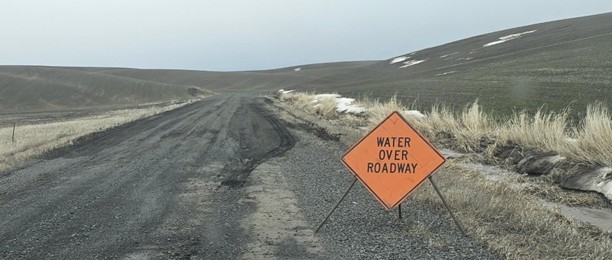
Header photo credit: Dave Huggins
“In 1963, Whitman County reported that 100,000 yards of gravel were lost from surface due to water running down the roads after high runoff.” – C.B. Harston, WSU Cooperative Extension 1972
Erosion, Flooding, and Research (2025)
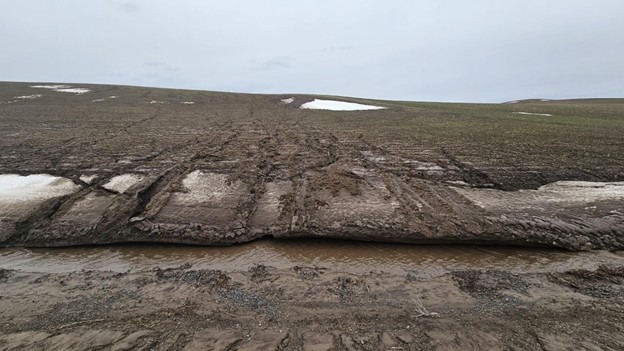
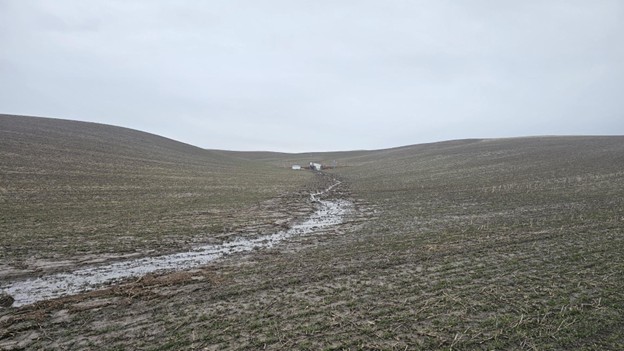
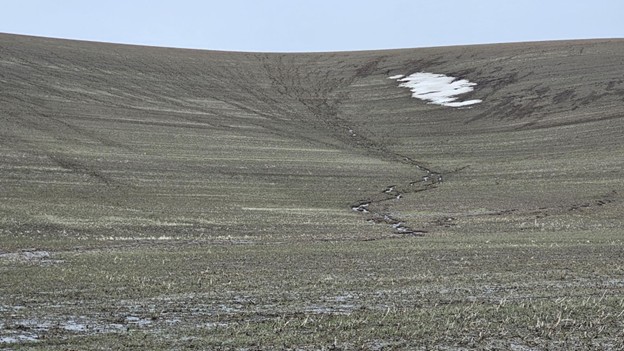
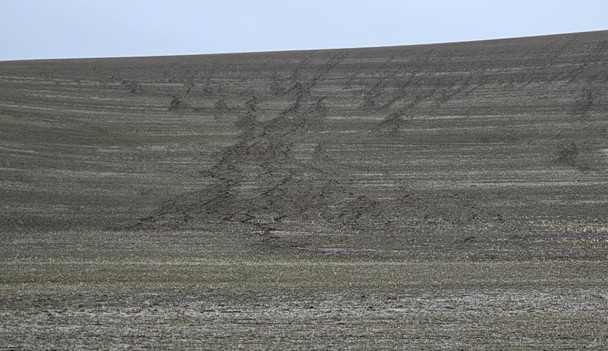
Soil Erosion Basics
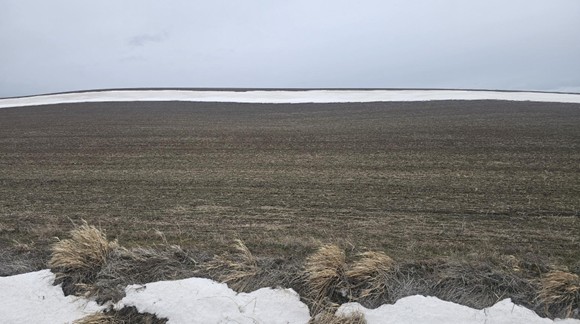
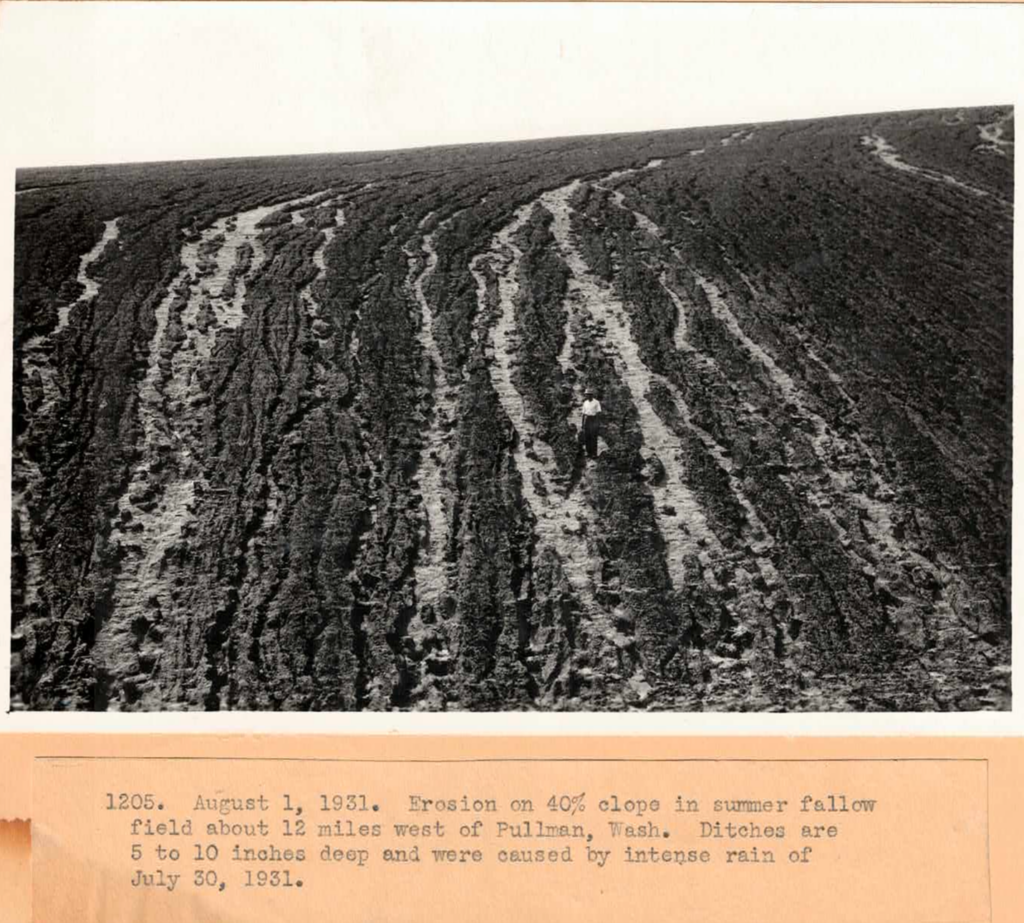
Abrupt transitions from snow to mud are a common phenomenon for spring on the Palouse. Unfortunately, when high volumes of water run over land, soil often moves with it. The most hazardous situation for soil loss is when warm temperatures that melt snow and thaw the top inch or more of frozen soil are accompanied by rain. Here, water that cannot infiltrate the underlying frozen soil runs over the surface carrying valuable topsoil and agrichemicals with it. This is a selective process as soil organic matter and clay particles are more easily transported down the slope.
Much is lost when water and topsoil move downslope. In addition to reducing soil water recharge, the loss of topsoil results in nutrient loss and reduces the soil’s future capacity to store water, thereby limiting crop yield potential. Furthermore, when nutrients and agrichemicals leave the field along with soil, a valuable resource becomes a challenge.
Soil erosion is typically characterized by three categories: water, wind, and displacement (such as results in movement downhill with tillage). In many cases, soil erosion can be reduced using best practices for soil health. Often Mother Nature is blamed for the amount of soil destruction that can occur when rain, melting snow, and partially thawed ground results in serious soil erosion. Management practices can mitigate or even eliminate soil erosion when adverse conditions arise.
Migitating Soil Erosion
The Revised Universal Soil Loss Equation (RUSLE2) from the USDA-ARS calculates soil erosion with a combination of soil type/vulnerability of loss and land use, such as cover management, and topography–including slope length, steepness, and shape.
Approaches to minimize water erosion utilize practices that increase water infiltration and enhance soil water storage (holding capacity). These practices include:
- Reducing soil disturbance
- Maintaining soil cover
- Maintaining living roots
- Increasing soil organic matter
- Reducing compaction and improving soil structure to enhance water infiltration and storage
The benefits of conservation practices accumulate over time and can build the capacity of a farming system to mitigate the impact of extreme weather events. The positive impacts of these practices were also seen across the region, including ‘divided slopes’ where long and/or steep slopes broken into fields with different cover types were seen to slow soil moving down the hill. The practices are also timeless as these 5-point recommendations from University of Idaho Extension in 1980 and the work on erosion completed by the STEEP project still apply today.
Researching Soil Erosion
Research on soil erosion has a long history in the Palouse and it was initiated near Pullman, Washington in the 1930s with the establishment of what is now the Palouse Conservation Field Station (PCFS). The PCFS site was one of 10 original erosion research sites initiated across the US and is still in active operation today.
The Cook Agronomy Farm (CAF) located in Pullman, Washington was founded in 1998 as a collaborative research effort between Washington State University, the University of Idaho, and the USDA-ARS Northwest Sustainable Agroecosystem Research Unit with the goal of conducting long-term, multi-disciplinary, field-scale cropping systems research. In 2012, CAF joined the USDA-ARS Long-Term Agroecosystem Research (LTAR) Network to participate in cross-disciplinary knowledge sharing across the nation with others investigating and quantifying long-term impacts of conservation practices in agriculture.
At CAF, two large-scale field units are managed with two different treatments:
- Reduced tillage and uniform agrichemical input
- Continuous no-tillage with precision nitrogen application
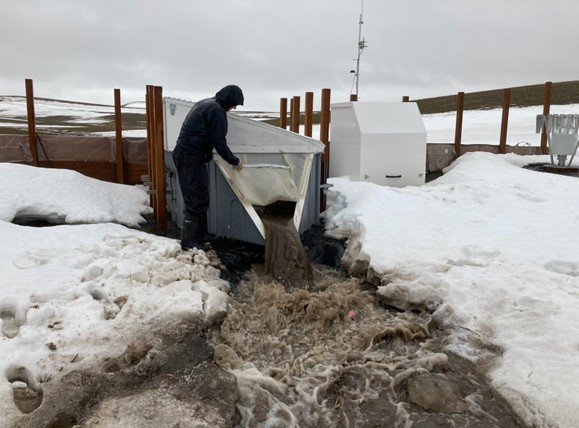
Crop rotation is paired each year with winter wheat, spring wheat, spring canola, garbanzo beans, and winter peas commonly grown. To document the impacts of these two management treatments on water, two isolated 30-acre catchments have been instrumented with paired flumes that monitor both surface runoff and subsurface flow from artificial drain lines within each field. Each flume is also equipped with automated water samplers that collect water samples throughout storm events which are then analyzed for sediment, nitrate, dissolved and particulate phosphorus concentration. These instruments provide all the necessary information to record the total losses from each field. With this instrumentation, scientists were recently able to document one of the most severe frozen soil runoff and erosion events that the Palouse region has experienced over the last 30 years.
Extreme Runoff and Erosion in 2025
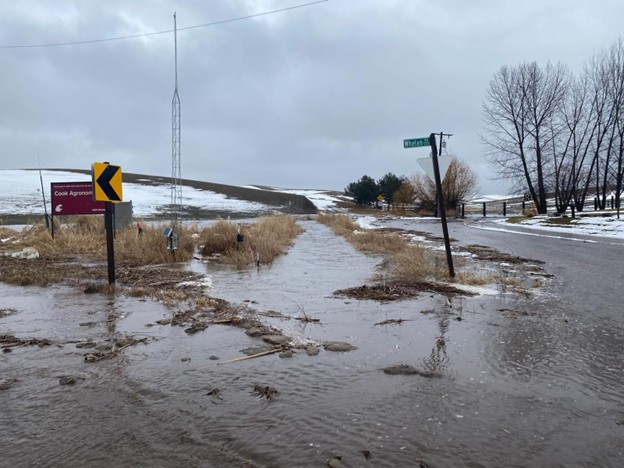
The frozen soil runoff storm event occurred on Feb. 23 and Feb 24 this winter. This event was set up by cold, dry conditions in January. There was little to no snow cover to insulate the soil across the region when nighttime temperatures dropped below 20 degrees F over a two-week period. Overnight temperatures dropped down to -14 degrees F in Moscow, Idaho on February 12. By mid-February the soil was frozen down to 6 inches in Moscow. In the weeks prior to the snowmelt event, 7-10 inches of snow accumulated over the frozen soil in the Moscow-Pullman area. Warming temperatures starting on February 22 and over 1.5 inches of rainfall lead to one of the largest flood events in the last 30 years in Moscow, Idaho. The combination of 1.5 inches of rainfall with 1-2 inches of water melted from the snowpack over frozen soil which was largely impermeable to water were the perfect conditions for an extreme runoff and erosion event.
Preliminary data collected during this event indicate that although similar amounts of runoff were experienced from both watersheds at CAF, the continuous no-till management experienced less soil loss as surface residue cover on the ground held the soil. The photos at the top of this page help tell the story.
More resources on managing soil erosion in Eastern Washington were compiled by the Washington Soil Health Initiative.

Carol McFarland is no longer with WSU. For questions or comments, contact us at small.grains@wsu.edu.

Co-author: Erin Brooks, Professor, Agricultural Engineer, University of Idaho Department of Soil and Water Systems

Co-author: David Huggins, Research Soil Scientist/Research Leader, Northwest Sustainable Agroecosystem Research Unit, USDA-ARS
Reference:
| Title | Environmental education series: Erosion |
| Series | Extension Mimeograph 3650, 1972 |
| Date | 1972-11 |
| Description | Please be aware that the information in this mimeograph is most likely obsolete; these are being published for historical purposes and you should contact the Washington State University Extension Service directly for up-to-date editions or information. These Extension Mimeograph (EM or HM) publications were released out of Washington State College’s Extension Service, intended to improve the work and lives of Washington’s farmers and homemakers. |
| Subject | Agriculture–Washington (State); Home economics–Washington (State) |
| Creator | Harston, C. B., 1911- |
| Publisher | Washington State University. Cooperative Extension. |