Dr. Xianming Chen’s March stripe rust forecast for the 2025 wheat growing season in the inland Pacific Northwest indicates a low risk for stripe rust, with predicted yield losses ranging from 1-20% in commercially available varieties. This significantly reduced risk, compared to earlier predictions of up to 29% loss, is attributed to a cold snap in February. Field surveys across several Washington counties have found no evidence of stripe rust, even in locations where it was previously observed in November. This absence of disease is a stark contrast to last year, when stripe rust was prevalent by late February.
Given the low disease pressure and lack of observed stripe rust, early season fungicide application at herbicide timing is currently not recommended for winter wheat in the region. As always, continue scouting fields and following the stripe rust updates to determine whether symptoms appear and if fungicide application is needed later in the season. For spring wheat and barley, planting resistant (R, rating 1 or 2) or moderately resistant (MR, ratings 3 or 4) varieties is recommended. Stripe rust ratings can be found on the Variety Selection Tool located on the WSU Wheat and Small Grains website or by visiting the Seed Descriptions & Resources page of the Washington State Crop Improvement Association’s website. Nationally, stripe rust has yet to be reported, a positive sign compared to last year when it was already present in several states by this time.
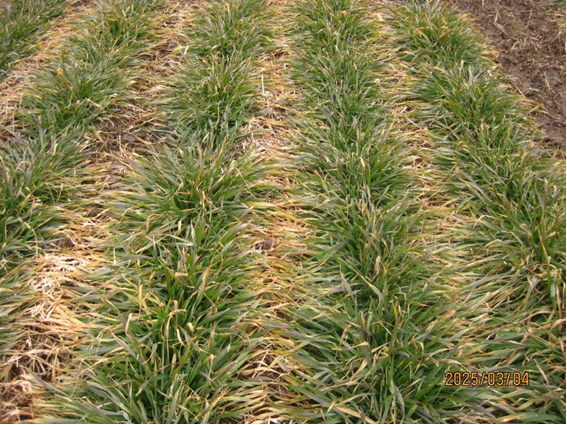
Image: Wheat plants without stripe rust in a field in Lincoln County, WA on March 4, 2025, the same field in which stripe rust was found on November 5, 2024.

For questions or comments, contact Drew Lyon via email at drew.lyon@wsu.edu or phone at 509-335-2961.