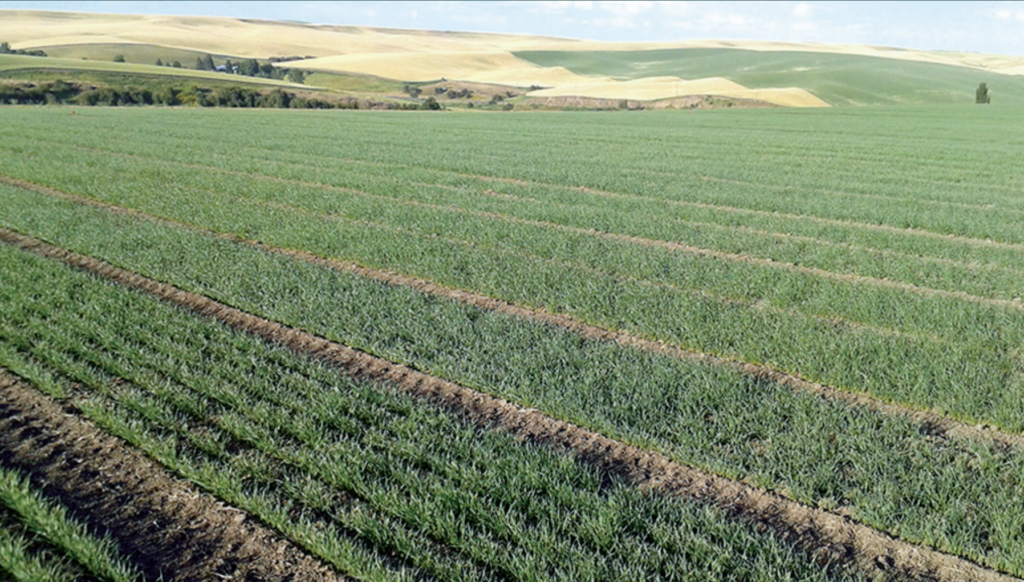
Soil acidification in the inland Pacific Northwest’s small grains has been an issue of concern since University of Idaho researcher Dr. Robert Mahler characterized declining soil pH values in the 1980s. Soil pH is an often invisible threat to soil health and as one of the ‘master variables’ of the soil, it impacts nutrient availability, herbicide activity and carryover, and soil biology. Soil pH decline is accelerated with the addition of ammonium-based fertilizers in the process of nitrification where hydrogen ions are released during the conversion to nitrate. The accumulated hydrogen ions lower soil pH. A new short video illustrating the microbially-mediated process (opens in new tab) has just been released by the PNW Farmers’ Network. There are also many resources available on the WSU Small Grains website to learn more about the impacts of low soil pH on the cropping system.
Soil pH can vary across the landscape and acidic soil can present as poorly performing patches in the field. An inexpensive and easy-to-use diagnostic tool is available to producers and their advisers: an in-field soil pH meter. These portable tools allow managers a low-cost way to identify acidic soils. These tools can reveal acidic zones, either across the field or as stratified bands in the profile, in a way that aggregated soil sampling can miss. Direct seeded systems especially may be experiencing acute soil acidification in the zone where fertilizers are banded year after year.
Now-retired Columbia County Extension Specialist Paul Carter wrote an Extension publication (FS205E) describing how to use an In-Field Soil pH Meter (opens in new tab). A group of student interns participating in Dr. Andrei Smertenko’s Research and Extension Experiences for Undergraduate (REEU) students program in 2024 translated those methods into a 5-minute instructional video that includes best practices for soil testing (opens in new tab) from Dr. Rachel Wieme and Pomeroy producers Paul Ruark and Tanner Cranor. These best practices include soil testing at the same time every year. The fall season can be a good choice for both soil testing and applying lime as a soil amendment. Despite cool temperatures slowing the reaction of calcium carbonate, higher moisture content in the soil supports the reaction and allows for some distribution of the product over the winter. In-field pH testing can be a useful tool for assessing if and where areas of concern might be, but lab-based soil testing is recommended for the most accurate measurements of soil pH.
Researchers and producers alike continue to work to address this issue throughout the iPNW. Recordings from the winter 2023-2024 Acidic Soils Solutions event (opens in new tab) co-hosted by WSU and UI Extension with support from the PNW Farmers’ Network feature some of the most recent research in the region on low soil pH. Check out the On-Farm Trials podcast (opens in new tab) to hear how producers in the area are addressing low soil pH. In the most recent episode, Clay Hutchens of Dayton, Washington describes his collaboration with the Columbia County Conservation District. Stay tuned to hear from Howard Nelson and Aaron Esser about their work on Howard’s farm outside of Creston, Washington as well as Aaron’s work on the WSU Wilke Research and Extension Farm. Soil acidification is a complex issue and the first steps are to learn more and identify if low soil pH might be an underlying issue for underperformance in the field.
Additional resources and events can be found on the WSU Small Grains website. Be sure to attend the Wheat Academy December 10 and 11 (pre-registration is required) for sessions about soil acidification and soil health work in the region, and don’t miss the upcoming soil acidity event hosted at the University of Idaho (opens in new tab) on December 16 from 9:00-12:30 featuring the research results of Dr. Kurt Schroeder’s liming trials across the region and more.

Carol McFarland is no longer with WSU. For questions or comments, contact us at small.grains@wsu.edu.

For questions or comments, contact Rachel via email at rachel.wieme@wsu.edu.