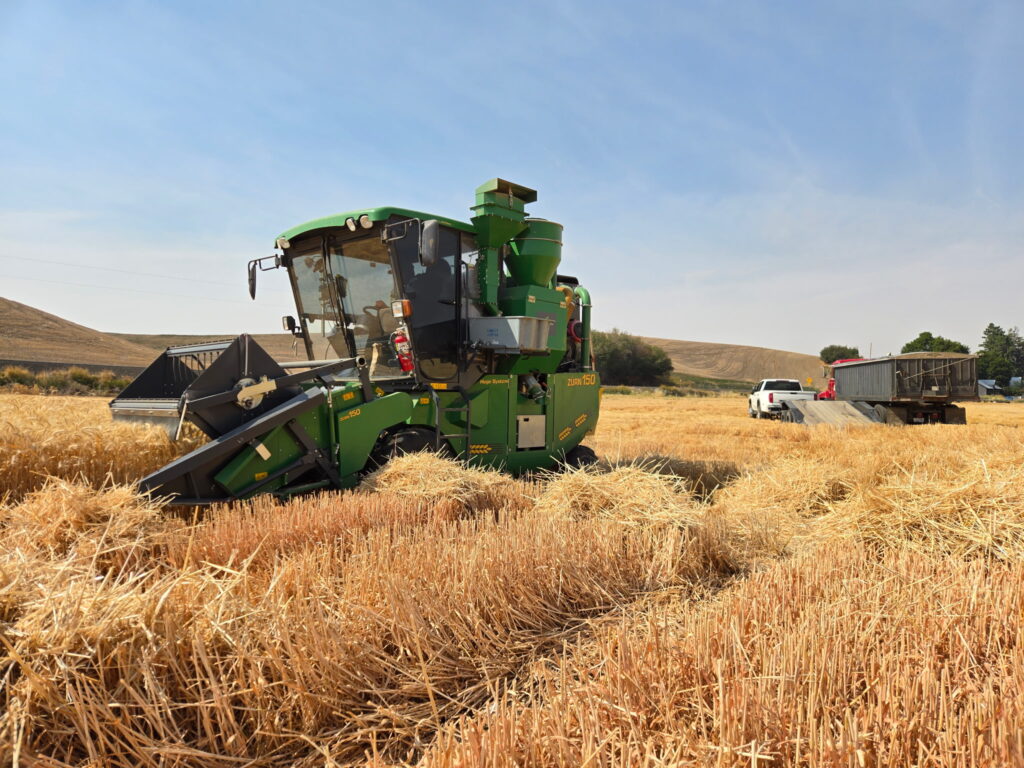
The 2026 variety trial data, for the winter crop, is now available on the WSU Small Grains website. Variety testing data is intended to provide wheat and barley growers with unbiased information on variety performance and relevant traits to help support optimal on-farm production, provide samples for rigorous end-use quality evaluation, allow comparison to new and up-and-coming variety candidates, and support market class production decisions.
The 2026 winter received well-below-average snowfall. Locations where snow mold ratings would take place, such as Douglas, did not achieve 80 consistent days under snow, which is necessary for snow mold to develop. This resulted in fewer locations being discarded. The only location that was discarded this year was at Ritzville, due to poor emergence which resulted in high grassy weed pressure.
Stripe rust was another big problem for growers this year. The St. John and Reardan trials were hit the hardest with rust, despite our efforts to apply multiple rounds of fungicide. To help you identify and manage stripe rust, we provide a list on varietal resistance, information about high-temperature adult-plant resistance, and the year’s stripe rust forecast from USDA’s Dr. Xianming Chen.
The lines that had herbicide resistance to CoAXium (AX), Clearfield (CL+), and Metribuzin (MZ) were combined into one trial which is referred to as “traited soft white.” This year’s yields were higher when compared to the 2024 and 2025 growing seasons, which also meant the protein levels this growing season were lower. Check out the “High yield, low protein. What to know.” post to learn more about why grain protein matters.
The trials are divided into two different precipitation zones, low rainfall (less than 16 inches) and high rainfall/irrigated (greater than 16 inches). Soft white winter varieties that had the highest yield for the low rainfall locations were LCS Harmony (LWW22-6387), LCS Shine, Rollie, UIL 18-658052A, and LCS Jefe. However, LCS Harmony’s yields were only 3-6 BU/AC higher. As for traited soft white winter wheat, LWWA23-5134 AX, LWWC21-0455 CL+, and UIL 19-713071A CL+, all had a yield of 80 BU/AC or higher while WA8420 AX and ARS18X376-16CBW CL+ had a yield of 78 BU/AC. As for the high rainfall locations, the highest yielding variety in both soft white and traited soft white trials was LCS Shine. Other top yielders in the soft white trials were LCS Jefe, LCS Honcho (LWW22-2864), LCS Blackjack, and WA8448. As for the traited soft white, the highest yielding varieties following LCS Shine were Mallory CL+, WA8445 CL+, OR2200083 CL+, and LCS Scorpion AX.
This year, the hard red winter wheat locations were combined into one assessment regardless of the rainfall amount to produce an overall average. The varieties with the highest yields were WA8469, WA8475, HSG 124, LWH23-0318, and LCS Hornet (LWH22-5463). The varieties with the highest protein percentage were WA8425, Kairos, OR2190165R, Scorpio, and CP7462, with WA8425 having a protein percentage at 11.9%.
We would like to thank our many supporters, including the Washington Grain Commission and USDA-ARS, as well as the grower-cooperators, private-sector collaborators, the WSU Winter Wheat Program, and wheat producers whose continued partnership helps make this program possible. We would also like to give special thanks to the Club Wheat and Spring Wheat breeding programs for their help in running the Variety Testing program over the last two years.
Please contact Tricia DeMacon with any questions regarding the 2026 WSU Variety Testing Program.