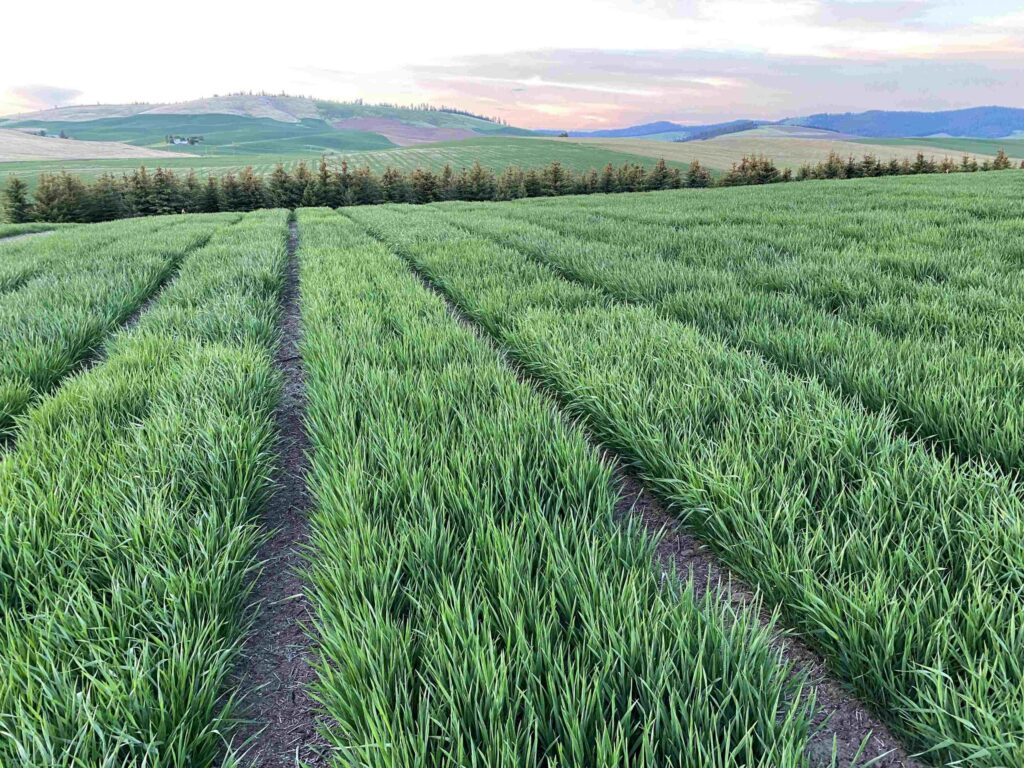
There is only a limited number of hard red winter lines tested with the CL or AX traits, and thus, those are included in the normal hard red winter trials for consistent fertility management. As in the past, separate entry lists were used to target low and high rainfall zones and trial data are summarized by rainfall zone: <12 inches, 12-16 inches, 16-20 inches, and >20 inches of annual rainfall. A separate list of soft white and hard red winter wheat lines was evaluated under irrigation at Moses Lake and Pasco this year, however, the grower terminated the Pasco field after severe winter injury occurred to the surrounding fall planted HRS wheat.
To improve data accessibility, the 2024 WSU Extension variety testing data is presented in a different format this year than in the past. Rather than individual PDF tables posted for each location, tables are now embedded within the website and multiple locations are combined within precipitation zone. Single-year and two-year averages are provided for each table as well.
Soil moisture in the fall was generally good for most low rainfall trials, therefore emergence was not a major factor in variety performance at those trials. Indeed, overall yields were quite high at Douglas, Ritzville, and Harrington trials. The exceptions were at Horse Heaven and Connell (marginal moisture planted into a direct seed environment at both) and Lind where soil moisture was down at a depth of around nine inches. Connell and Lind trials were abandoned due to poor emergence at both and Horse Heaven resulted in high variability among trial replications and was not published.
There were several major weather events during the 2024 season that influenced trial results. In January, there was a major cold snap with temperatures in the negative teens. At locations without any snow cover, cold sensitive lines such as WB1545 and Mallory CL+ died out, while a few other lines were injured but not killed. This was particularly true at Ritzville and Harrington, though less severe injury was recorded at multiple other sites.
Late spring freezes in June may have affected yields in some areas along Highway 2 and prolonged heat in July reduced grain fill, particularly in the highest rainfall region. This was most pronounced at Pullman with low test weights and elevated protein.
Due to the good planting conditions at several sites in the <12 inch rainfall zone, some of the highest grain yields were recorded on varieties like LCS Shine and ARS Crescent, which aren’t generally known for their emergence potential. However, LCS Shine still regularly yields well most years in the low rainfall zone. Still, caution should be used in years without good soil moisture at seeding. Norwest Duet, Devote, and LCS Hulk also rounded out the top five in this region.
Grain yields across rainfall zones were generally good, exceptions being Dusty and Fairfield. Dusty ran into tough residue conditions at planting that reduced overall stands. A combination of freeze injury and significant Cephalosporium stripe occurred at Fairfield, which lowered overall yield and altered certain rankings.
For the soft white winter trials in the 12-16 inch rainfall zone, LCS Jefe topped the 2024 average followed by LCS Hulk, WB1621, Norwest Duet, and Norwest Tandem. LCS Shine did well at Eureka and Anatone but was impacted by wildlife grazing at Creston and Reardan, lowering its overall average in the 12-16 inch rainfall zone. In the 16-20 inch rainfall zone, Norwest Tandem and TMC M-Pire topped the trial followed by LCS Jefe, Inspire, and LCS Blackjack. In the >20 inch rainfall zone, LCS Shine and Norwest Duet topped the trial followed by LCS Jefe, LCS Kamiak, and LCS Blackjack. Despite a low CV, there was not a lot of statistical separation among the top varieties at the Moses Lake Irrigated SWW trial in 2024.
In the Clearfield/CoAXium trials, Sockeye CL+ continued to land near the top in most cases, although it was closer to average in the 16-20 inch rainfall zone this year. VI Encore CL+ yields were very competitive with Sockeye CL+ in all but the lowest precipitation zone. Piranha CL+ generally came in just below Sockeye CL+ once again, except in the 16-20 inch rainfall zone. While LCS Kraken AX tied Nova AX for the top CoAXium line in the trial in the <12 inch rainfall zone, Nova AX was the best-rated CoAXium variety in all other precipitation zones.
For the hard red winter wheat trials, Kivari AX and Whistler continue to yield well in the low rainfall zone. Scorpio did well at Douglas, but struggled at Ritzville in 2024, likely due to cold injury. LCS Jet, LCS Missile, and Scorpio landed in the top spots in the 12-16 inch rainfall zone while LCS Blackbird, Scorpio, and LCS Missile were the top three at Walla Walla. While LCS Blackbird is one of the few varieties available rated least desirable for end-use quality, it was released for growers in need of a hard red winter wheat with resistance to Soil-borne Wheat Mosaic Virus, which is a growing concern in parts of the state, particularly in the Walla Walla and irrigated regions.
View the full 2024 winter wheat variety trial results.

Written by Clark Neely who is no longer with WSU. For questions or comments, please contact us at small.grains@wsu.edu.