Hessian Fly
Introduction
The Hessian fly, Mayetiola destructor (Say), is considered one of the oldest and most damaging insect pests to wheat (Triticum spp. L.). Originally from Asia, it is believed to have been introduced in straw bedding used by Hessian troops during the Revolutionary War, hence its name. From this initial introduction in the Long Island, New York area, the fly quickly spread from farm to farm, destroying entire wheat fields (Pauly 2002). Since then, this pest has been found throughout major wheat-producing regions in both the United States and Canada. A pest survey of eastern WA detected Hessian fly in Adams, Whitman, and Walla Walla counties.
Identification
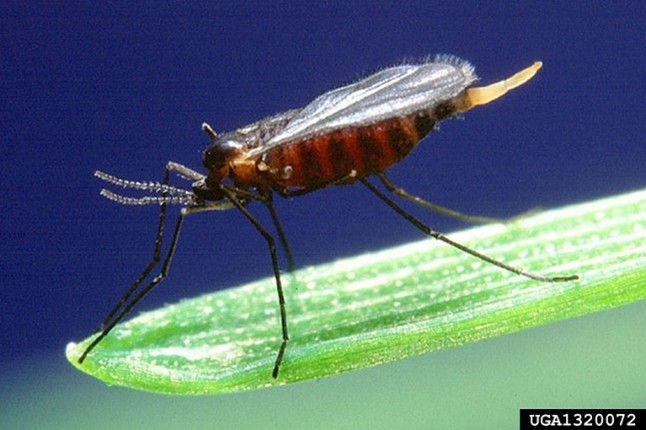
Hessian flies are relatively small (2 mm) in size but can be distinguished from other flies by having long legs, antennae, and reduced wing venation with seven or fewer veins reaching the wing margin. Both males and females have a brownish-to-black abdomen; however, the abdomen of females will take on a reddish-to-orange color when egg development begins.
Damage/Symptoms
Crop damage from Hessian flies can occur in several ways:
- Leaves initially may be darker in color but will eventually turn a blueish-green color as if they were drought-stressed.
- Plants will be stunted; winter kill can be a concern depending on the severity of the feeding damage.
- Tillers may be aborted, or entire plants can be killed resulting in reduced yields.
- Stems may weaken and lodge if plants are attacked after stem elongation.
- Overall feeding can reduce the number of seeds per head resulting in reduced head weights and overall yield.
Scouting
It is recommended to take a minimum of 100 side-to-side (i.e., 180-degree) sweeps at different locations throughout the field using a canvas-type sweep net to see if Hessian fly adults are present. Visual inspection of 5 plants for 30 seconds at 10 random locations within the field can also be used to detect Hessian fly adults.
If adult flies are detected, then wheat tillers should be checked for larvae to determine pest levels. Pest thresholds are based on the number of wheat tillers infested. Treatment measures and actions are recommended when 20% of tillers in winter wheat, or 38% of tillers in spring wheat, are infested to prevent this pest from reaching the economic injury level (Buntin 1999).
Management
There are several methods for managing Hessian flies if they become a problem. One of the most economical and effective control strategies is the utilization of resistant wheat varieties. Delayed planting e.g., November can lessen the number of eggs laid by females and thereby reduce any potential damage. With this form of management, an individual increases the risk of experiencing winterkill with late-planted wheat. The control of volunteer wheat, especially in alternative cropping systems, can impact populations.
For areas that have a history of high Hessian fly populations, or when other management techniques are not optional, for example, the use of resistant varieties or delayed planting dates, a seed treatment consisting of Gaucho 600F (imidacloprid) or Cruiser 5FS (thiamethoxam) is recommended. Several foliar-applied insecticide products can be used. Be sure and read and follow the pesticide label instructions before use and be aware of bee poisonings.