Armyworms
Introduction
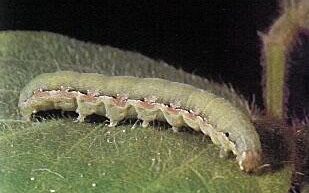
Armyworms can be problematic pests in cereal grains. Armyworms are moth caterpillars that vary in color (gray or green) with a distinct yellow, white, and brown stripe along the body. The adult is a yellow-brown moth. Moths emerge in the spring months and lay eggs on wheat or barley. Larvae developing from these eggs then feed on wheat from May into the summer.
Symptoms
Research in Washington by Diana Roberts and colleagues noted up to 35% yield losses due to this insect in spring wheat trials near Davenport. Feeding on wheat heads at night is most common. Characteristic damage is indicated by a small hole bored in the base of florets. However, this pest is generally not an economic concern for most growers.
Prevention
Wheat head armyworm is not typically a pest that causes economic harm, although sporadic incidents of major economic damage have been reported. Due to limited research, it is unclear what strategies work best to control this pest. There is some evidence that biological controls may help limit armyworm populations.
Management
Because the pest does not typically cause economic harm, insecticides are not routinely recommended. Sampling can be done with a sweep net or traps if armyworm populations need to be monitored.


Archived Publications
Integrated Pest Management for the Wheat Head Armyworm Complex in the Pacific Northwest
Wheat Head Armyworm True or False: A Tale from the Pacific Northwest
Use pesticides with care. Apply them only to plants, animals, or sites as listed on the label. When mixing or applying insecticides, follow all label precautions to protect yourself and others around you. It is a violation of the law to disregard label directions. If pesticides are spilled on skin or clothing, remove clothing and wash skin thoroughly. Store pesticides in their original containers and keep them out of the reach of children, pets, and livestock. Refer to the online version of the Pacific Northwest Insect Management Handbook for additional information regarding pesticide use and specific insecticide recommendations and application rates for Hessian fly (Hollingsworth 2019). The handbook is also available at Extension offices in Washington, Oregon, and Idaho.