Cabbage Seedpod Weevil
Introduction
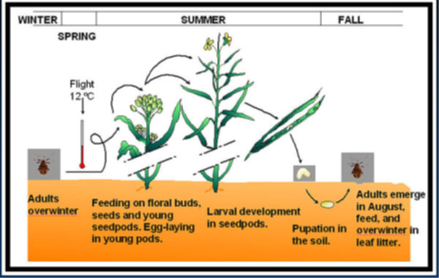
The cabbage seedpod weevil (CSPW), Ceutorhynchus obstrictus (Marsham), is an introduced insect pest from Europe and causes damage to members of the Brassicaceae or mustard family, including cultivated crops such as canola and brown mustard.
As the winter canola acreage in central and eastern Washington continues to increase, so does the threat of CSPW causing significant damage to yields if left unmanaged.
Identification
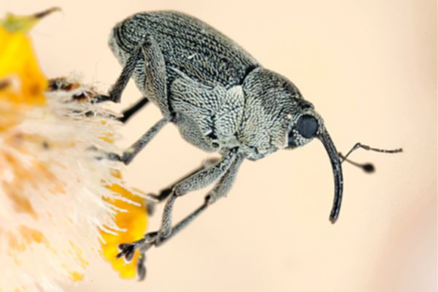
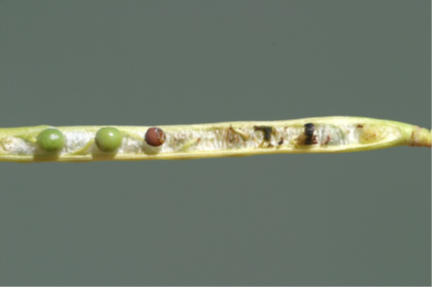
Like many weevil species, adults have a prominent, curved snout with elbowed antennae. The insects measure 3 to 4 mm long and are ash-grey in color.
Scouting
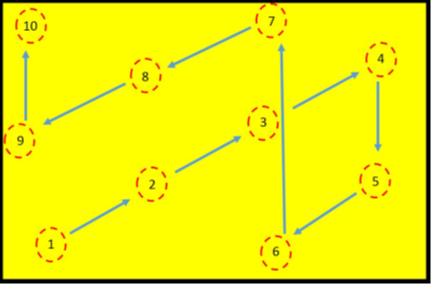
Field observations show that CSPW most commonly enters fields from the borders, where they do the most damage; then they work towards the middle of the field where they continue their destructive path. Therefore, it is important to pay particular attention to field borders, scouting twice a week when plants reach 10–20% bloom. At this stage of plant development, it is recommended to take a minimum of ten 180-degree (side-to-side) sweeps at different locations throughout the field (see figure), using a canvas-type sweep net. Control measures need to be taken if 20 or more adults are collected from ten sweeps (Canola Council of Canada 2014). If action is not taken, the damage caused by this pest can become equal to or surpass the cost of control measures, reaching what is called the “economic injury level.” If CSPW populations are only being detected at the field edges, an insecticide spray of the outside perimeter may be sufficient to stop further movement into the field.
Management
Cultural control in the form of “trap” crops can help mitigate pest numbers. As the name implies, trap crops are plants that are used to concentrate or attract insect pests away from the desired crop. This can be achieved by using two different cultivars, such as planting a field border of Brassica rapa around a field of Brassica napus. The B. rapa flowers about one week earlier than B. napus and effectively concentrate CSPW adults on those plants. An insecticide application can then be made to target only infested plants instead of treating the entire field. If only one variety is being planted, a field border or strip can be seeded seven to ten days earlier than the rest of the field to serve as the trap crop.
Timing of insecticide applications is important when managing CSPW. Begin sampling for CSPW adults when plants reach 10–20% bloom. It is important to try to target adults before too many eggs are laid within the newly developing seedpods. Several chemical control options for CSPW can be made as an in-crop application. Examples of insecticides that can be sprayed on canola are: Besiege (chlorantraniliprole + lambda-cyhalothrin) Declare (gamma-cyhalothrin), Warrior II (lambdacyhalothrin), and Mustang Maxx (zeta-cypermethrin). Gaucho 600F and Gaucho 480 can be applied as a seed treatment. Seed treatment products provide suppression only. Refer to the online version of the Pacific Northwest Insect Management Handbook for specific insecticide recommendations and application rates for CSPW. The handbook is also available at Extension offices in Washington, Oregon, and Idaho. Be sure and read and follow the pesticide label instructions before use.
It is important to note that the insecticide products listed above are highly toxic to bees. If commercial beekeepers have boxes placed in or near canola fields, it is critical to have timely communication between the beekeeper, canola grower, and chemical applicator, particularly when a decision to apply insecticide is made on short notice. It may be advisable to remove bee shelters during, and for 2–3 days following, application. Avoid direct application to bee shelters. Even if bee shelters are not present, do not apply these products or allow them to drift to blooming crops or weeds if bees are visiting in or adjacent to the treatment area. Avoid application when bees are actively foraging by applying during early morning or evening hours. Seed treatments containing Imidacloprid are also highly toxic to bees. Ensure that planting equipment is functioning properly per manufacturer specifications to minimize seed coat abrasion during planting to reduce dust which can drift to blooming crops or weeds and subsequently poison foraging bees. Refer to How to Reduce Bee Poisoning from Pesticides by Hooven et al. (2013) (PDF, opens in new tab) ) for more information on the toxicity of pesticides to bees.
Publications
Cabbage Seedpod Weevil Management in Canola (Oilseed Series)
Use pesticides with care. Apply them only to plants, animals, or sites as listed on the label. When mixing or applying insecticides, follow all label precautions to protect yourself and others around you. It is a violation of the law to disregard label directions. If pesticides are spilled on skin or clothing, remove clothing and wash skin thoroughly. Store pesticides in their original containers and keep them out of the reach of children, pets, and livestock. Refer to the online version of the Pacific Northwest Insect Management Handbook for additional information regarding pesticide use and specific insecticide recommendations and application rates for Hessian fly (Hollingsworth 2019). The handbook is also available at Extension offices in Washington, Oregon, and Idaho.