Cabbage Aphid
Introduction
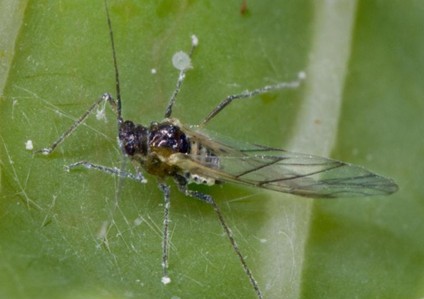
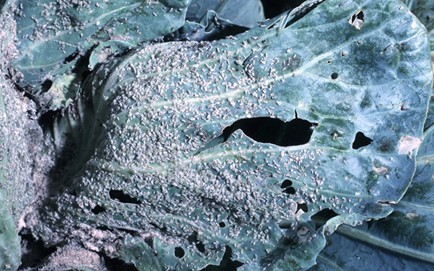
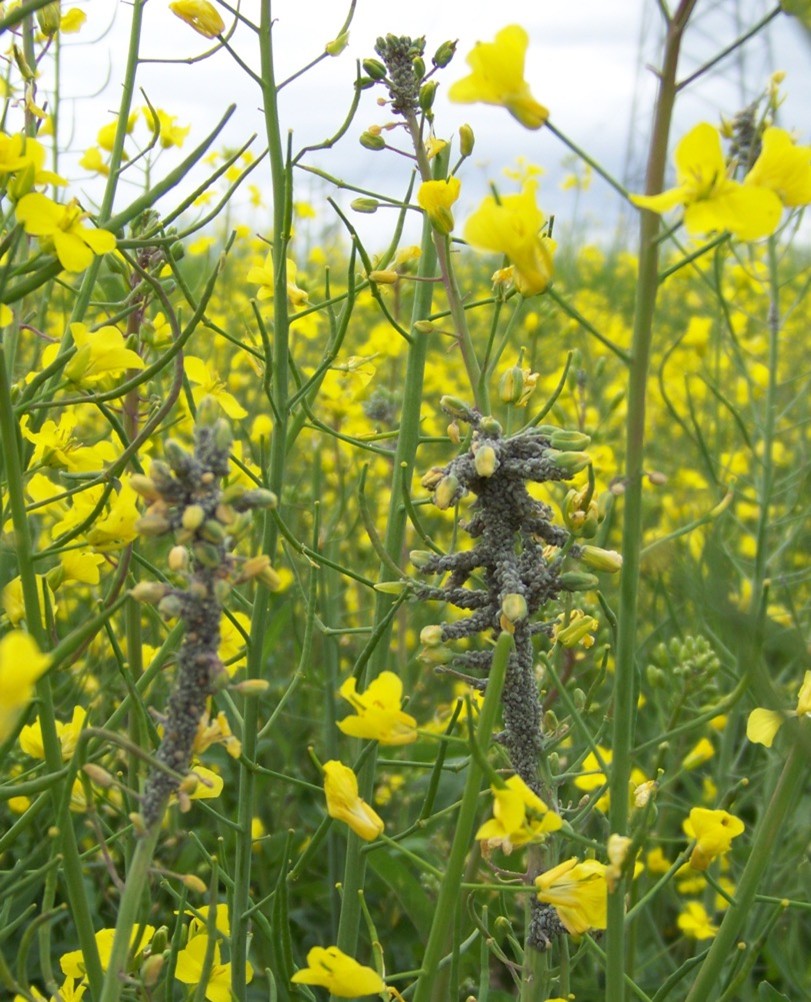
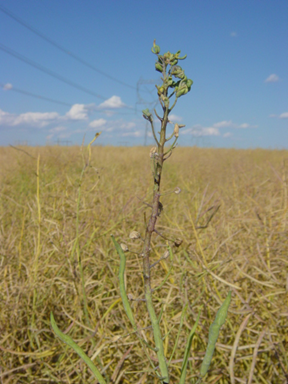
The Cabbage aphid (Brevicoryne brassicae), is a destructive species of aphid. Canola damaged by aphids in the seedling stage appears stunted and is more susceptible to winterkill. These plants will have curled leaves with shortened nodes. The canola may exhibit a purplish tint associated with plant stress. Aphid populations that develop during early bloom and pod-fill can cause deformed, stunted or completely sterile pods. Black sooty mold is also associated with aphid colonies. Aphids have also been reported to transmit several viruses to canola.
Identification
Cabbage aphids are small, pear-shaped, gray-green insects with piercing-sucking mouthparts. They will also possess a pair of cornicles (tube-like structures attached to the abdomen) that help distinguish them from all other insects.
Scouting
Treat for aphids when populations exceed:
- 2 per plant in the seedling stage
- 5 per leaf in the rosette stage
- or when 20 percent of the heads are infested during bloom.
Management
Several chemical control options for cabbage aphid can be made as an in-crop application. Examples of insecticides that can be sprayed on canola are: Besiege (chlorantraniliprole + lambda-cyhalothrin), Declare (gamma-cyhalothrin), Warrior II (lambdacyhalothrin), and Mustang Maxx (zeta-cypermethrin). Gaucho 600F and Gaucho 480 can be applied as a seed treatment. Seed treatment products provide suppression only. For a complete list of products refer to the online version of the Pacific Northwest Insect Management Handbook for specific insecticide recommendations and application rates for cabbage aphid. The handbook is also available at Extension offices in Washington, Oregon, and Idaho. Be sure and read and follow the pesticide label instructions before use.
It is important to note that the insecticide products listed above are highly toxic to bees. If commercial beekeepers have boxes placed in or near canola fields, it is critical to have timely communication between the beekeeper, canola grower, and chemical applicator, particularly when a decision to apply insecticide is made on short notice. It may be advisable to remove bee shelters during, and for 2–3 days following, application. Avoid direct application to bee shelters. Even if bee shelters are not present, do not apply these products or allow them to drift to blooming crops or weeds if bees are visiting in or adjacent to the treatment area. Avoid application when bees are actively foraging by applying during early morning or evening hours. Seed treatments containing Imidacloprid are also highly toxic to bees. Ensure that planting equipment is functioning properly per manufacturer specifications to minimize seed coat abrasion during planting to reduce dust which can drift to blooming crops or weeds and subsequently poison foraging bees. Refer to How to Reduce Bee Poisoning from Pesticides by Hooven et al. (2013) (PDF, opens in new tab) for more information on the toxicity of pesticides to bees.
Use pesticides with care. Apply them only to plants, animals, or sites as listed on the label. When mixing or applying insecticides, follow all label precautions to protect yourself and others around you. It is a violation of the law to disregard label directions. If pesticides are spilled on skin or clothing, remove clothing and wash skin thoroughly. Store pesticides in their original containers and keep them out of the reach of children, pets, and livestock. Refer to the online version of the Pacific Northwest Insect Management Handbook for additional information regarding pesticide use and specific insecticide recommendations and application rates for Hessian fly (Hollingsworth 2019). The handbook is also available at Extension offices in Washington, Oregon, and Idaho.