Canada Thistle
Description
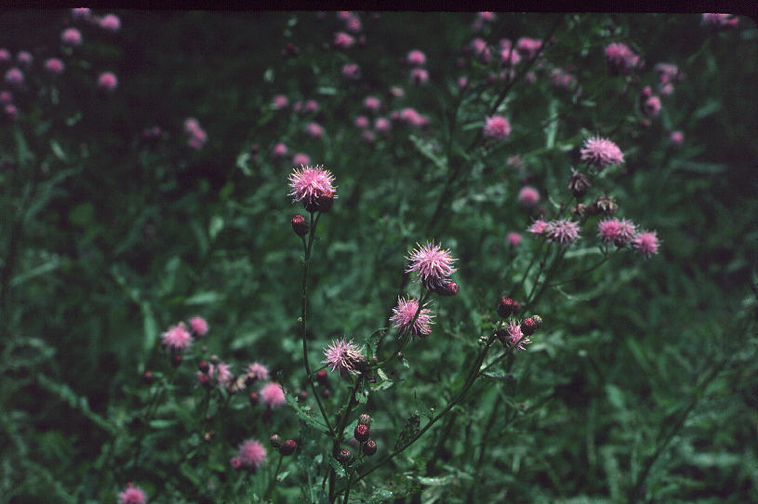
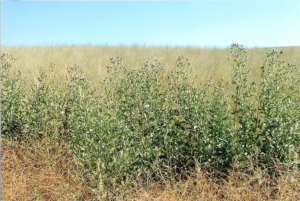
Canada thistle (Cirsium arvense L.) is an aggressive, perennial weed that infests crops, pastures, rangeland, roadsides, and non-crop areas. Canada thistle was introduced into the United States in the early 1600s and by 1954 was declared a noxious weed in forty-three states. Canada thistle is declared a “noxious weed” throughout the U.S. and is a major agricultural pest, costing tens of millions of dollars in direct crop losses annually and additional millions for control.
Canada thistle can be distinguished from other thistles by its deep-running perennial rootstocks, slender stems, and small compact heads. Canada thistle reduces forage consumption in pastures and rangeland because cattle typically will not graze near infestations.
Canada thistle develops from seed or vegetative root buds. Horizontal roots may extend over 3 feet and vertical roots may grow up to 5 feet deep. Canada thistle allocates most of its reproductive energy into vegetative propagation. New shoots and roots can form along with the root system of established plants.
Canada thistle begins to flower around June and continues through September. Pollination is mostly by honeybees, and wind pollination is limited. Most seeds germinate within one year. Canada thistle can produce up to 1,500 seeds per flowering shoot. Plants can spread vegetatively and over long distances by their seed. Seed may be transported by water, animals, farm equipment, and other vehicles, and in contaminated crop seed. Seed can remain viable in soil for up to 20 years, and deep burial promotes survival longevity.
Management
Canada thistle has high root nutrient reserves and stress is very important to effectively cause the plant to use up these reserves. Successful control requires a management plan implemented over multiple years.
Control Methods
Cultural
Aggressive sod-forming grasses and alfalfa can compete effectively with Canada thistle. Although, competition alone may not be enough to effectively reduce Canada thistle populations.
Chemical
Clopyralid plus 2,4-D (Curtail®), clopyralid (Transline®), picloram (Tordon 22K®), dicamba (Banvel®), 2,4-D and glyphosate (Roundup®) can be effective for Canada thistle control. These herbicides are most effective when combined with cultural and/or mechanical control. Fall chemical applications may also be very effective.
Mechanical control
Mowing alone is not effective and can increase production. Mowing in combination with herbicide treatments is effective.
Biological control
Four insects have been released for the control of Canada thistle:
- Canada thistle stem weevil, Ceutorhyncus litura
- Canada thistle stem gall fly, Urophora cardui
- Defoliating beetle, Cassida rubiginosa
- Canada thistle bud weevil, Larinus planus
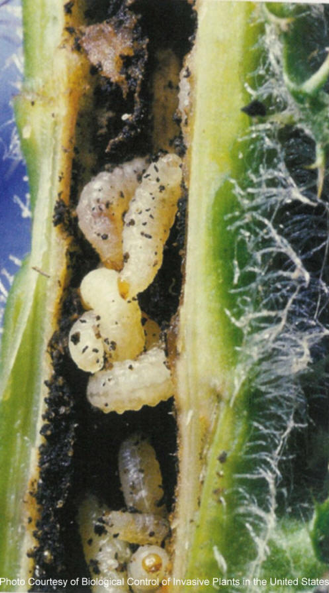
The stem mining weevil, Ceutorhyncus litura, attack the stems of Canada thistle which causes stress to the plant and allows entrance of other pathogens. The larvae mine the stem, eventually causing exit holes where they leave the stem near the ground. The larvae pupate in the soil, emerging in late summer to overwinter as adults. Ceutorhyncus alone will not effectively control Canada thistle. It must be combined with other methods to be successful.
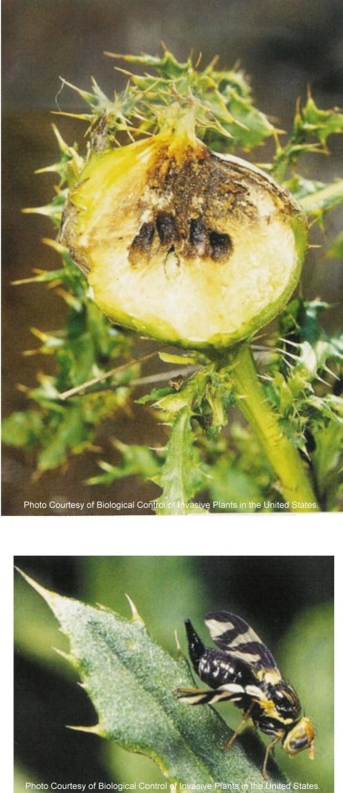
The thistle stem gall fly, Urophora cardui, lays eggs on the apical meristems of developing shoots. The larvae burrow into shoots. Their feeding causes gall formation in the flowering head. The severity of impact on Canada thistle depends on whether the galls are on the main shoots or lateral shoots, and whether the insects attack the thistle early or late in the season. Larger galls on young main stems can reduce plant height by more than 50%.
The defoliating beetle, Cassida rubiginosas, an introduced species causes local defoliation of Canada thistle; however, its impact is usually restricted by parasitoids.
Canada thistle bud weevil, Larinus planus, accidentally released in the U.S is effective in reducing the seed number in Canada thistle, but can detrimentally affect some native thistle seed numbers.
Biological control is not a feasible option in annual cropping systems.