Contributed by Albert Adjesiwor, Associate Professor & Extension Weed Scientist, University of Idaho
If you grow wheat in the Pacific Northwest, Italian ryegrass and downy brome probably need no introduction. Between them, they are the two grass weeds most likely to cost you yield, dock your grains, and force you to change your rotation. They are also the two weeds where our herbicide options have gotten thinner rather than wider. Group 1 (ACCase), Group 2 (ALS), and most recently glyphosate (group 9) resistance are becoming widespread in Italian ryegrass and downy brome across the region. We have not added a new site of action to the wheat herbicide toolbox in a long time. That is why we have started evaluating fluridone as a potential herbicide for PNW small grain production systems.
What is fluridone?
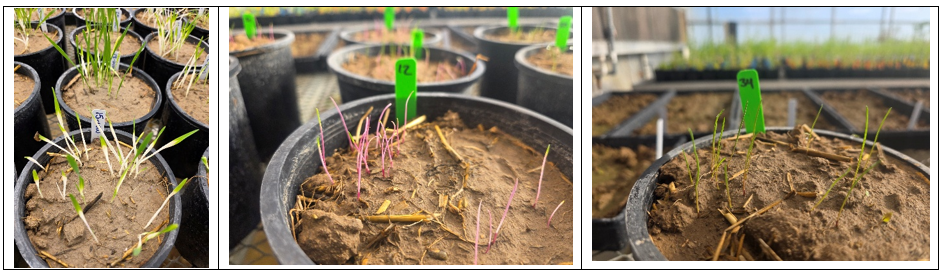
Fluridone is a Group 12 herbicide—it inhibits phytoene desaturase, an enzyme in the carotenoid biosynthesis pathway. Without carotenoids, chlorophyll is destroyed by light, and susceptible seedlings emerge white or bleached and then die. If you have seen fluridone injury before, that bleaching is the signature symptom (Figure 1).
Two things make this interesting for wheat. First, Group 12 is a new site of action for grass weed control in Pacific Northwest small grains. Second, fluridone is soil-applied and residual. It is taken up primarily by the roots and shoots of germinating seedlings, so it works on the flush of grass that comes up with the crop—exactly the flush that is hardest to reach with postemergence products once they get past the two-tiller stage.
Fluridone is not a new molecule. It has been used for decades in aquatic weed management and, more recently, as a preemergence herbicide in cotton and in a range of perennial crops. Brake® On! (fluridone, 1.2 lb ai/gal) is the formulation most often discussed in this context.
One important caveat up front: fluridone is not currently registered for use in wheat. The Brake On! label covers perennial crops such as tree fruit, tree nuts, citrus, berries, and forages and it is registered in Idaho, Oregon, and Washington. The experimental treatments described below, including tank mixtures with Chateau EZ, do not conform to current product labeling for wheat. Everything below is research data, not a pesticide use recommendation. These treatments are being evaluated for research purposes only and should not be used in commercial wheat production. Always read and follow the current pesticide label.
What we did
In 2026, we screened fluridone in a greenhouse study at the University of Idaho Kimberly Research and Extension Center. Winter wheat, Italian ryegrass, and downy brome were seeded in 1-gallon pots filled with field soil and Brake On! was applied preemergence at 21, 31.5, and 42 fl oz/A alone and tank-mixed with Chateau EZ (flumioxazin) at 2 fl oz/A. We included Chateau EZ alone at 2 fl oz/A and Zidua SC (pyroxasulfone) at 3 fl oz/A as comparisons. Italian ryegrass control, downy brome control, and winter wheat injury were rated visually four weeks after treatment.
What we saw
Italian ryegrass control was the bright spot (Figure 2). Brake On! at 42 fl oz/A and both Brake On! + Chateau EZ tank mixes gave essentially complete control, and 31.5 fl oz/A was not far behind—all statistically similar to Zidua SC, our best current soil-applied standard. Control dropped to about 80% and got noticeably more variable at 21 fl oz/A. Chateau EZ alone at 2 fl oz/A did not provide much Italian ryegrass control.
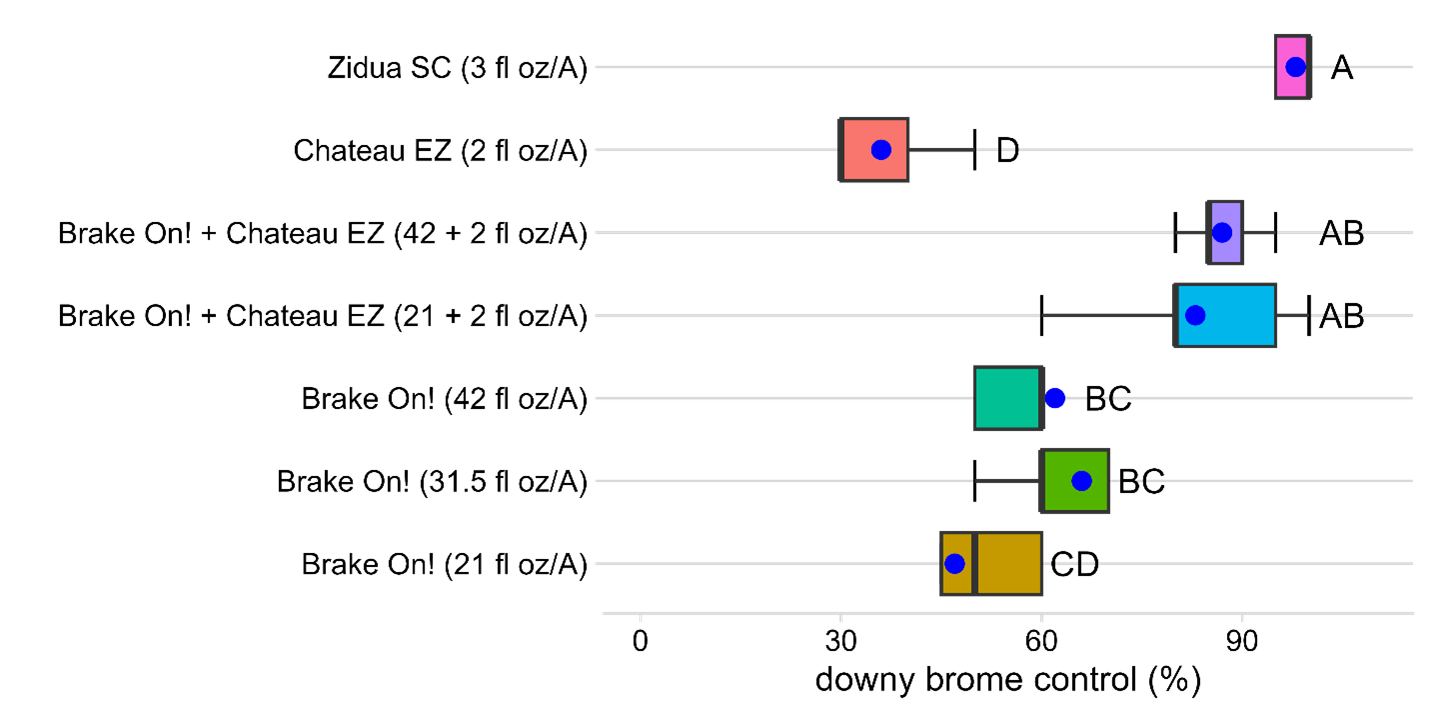
Downy brome was a different story (Figure 3). Brake On! alone provided about 50 to 65% control, and raising the rate from 21 to 42 fl oz/A did not provide much extra benefit. Adding Chateau EZ lifted control to roughly 85%, statistically similar to Zidua SC, which was the strongest treatment on downy brome at about 95%. If fluridone has a place on downy brome, it looks like a mixing partner rather than a stand-alone treatment.
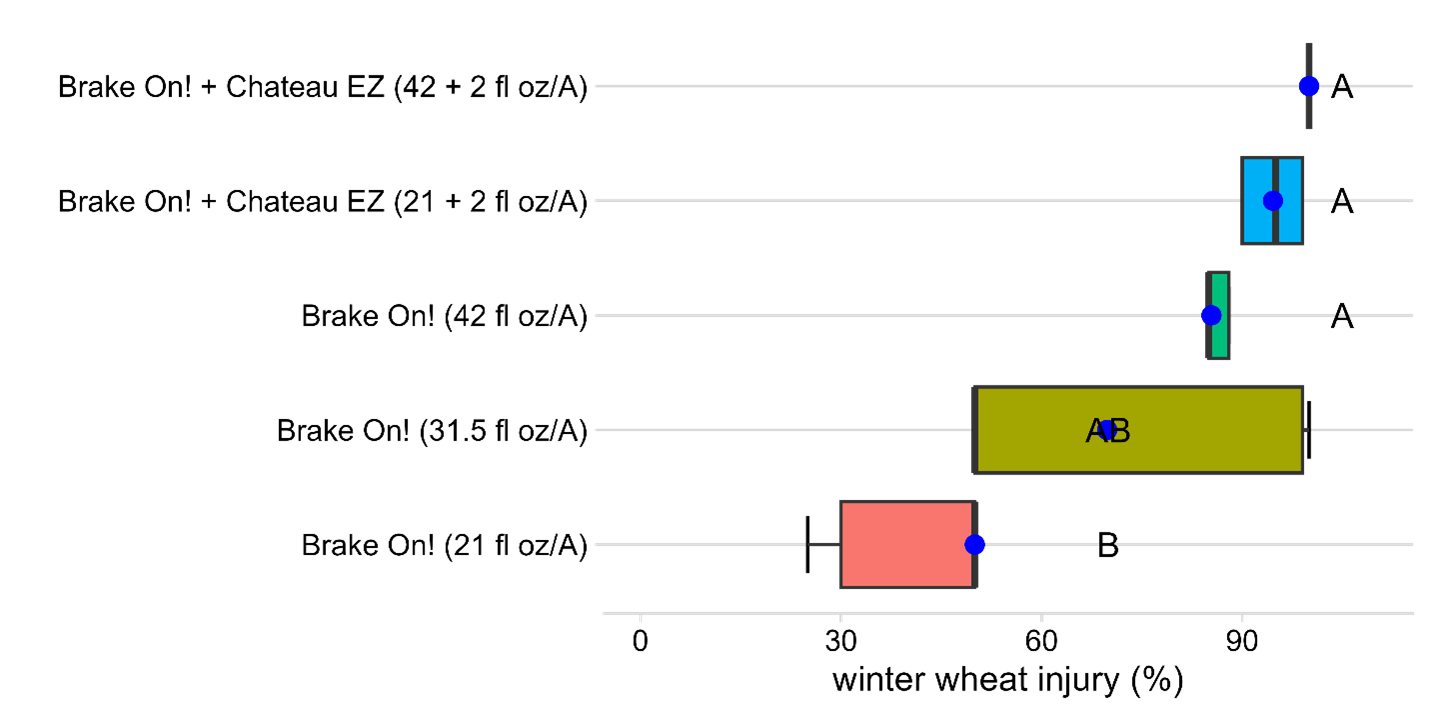
Then there is the catch (Figure 4). Winter wheat injury was substantial across the board—about 50% at 21 fl oz/A, 70% at 31.5 fl oz/A, and 85 to 95% at 42 fl oz/A and in both tank mixes. In other words, the rates that gave us the Italian ryegrass control we seek are the same rates that cause damage to the wheat. Symptoms were the classic fluridone bleaching (Figure 1), and in a pot study there is nowhere for the herbicide to go.
What to watch
So the hurdle is not efficacy—it is selectivity. The obvious next questions are whether crop safety can be improved in the field by keeping fluridone above the wheat seed, by deeper seed placement or by dropping the rate far enough to preserve ryegrass control without killing the crop. Pots are a worst case: roots are confined, there is no dilution into a deep soil profile, and organic matter and soil texture are fixed. Field results on real ground, with real precipitation patterns, may look considerably better—or may simply move the problem around. Carryover to sensitive rotational crops is another open question for our systems. And because fluridone is a Group 12 herbicide, the label already limits it to no more than two consecutive years on the same field. A new site of action buys us time, not immunity.
The bottom line and next steps
Fluridone clearly has the activity on Italian ryegrass that we have been looking for and it brings a site of action our resistant grass weeds have never seen in this cropping system. Downy brome control was weaker and would need a partner. But the reason fluridone is not a wheat herbicide today is wheat safety, and our results say that plainly. This is a promising molecule at an early stage of evaluation, not a tool waiting on paperwork. We will be following it into field trials and will also be evaluating fluridone safety on pulse crops. The hope is that since fluridone is labeled for forage legumes, such as alfalfa, bean, and clovers, there might be some crop safety in pulse crops. Stay tuned!