Contributed by Morgan Menaker and Robert Meadows, Washington State University
Introduction and Plant Biology
Italian ryegrass (Lolium perenne subspecies multiflorum) is a winter annual bunchgrass that emerges from early fall through late spring, reaching peak germination in mid-May through June. This weed reproduces only by seed. It is a highly competitive weed in small grain systems and has developed resistance to multiple herbicide modes of action in the Pacific Northwest (PNW), including Groups 1, 2, 5, 9, and 15 (excluding products containing pyroxasulfone; e.g., Anthem Flex, Zidua).
Key identifying features include shiny, waxy, hairless leaves and purple coloration at the base of stems. Italian ryegrass typically occurs in low-lying, moisture-rich areas. Seedheads are flat due to alternating, edgewise spikelets. Plants can produce up to 45,000 seeds, though averages are closer to 300. A key weakness is short seed longevity—most seed persist less than 18 months in the soil.
Management
Effective management requires an integrated approach, including crop rotation and diversified herbicide programs. Growers have reported success using manual removal (rouging) for escapes and, in severe infestations, applying non-selective herbicides to terminate both weeds and crop in localized areas.
Roundup Ready and TruFlex spring canola are widely used in high and mid-range precipitation zones of the inland PNW to manage grassy weeds. However, this system relies solely on Group 9; glyphosate. To preserve glyphosate efficacy for burndown and in-crop applications, alternative chemistries and application timings must be incorporated.
Current Trial
A field trial was conducted in eastern Whitman County near Colfax, WA (Table 1). Treatments included Anthem Flex (pyroxasulfone, Group 15) and Valor (flumioxazin, Group 14), applied with and without a soil adjuvant (Infuse, Nutrien), and in combination with glyphosate (Group 9).
The study used a randomized design with four replicates per treatment. Plots measured 5 × 30 ft, and applications were made using a CO₂ backpack sprayer calibrated to 12.5 GPA.
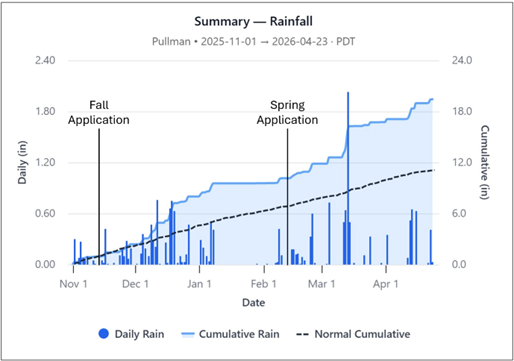
Fall treatments were applied on 11/12/2025, and spring treatments on 2/13/2026. Weed control was evaluated on 4/3/2026. Applications were timed ahead of forecasted rainfall events (Figure 1).
Table 1. 1
Treatment means (n = 4). Means within a column followed by the same letter are not significantly different at P < 0.05 (Tukey HSD).
| Treatment Number | Treatment Herbicides | Rate (fl oz/A) | Application Date | Application Description | Italian Ryegrass (plants/m-2) on April 3, 2026 |
|---|---|---|---|---|---|
| 0 | Nontreated check | None | None | None | 30b1 |
| 1 | Anthem Flex | 3.5 | 11/12/2025 | pre-plant | 7a |
| 2 | Valor | 4 | 11/12/2025 | pre-plant | 5a |
| 3 | Anthem Flex | 3.5 | 11/12/2025 | pre-plant | 14a |
| 3 | Infuse | 24 | 11/12/2025 | pre-plant | |
| 4 | Valor | 4 | 11/12/2025 | pre-plant | 13a |
| 4 | Infuse | 24 | 11/12/2025 | pre-plant | |
| 5 | Anthem Flex | 3.5 | 2/13/2026 | pre-plant | 10a |
| 5 | Glyphosate | 40 | 2/13/2026 | pre-plant | |
| 6 | Valor | 2 | 2/13/2026 | pre-plant | 7a |
| 6 | Glyphosate | 40 | 2/13/2026 | pre-plant | |
| 7 | Anthem Flex | 3.5 | 2/13/2026 | pre-plant | 4a |
| 7 | Glyphosate | 40 | 2/13/2026 | pre-plant | |
| 7 | Infuse | 24 | 2/13/2026 | pre-plant | |
| 8 | Valor | 2 | 2/13/2026 | pre-plant | 8a |
| 8 | Glyphosate | 40 | 2/13/2026 | pre-plant | |
| 8 | Infuse | 24 | 2/13/2026 | pre-plant |