Contributed by Victor Ribeiro, David Maliszewski, and Jose Carlos Barbosa dos Santos, Oregon State University
Mayweed chamomile (Anthemis cotula L.), also known as dog fennel, mayweed, stinking chamomile, or stinkweed, is a problematic weed in a variety of cropping systems and disturbed areas of the Pacific Northwest (PNW). It is an annual species that germinates in the fall and spring in the PNW and reproduces exclusively by seed.
Identification
Mayweed chamomile can be identified in the field by its finely divided, feathery leaves and its strong, unpleasant odor when crushed.
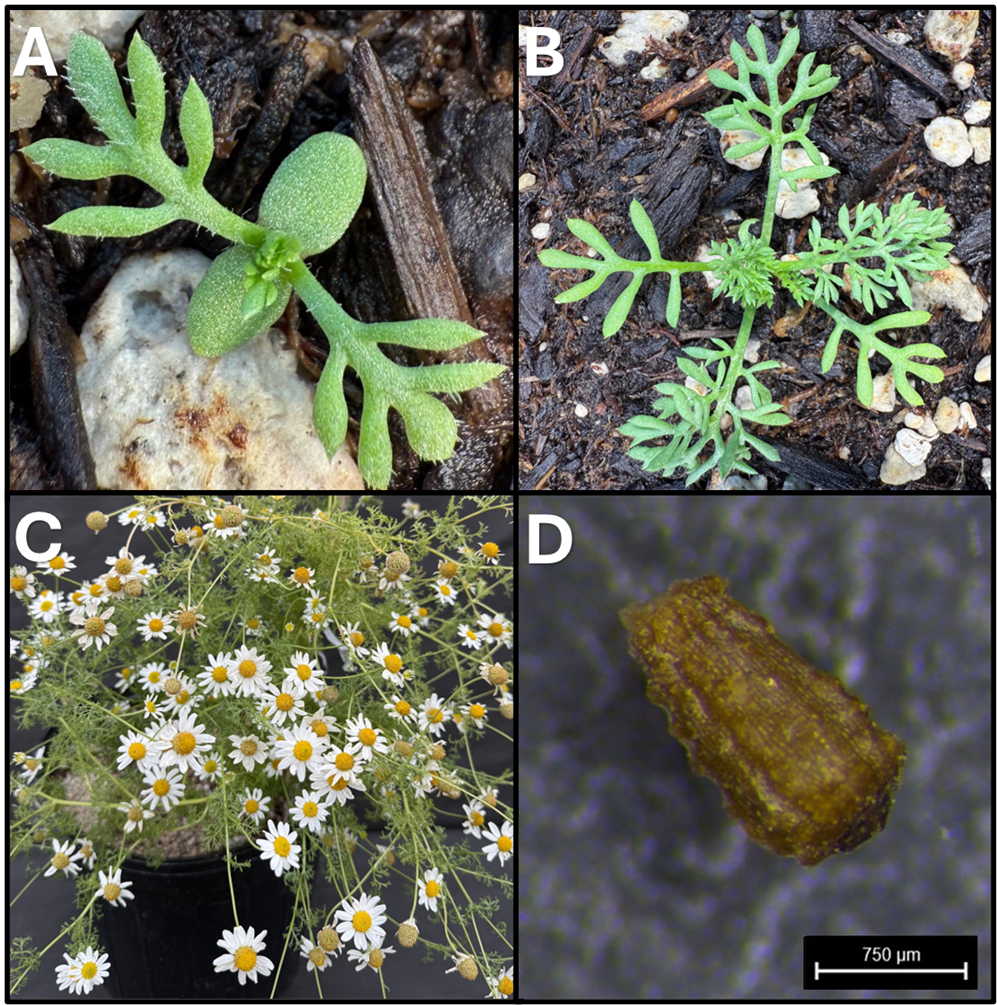
At the seedling stage, cotyledons are about 0.3 inches long with faint veins, and their bases are fused, forming a small fleshy cup (Figure 1A). The first true leaves develop in opposite pairs and are covered with short hairs. As the plant grows, leaves become alternate and are finely divided into narrow leaflets and lobes (Figure 1B).
Flowerheads consist of 10 to 16 white ray flowers (0.25–0.5 inches long) surrounding a central disk of numerous small yellow flowers. Flowerheads occur at the ends of branches and in the leaf axils (Figure 1C). Seeds are brown, approximately 0.06 inches long, with longitudinal ribs and wart-like projections (Figure 1D).
Effective management of mayweed chamomile relies on an integrated approach, including cultural, mechanical, and chemical control strategies. Preventing seed production is particularly important because this species reproduces exclusively by seed and can quickly build a persistent seedbank. Individual plants can produce between 5,000 and 27,000 seeds, which may remain viable in the soil for up to 25 years (Darlington 1931; Rashid et al., 2007). As a result, infestations can persist for many years if seed production is not effectively controlled.
In many cropping systems and non-crop areas, herbicides remain an important tool for managing established infestations. However, herbicide performance can vary depending on the active ingredient and the growth stage of the weed at the time of application.
To evaluate herbicide options and the influence of application timing, a field study was established in the fall of 2025 at the Oregon State University Hyslop Farm in a bareground site with a naturally high infestation of mayweed chamomile, providing an ideal setting to assess herbicide performance under field conditions (Table 1). Treatments were applied with adjuvants according to label recommendations using a CO2-backpack sprayer calibrated to deliver 20 GPA at two different timings: November 12, 2025, when mayweed chamomile plants were at the 2–4 leaf stage and approximately 2 in tall, and December 3, 2025, when plants had reached the 7-leaf stage and were approximately 3.5 in tall. Weed control was assessed on March 2, 2026, to determine which herbicide treatments and application timings provided the most consistent control.
Some herbicides evaluated in this study are not currently registered for use in grass seed production systems and were included for research purposes only. Other herbicides are labeled for grasses grown for seed but are not necessarily labeled for use in non-crop areas. Application rates for labeled products were based on recommendations for grasses grown for seed, whereas rates for non-labeled products were based on labeled use rates in wheat.
Table 1. Herbicides evaluated in the study.
| Active ingredient | Trade Name | Mode of action (Group)e | Rate (oz/A) |
| tolpyralate/bromoxynila | Tolvera | HPPD/PSII (27/6) | 14.7 |
| bicyclopyrone/bromoxynilb | Talinor | HPPD/PSII (27/6) | 13.7 |
| bicyclopyrone/bromoxynilc | Talinor | HPPD/PSII (27/6) | 18.2 |
| pyrasulfotole/bromoxynil | Huskie | HPPD/PSII (27/6) | 15 |
| florasulam/fluroxypyr | Starane Flex | ALS/auxin mimic (2/4) | 13.5 |
| tribenurond | Express SG | ALS (2) | 0.33 |
| 2,4-D | Low Vol 6 | auxin mimic (4) | 16 |
| tribenuron + 2,4-Dd | Express + Low Vol 6 | ALS + auxin mimic (2 + 4) | 0.33 + 10.6 |
| saflufenacil | Sharpen | PPO (14) | 2 |
| clopyralid | Stinger | auxin mimic (4) | 10.6 |
aMSO (1% v/v) was added to the spray solution.
bCoAct+ (2.75 fl oz/A) + COC (1% v/v) was added to the spray solution.
cCoAct+ (3.6 fl oz/A) + COC (1% v/v) was added to the spray solution.
dNIS (1% v/v) was added to the spray solution.
eALS, acetolactate synthase; HPPD, 4-hydroxyphenylpyruvate dioxygenase; PPO, protoporphyrinogen oxidase, PSII, photosystem II.
Products were evaluated for research purposes only and represent off-label uses; results are not recommendations for commercial use.
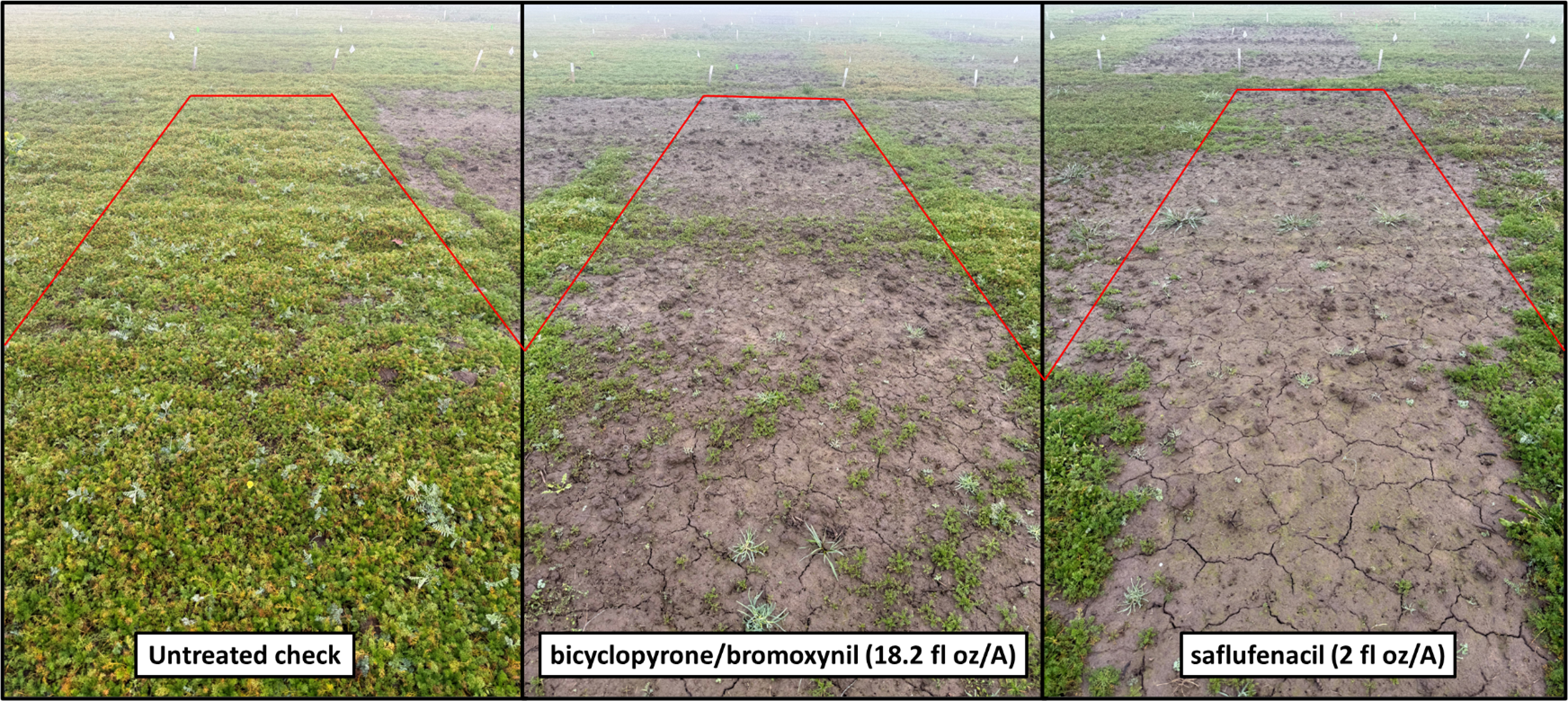
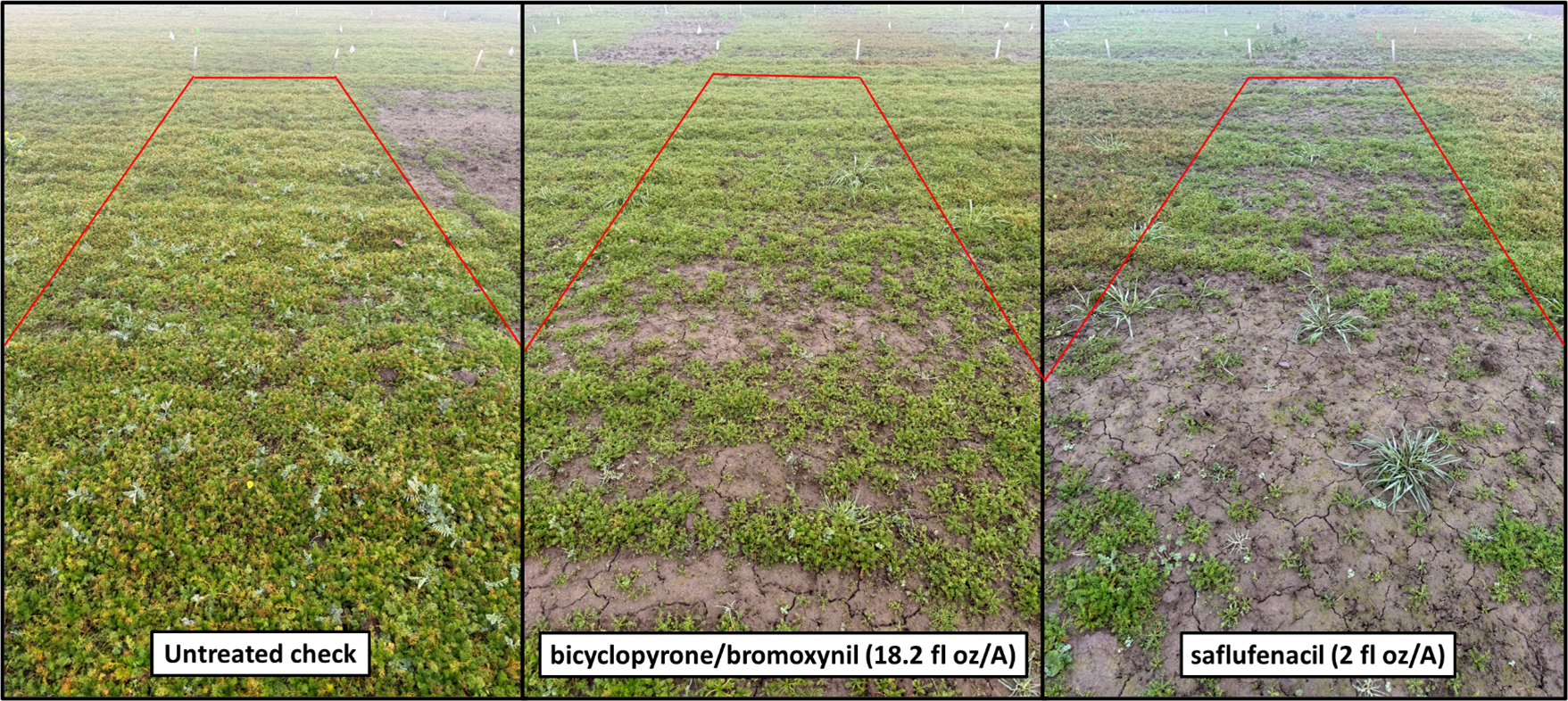
Herbicide performance differed depending on the active ingredient and application timing (Figure 2). Overall, control declined when herbicides were applied later to larger plants. When applied at the early timing, bicyclopyrone/bromoxynil (18.2 fl oz/A) and saflufenacil (2 fl oz/A) provided the highest levels of control, exceeding 90% (Figures 2 and 3). However, bicyclopyrone/bromoxynil applied at the lower rate (13.7 fl oz/A) provided reduced control (72%) compared with the higher rate (92%). In contrast, control was substantially reduced for most treatments when applied at the later timing. Saflufenacil remained the most effective treatment at the late application timing, providing 64% control, followed by tribenuron + 2,4-D (53%) and clopyralid (52%) (Figure 2). Several treatments that performed well at the early timing, including bicyclopyrone/bromoxynil, showed a marked reduction in efficacy when applied to larger plants (Figure 4).
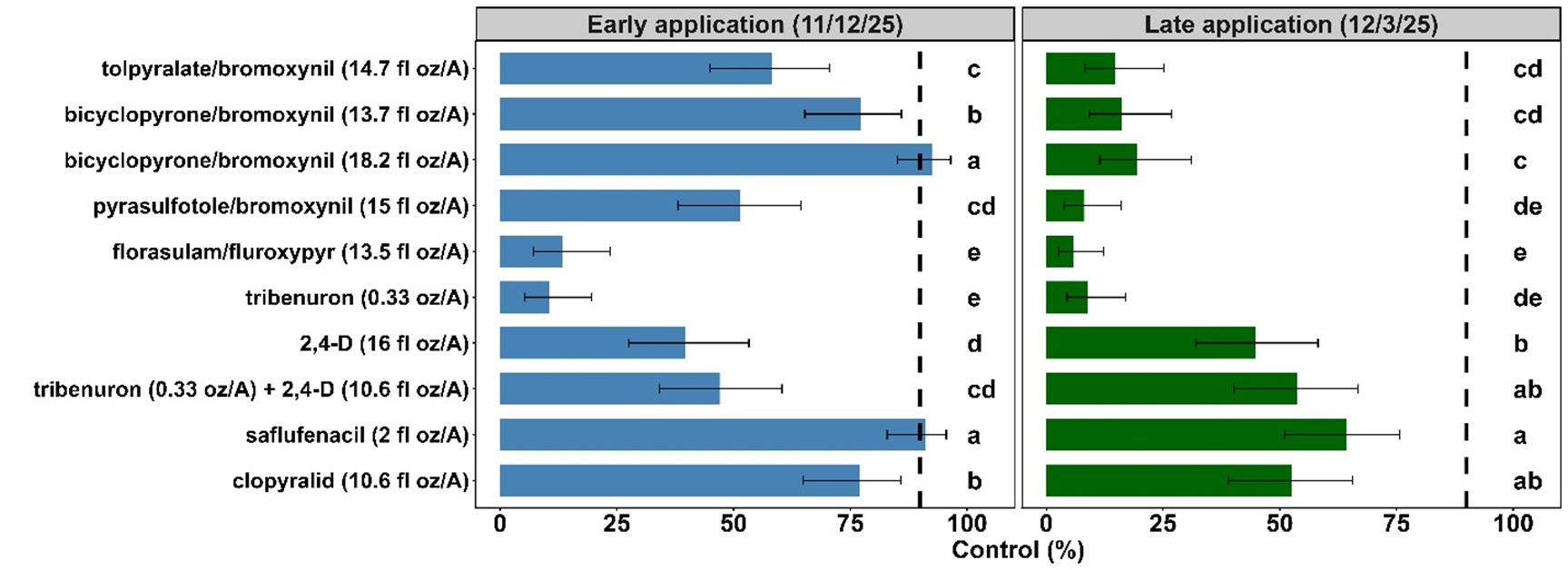
These findings emphasize the importance of selecting effective herbicides and applying them when mayweed chamomile plants are at an early growth stage (2–4 leaf stage, ~2 in tall) to achieve the best control. Delaying the application by three weeks resulted in substantially reduced efficacy, with control dropping to 64% or lower. Reduced performance at the later timing highlights how plant size and developmental stage strongly influence herbicide effectiveness. Environmental conditions likely also contributed to the differences observed, as the temperature at the first application was warmer (59 °F) compared to the second timing (47 °F), potentially affecting both plant growth and herbicide activity. Overall, these results underscore the value of timely applications and consideration of environmental factors to maximize mayweed chamomile control in bareground.
Our program is currently evaluating these herbicides in grass seed crops, including perennial ryegrass and tall fescue, targeting a variety of weed species, to identify additional effective management options for growers. Bicyclopyrone/bromoxynil (Talinor), florasulam/fluroxypyr (Starane Flex), and tolpyralate/bromoxynil (Tolvera) are non-labeled products in grass seed crops. These treatments and rates application were for research purposes only.
References
Darlington, H.T. (1931) The 60-year period of Dr. Beal’s seed viability experiment. American Journal of Botany, 18, 262–265.
Rashid, I., Reshi, Z.A., Allaie, R.R. and Wafai, B.A. (2007) Germination ecology of invasive alien Anthemis cotula helps it synchronise its successful recruitment with favourable habitat conditions. Annals of Applied Biology, 150, 361–369.