Contributed by Victor Ribeiro, Oregon State University
In September 2024, I joined the Department of Crop and Soil Science at Oregon State University as an assistant professor and Extension weed specialist with a statewide assignment. As part of my efforts to establish an effective applied research and extension program, I conducted a weed management needs assessment survey to identify the key challenges and priorities of Oregon growers and other agricultural stakeholders. The findings will help guide future research and outreach efforts to improve weed management strategies in Oregon’s field crops.
The survey was made available online through the Qualtrics platform from October 2024 to February 2025. A survey link was distributed via email to several commodities and industry groups. The survey was also shared on LinkedIn and Twitter, and a QR code linking to the survey was shared during the Oregon Society of Weed Science and winter extension meeting presentations. Additionally, Extension agents assisted in distributing the survey.
The survey included eight questions divided into three sections: the first section gathered general information (respondent’s occupation and location); the second focused on resource and support needs; and the third addressed current weed management challenges. The survey allowed only one response for questions Q1, Q2, Q3, Q4, Q7, and Q8, resulting in cumulative totals of 100%. In contrast, questions Q5 and Q6 allowed multiple responses, leading to totals exceeding 100%. The data were exported to a Microsoft Excel file, with responses to each question organized into separate columns, and were analyzed and visualized using bar graphs in R statistical software.
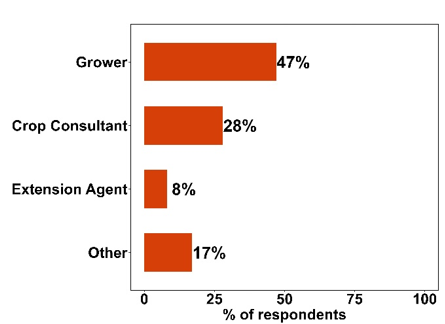
A total of 184 respondents participated in the survey, with 47% identifying as growers, 28% as crop consultants, 8% as extension agents, and 17% as “other” (e.g., researchers, field representatives, and educators) (Figure 1a). Seventy-four percent of the respondents were located in Western Oregon, while 26% were based in Eastern Oregon (Figure 1b).
(a)
(b)
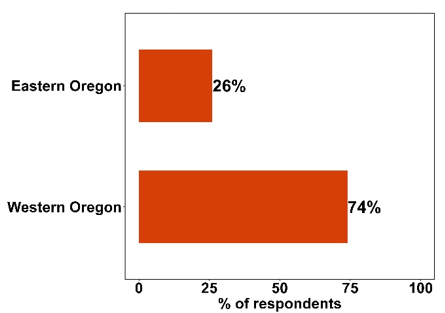
Figure 1. General information. (a) Q1. What is your occupation? (b) Q2. What is your location?
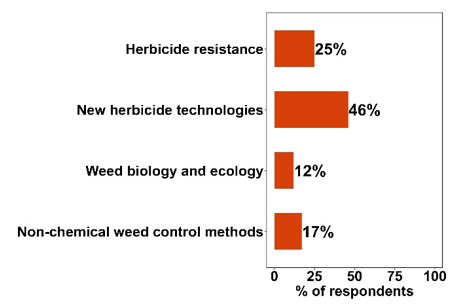
When respondents were asked about topics they would like more information or training on, 46% expressed interest in new herbicide technologies, 25% indicated herbicide resistance, 17% in non-chemical weed control methods, and 12% in weed biology and ecology (Figure 2a). In terms of preferred methods for receiving weed management information, 36% of respondents favored field days, 22% preferred workshops, 21% chose webinars and online courses, and 20% preferred website posts (Figure 2b).
(a)
(b)
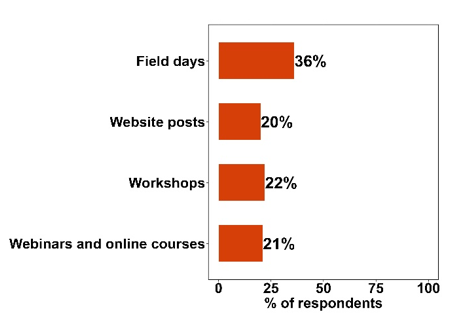
Figure 2. Resource and support needs. (a) Q3. What topics would you like more information or training on? (b) Q4. How do you prefer to receive weed management?
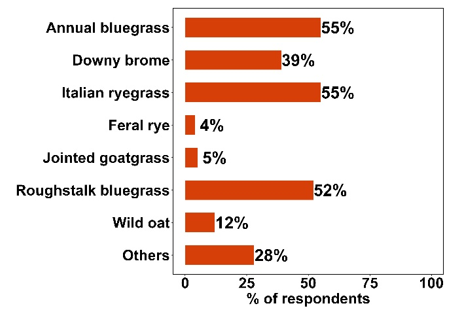
Respondents indicated several weed species as particularly problematic in their fields (Figure 3ab). Among grass weeds, annual bluegrass (Poa annua), Italian ryegrass (Lolium multiflorum), and roughstalk bluegrass (Poa trivialis) were the most frequently reported, with at least 52% of respondents indicating them as major concerns, followed by downy brome (Bromus tectorum L.) at 39% (Figure 3a). Wild oat (Avena fatua), jointed goatgrass (Aegilops cylindrica), and feral rye (Secale cereale) were reported by 12%, 5%, and 4% of respondents, respectively. Additionally, 28% of respondents listed “other” grass weeds, including rattail fescue (Vulpia myuros), barnyardgrass (Echinochloa crus-galli), foxtail (Setaria spp.), and other bromegrasses (Bromus spp.).
For broadleaf weeds, wild carrot (Daucus carrota L.) was by far the most problematic weed species, reported by 65% of respondents (Figure 3b). Sharppoint fluvellin (Kickxia elatine) and Russian thistle (Salsola tragus) followed, with 37% and 31%, respectively. Prickly lettuce (Lactuca serriola L.), mayweed chamomile (Anthemis cotula), pineapple weed (Matricaria matricarioides), Kochia (Bassia scoparia), and Palmer amaranth (Amaranthus palmeri) were identified as concerns by 26%, 24%, 22%, 16%, 9% of respondents, respectively. Additionally, 30% of respondents listed “other” problematic broadleaf weeds, including common groundsel (Senecio vulgaris), horseweed (Erigeon canadensis L.), thistles (Cirsium spp.), and pigweeds (Amaranthus spp.).
(a)
(b)
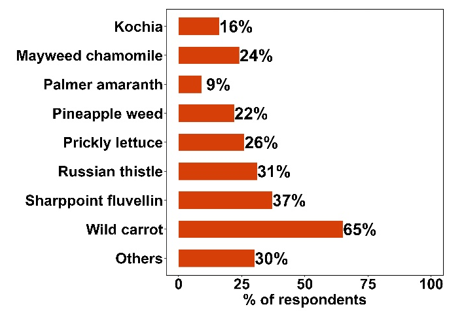
Figure 3. Current weed management challenges: grass and broadleaf weeds. (a) Q5. What are the most problematic grass weed species in your fields? (b) Q6. What are the most problematic broadleaf weed species in your fields?
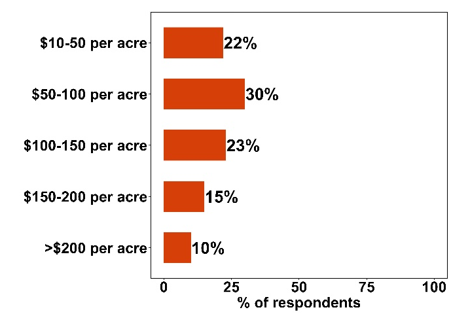
To better understand the economic impact of weed management in growers’ fields, respondents were asked about the average cost of weed control per acre in their crops. Thirty percent of respondents reported an average weed control cost of $50-100 per acre, followed by 23% who estimated $100-150 per acre (Figure 4a). Other responses included 22% reporting costs of $10-50 per acre, 15% reporting $150-200 per acre, and 10% reporting spending more than $200 per acre.
In addition to the costs associated with weed management, respondents were also asked about their level of concern regarding herbicide-resistant weeds on their farms. Fifty-eight percent of respondents indicated being very concerned, 39% were somewhat concerned, and only 3% were not concerned (Figure 4b).
(a)
(b)
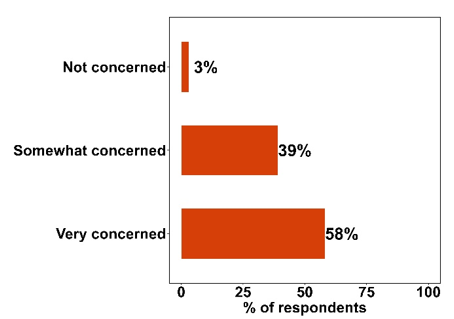
Figure 4. Current weed management challenges: economic and resistance concerns. (a) Q7. What is the average cost (per acre) of weed control in your crops? (b) Q8. How concerned are you about herbicide-resistant weeds on your farm?
As I move forward in my role, these findings will serve as a foundation for prioritizing research topics, fostering collaborations with key stakeholders, and designing applied research projects and extension programs that are directly aligned with the needs and concerns of Oregon’s growers. I look forward to collaborating with stakeholders across the state to address these challenges and develop practical, science-based solutions that are adaptable to Oregon’s diverse field crops.
Thank you to everyone who participated in the survey. Your input is instrumental in guiding the direction of future research and outreach efforts within Oregon’s agricultural community.