Contributed by Vhuthu Ndou and Judit Barroso, Oregon State University
Herbicides are an essential component of weed management. However, the repeated use of the same mode of action has given rise to herbicide resistance and a more integrated weed management approach is desirable. One agroecological approach to weed reduction that might not have received enough consideration in the region is intercropping.
Intercropping is the growing of two or more crops at the same time and in the same field. Intercropping cereals and legumes increases nitrogen (N) stocks since legumes can fix N from the atmosphere. In addition to improving N stocks, intercrops can compete with weeds in the interrow for light, nutrients and water, provide a physical barrier, and they can also shade the interrow, reducing the establishment and survival of weeds. Some other intercrops can also release chemicals that can negatively affect weeds, pests, and diseases (e.g., Brassica intercrops).
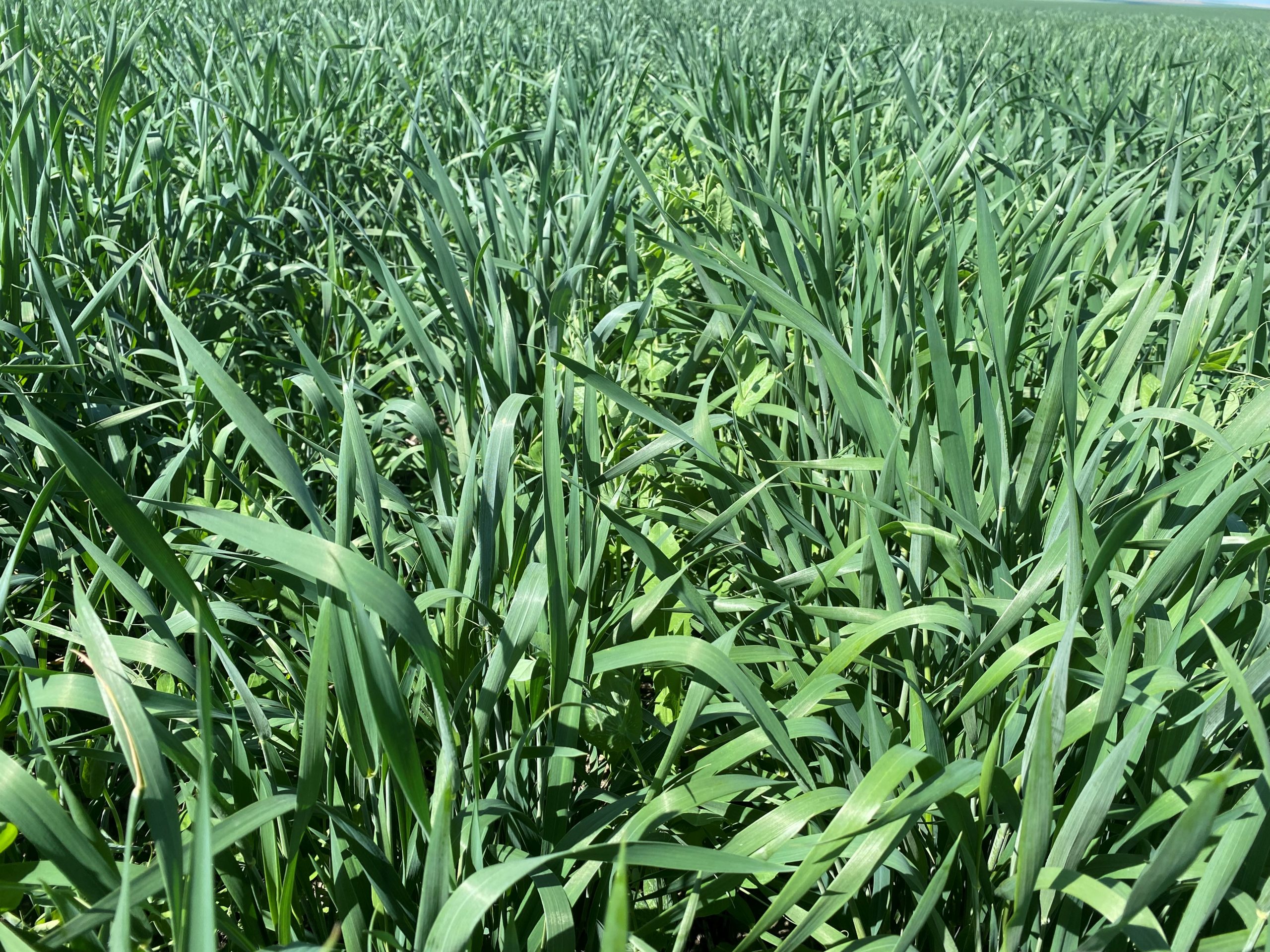
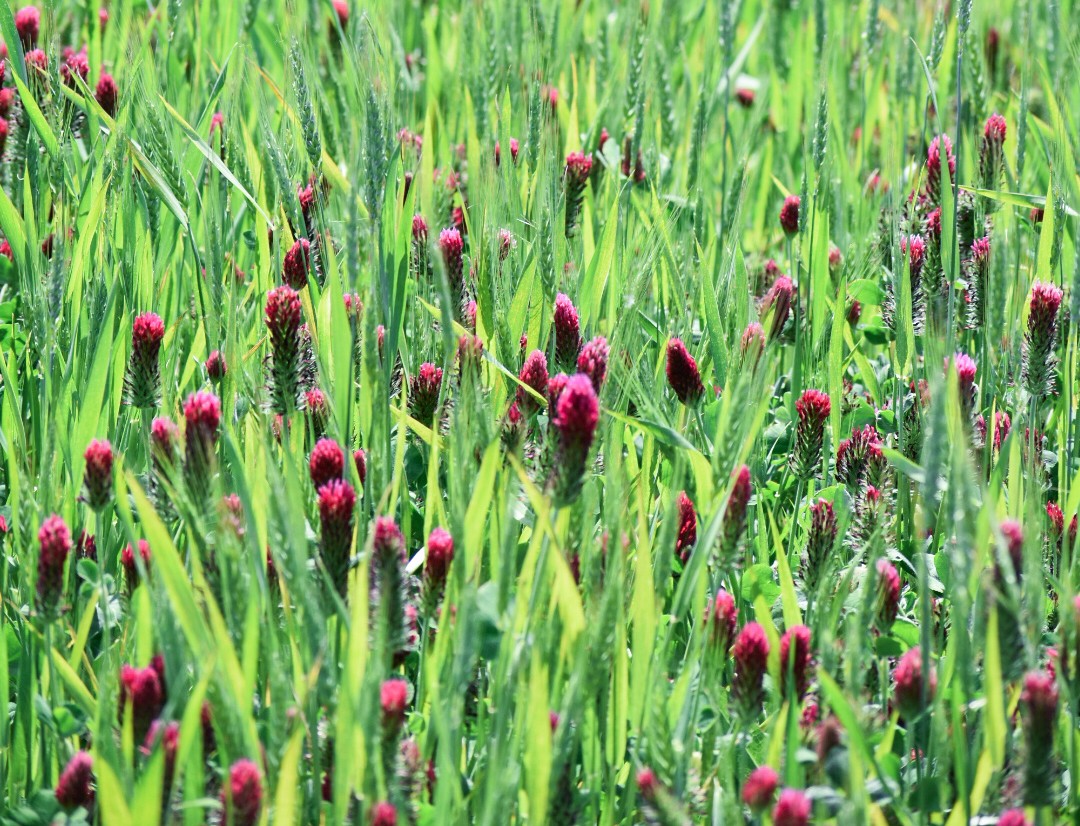
In the 2021-2022 growing seasons, we initiated an experiment where winter wheat was intercropped with various legumes: Frosty Berseem (FB) clover, Kentucky Pride Crimson (KPC) clover, or Dixie Crimson (DC) clover, Icicle winter peas, and common vetch at the USDA-ARS Columbia Plateau Conservation Research Center, Adams, OR, using a partially randomized experiment with four replications. In the 2022-2023 and 2023-2024 growing seasons, we repeated the study in the same area (Figure 1). In the three years, we evaluated the effect of the intercrop on the wheat and weeds by estimating visually the percentage cover per species in each plot. After our evaluation in spring, we applied a grass weed herbicide uniformly in the experimental area. Aggressor® (quizalofop) was applied to CoAXium wheat with two 8 fl oz/A applications in 2022 and 2023, and Beyond® (imazamox) was applied to Clearfield wheat at 6 fl oz/A in 2024. In 2022, the intercrops were grown to maturity and there was no application of broadleaf herbicide. Prickly lettuce, the predominant broadleaf weed in the experiment, was hand-pulled prior to crop harvest that year. In 2023 and 2024, Huskie® (bromoxynil + pyrasulfotole) at 15 fl oz/A was used to terminate the intercrops and control broadleaf weeds in mid-May 2023 and mid-March 2024.
(a)
(b)
Figure 1: Winter wheat growing alongside (a) peas (May 16, 2023, courtesy of Wayne Polumsky) and (b) dixie crimson clover (May 20, 2024, courtesy of Hero Gollany) in the field at the Columbia Plateau Conservation Research Center in Adams, Oregon.
The first two years of the study, none of the clover intercrops survived winter due to late planting (October). In the last year of the study (2023-2024), the clovers were seeded earlier, following the initial rains in August, and they established successfully that year.
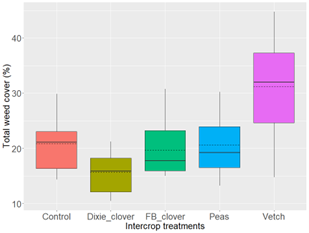
In 2022, the results for total weed cover showed no differences among the plots growing peas, vetch, or no intercrop (both clovers did not establish that year). In 2023, the total weed cover in peas (12%) was not different from the vetch (14%), but both had lower total weed cover than the plots without intercrop (22%). In 2024, when the clovers were well established, the control, clover and pea plots had significantly less weed cover than vetch (31%), particularly the Dixie clover (16%). However, the highest percentage of weeds in the vetch plots this year was partially due to the great amount of volunteer vetch in those plots. (Figure 2a).
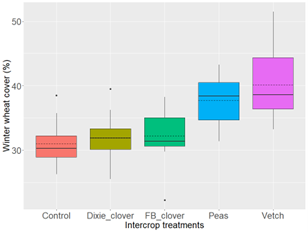
Results regarding wheat percentage cover showed no differences between the treatments in 2022. In other words, no negative or positive effect of the intercrops (peas or vetch) on the cash crop (wheat) was observed during spring plant surveys. In 2023, pea and vetch plots tended to show a lower percentage of wheat cover (13%) than the plots without established intercrop (16%). However, in 2024, when the Dixie and FB clovers were well established, vetch and peas resulted in significantly greater wheat cover (40 and 38%, respectively) than both clovers (32%), and the control (31%) (Figure 2b).
(a)
(b)
Figure 2: a) Total weed percentage cover in winter wheat growing with different intercrops and without intercrop (control) and b) Winter wheat percentage cover when growing with different intercrops and without intercrop (control) in Adams, OR in the 2023-2024 season. Boxes indicate the distribution of 50% of the data, and the black solid line and the dashed line inside the boxes indicate the median and mean of the data, respectively.
It would be interesting to study how some of the mentioned differences translate to higher or lower yield, and we hope to be able to provide that information in the near future. However, due to the different results obtained in each of the three years, extended years of study are necessary to understand the variability. Stay tuned for additional findings regarding this study.
We are grateful to Wayne Polumsky, Steve Umbarger, Kyle Carlson and Bret Carter for trial establishment and management; Dr. Fernando Oreja and Jennifer Gourlie for assisting with data collection; and Dr. Hero Gollany for leading this research.