Skip to main content Skip to navigation

Does legume intercropping affect wheat establishment and weed suppression? It’s complicated!

Posted by jenna.osiensky | February 13, 2025

Contributed by Vhuthu Ndou and Judit Barroso, Oregon State University

Herbicides are an essential component of weed management. However, the repeated use of the same mode of action has given rise to herbicide resistance and a more integrated weed management approach is desirable. One agroecological approach to weed reduction that might not have received enough consideration in the region is intercropping.

Intercropping is the growing of two or more crops at the same time and in the same field. Intercropping cereals and legumes increases nitrogen (N) stocks since legumes can fix N from the atmosphere. In addition to improving N stocks, intercrops can compete with weeds in the interrow for light, nutrients and water, provide a physical barrier, and they can also shade the interrow, reducing the establishment and survival of weeds. Some other intercrops can also release chemicals that can negatively affect weeds, pests, and diseases (e.g., Brassica intercrops).

In the 2021-2022 growing seasons, we initiated an experiment where winter wheat was intercropped with various legumes: Frosty Berseem (FB) clover, Kentucky Pride Crimson (KPC) clover, or Dixie Crimson (DC) clover, Icicle winter peas, and common vetch at the USDA-ARS Columbia Plateau Conservation Research Center, Adams, OR, using a partially randomized experiment with four replications. In the 2022-2023 and 2023-2024 growing seasons, we repeated the study in the same area (Figure 1). In the three years, we evaluated the effect of the intercrop on the wheat and weeds by estimating visually the percentage cover per species in each plot. After our evaluation in spring, we applied a grass weed herbicide uniformly in the experimental area. Aggressor® (quizalofop) was applied to CoAXium wheat with two 8 fl oz/A applications in 2022 and 2023, and Beyond® (imazamox) was applied to Clearfield wheat at 6 fl oz/A in 2024. In 2022, the intercrops were grown to maturity and there was no application of broadleaf herbicide. Prickly lettuce, the predominant broadleaf weed in the experiment, was hand-pulled prior to crop harvest that year. In 2023 and 2024, Huskie® (bromoxynil + pyrasulfotole) at 15 fl oz/A was used to terminate the intercrops and control broadleaf weeds in mid-May 2023 and mid-March 2024.
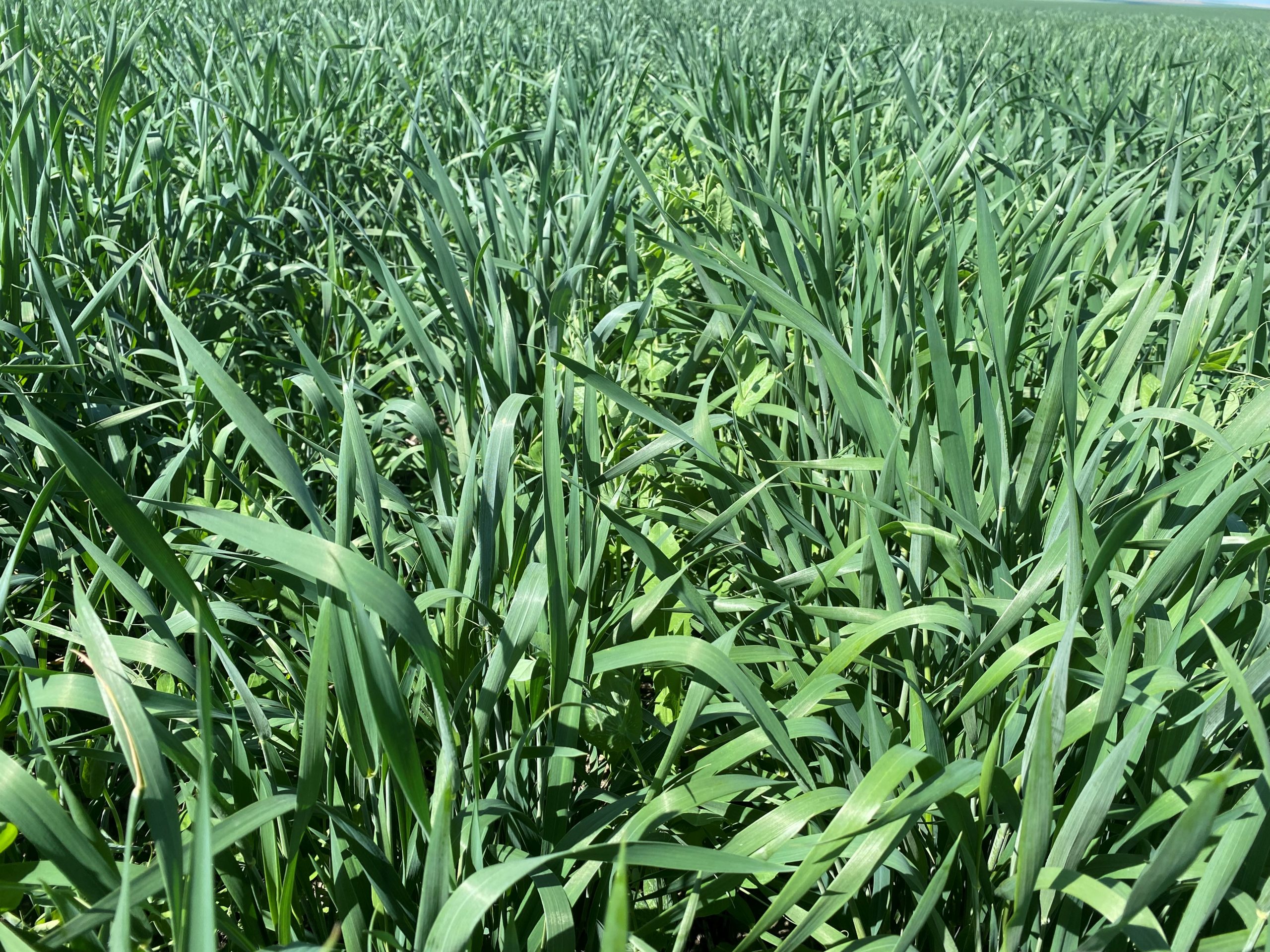
Winter wheat growing alongside (a) peas (May 16, 2023, courtesy of Wayne Polumsky).

(a)

Dixie crimson clover (May 20, 2024, courtesy of Hero Gollany) in the field at the Columbia Plateau Conservation Research Center in Adams, Oregon.

(b)

Figure 1: Winter wheat growing alongside (a) peas (May 16, 2023, courtesy of Wayne Polumsky) and (b) dixie crimson clover (May 20, 2024, courtesy of Hero Gollany) in the field at the Columbia Plateau Conservation Research Center in Adams, Oregon.

The first two years of the study, none of the clover intercrops survived winter due to late planting (October). In the last year of the study (2023-2024), the clovers were seeded earlier, following the initial rains in August, and they established successfully that year.

In 2022, the results for total weed cover showed no differences among the plots growing peas, vetch, or no intercrop (both clovers did not establish that year). In 2023, the total weed cover in peas (12%) was not different from the vetch (14%), but both had lower total weed cover than the plots without intercrop (22%). In 2024, when the clovers were well established, the control, clover and pea plots had significantly less weed cover than vetch (31%), particularly the Dixie clover (16%). However, the highest percentage of weeds in the vetch plots this year was partially due to the great amount of volunteer vetch in those plots. (Figure 2a).

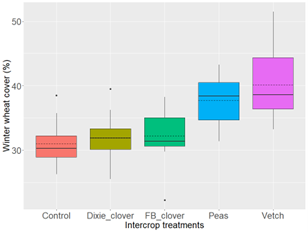
Results regarding wheat percentage cover showed no differences between the treatments in 2022. In other words, no negative or positive effect of the intercrops (peas or vetch) on the cash crop (wheat) was observed during spring plant surveys. In 2023, pea and vetch plots tended to show a lower percentage of wheat cover (13%) than the plots without established intercrop (16%). However, in 2024, when the Dixie and FB clovers were well established, vetch and peas resulted in significantly greater wheat cover (40 and 38%, respectively) than both clovers (32%), and the control (31%) (Figure 2b).
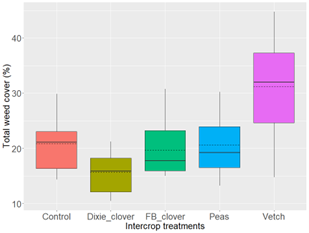
Total weed percentage cover in winter wheat growing with different intercrops and without intercrop (control) in Adams, OR in the 2023-2024 season. Boxes indicate the distribution of 50% of the data, and the black solid line and the dashed line inside the boxes indicate the median and mean of the data, respectively. Full results of this study can be found in the article.

(a)

Winter wheat percentage cover when growing with different intercrops and without intercrop (control) in Adams, OR in the 2023-2024 season. Boxes indicate the distribution of 50% of the data, and the black solid line and the dashed line inside the boxes indicate the median and mean of the data, respectively. Full results of this graphic can be found in the article.

(b)

Figure 2: a) Total weed percentage cover in winter wheat growing with different intercrops and without intercrop (control) and b) Winter wheat percentage cover when growing with different intercrops and without intercrop (control) in Adams, OR in the 2023-2024 season. Boxes indicate the distribution of 50% of the data, and the black solid line and the dashed line inside the boxes indicate the median and mean of the data, respectively.

It would be interesting to study how some of the mentioned differences translate to higher or lower yield, and we hope to be able to provide that information in the near future. However, due to the different results obtained in each of the three years, extended years of study are necessary to understand the variability. Stay tuned for additional findings regarding this study.

We are grateful to Wayne Polumsky, Steve Umbarger, Kyle Carlson and Bret Carter for trial establishment and management; Dr. Fernando Oreja and Jennifer Gourlie for assisting with data collection; and Dr. Hero Gollany for leading this research.

6 thoughts on "Does legume intercropping affect wheat establishment and weed suppression? It’s complicated!"

  1. Thank you for doing this study. I hope you can continue this for several more years. It’s good to know the likely hood of stand establishment/failure along with yield data. I’m watching, good luck.

    1. Judit Barroso says:

      Thank you so much Tracy for your supportive comment and my apologies for missing it earlier.

  2. Mike Davis says:

    Wow, this article on intercropping is incredibly insightful! I hadn’t really considered how impactful this simple strategy could be for weed management and crop resilience—things got explained clearly with a cool real-world application. How does cost scale with farm size (a) in this practice and what types of crops did farmers find most suited to the method in your experience.

    1. Judit Barroso says:

      Mike, thanks so much for your very nice comment about this work. To your first question, how does cost scale with farm size in this practice, I do not have a good answer for you yet. We are still trying to figure out optimum intercrops seeding rates and the seeding operation per se is still a challenge. In regard to your second question, as far as we are aware inter-seeding is not a common or established practice in the region, we are doing the study with legume inter-seeded with the goal of reducing fertilizer and herbicide inputs to make our cropping systems more resilient and sustainable. If you want to know more about this work, I encourage you to contact Dr. Hero Gollany (hero.gollany@usda.gov) who is the leader of this research.

  3. Samantha Blake says:

    This was a really thought-provoking post on intercropping! It’s so valuable to see a realistic look at integrated weed management strategy, pushing beyond single solutions and highlighting the potential for sustainability while also acknowledging the practical challenges involved.

    The idea of the “sweet spot” for seeding rates and compatible cultivars is certainly key. I’m curious, for dryland winter wheat in the Northwest, have any pioneer growers found truly consistent, scalable successful intercrops for specific persistent weed challenges yet, or is it more often a field-by-field, tailored approach right now?

    Also, given the mention of variable results, how might smaller-scale growers or those looking to experiment start gently? Are there particular resource/yield monitoring techniques or decision-making guides that can help determine if it’s “paying off” in ecological as well as economic terms over just a couple of seasons? Thanks for sharing your insights!

    1. Judit Barroso says:

      Thank you very much, Samantha, for your comments and interest in the post.
      You are bringing very important questions. To your first question about results from pioneer growers, we are not aware of many growers trying intercropping in the region yet. There is some work done with spring crops intercropping, particularly canola and peas of what is called Peaola, but we are not aware of winter crops intercropping in the region.
      To your second question about if it pays off, we are hoping to have an Agricultural Economist colleague that help us with the numbers soon. Meanwhile, Dr. Gollany is looking at the potential nitrogen (N) and herbicide reduction in the intercropping system compared with the solo wheat. The potential advantages of these results (fertilizer and herbicide reduction) might be easy to put in numbers. However, there might be other potential advantages, like slowing down soil acidification (low soil pH) process in the N fertilizer application zone (delaying liming requirement), an increase in soil organic matter, etc., that will be harder to quantify in the short-term. Nonetheless, we are continuing to study these intercropping systems and we are hoping to get more consistent data as we add more years. We will communicate significant results as soon as we have them in our websites and field days. Stay tune! And thanks again for your interest and questions.

      Best regards,
      Judit

Leave a Reply

Your email address will not be published.