Contributed by Aaron Becerra-Alvarez1 and Kristine Buckland2
1Assistant Professor in Weed Science, Department of Horticulture, Oregon State University; 2Associate Professor and Vegetable and Specialty Seed Specialist, Department of Horticulture, Oregon State University
Vegetable farmers rely on cultivation and hand labor for weed control. Innovative mechanized weed control equipment is of increasing interest to vegetable farmers due to the limited labor available and increasing costs of the available labor. While many new cultivators connect to a tractor, there is innovation in the field of robotics for farming that have developed autonomous equipment. A Denmark-based company called FarmDroid is exploring the US vegetable farming market with their autonomous robot that performs automatic sowing and weeding of crops. One of the places of interest is western Oregon because of the similarities in crops and smaller farm sizes to the company’s homebase in Denmark.
Dr. Kristine Buckland, Oregon State University (OSU) vegetable and specialty seed crop specialist, and Dr. Pete Berry, OSU Crops and Soils Department weed scientist, obtained funding to evaluate new agricultural technology in Oregon, including the FarmDroid FD20 in western Oregon (Figure 1). This year the team spent time getting the FarmDroid FD20 operating at the OSU North Willamette Research and Extension Center in Aurora, Oregon and conducted demonstrations with garden beets and turnips. We will share our thoughts on the technology and discuss future research that will be conducted.
The FarmDroid FD20 is a solar-powered autonomous robot. It is equipped with seed hoppers that can sow the crop and cultivating knives that move inside the crop row to cultivate in between sown plants. (See video link below.) The system uses real-time kinetic positioning (RTK) to map the location of the planted seed and location of the robot. Then, after sowing, the robot can go in the field and cultivate in between the plants based on the location of the planted seeds. It relies solely on RTK and no computer vision is utilized. For the system to work, it requires a home base satellite station that connects with the robot in the field and should be within a 6-mile radius of the robot. FarmDroid states one robot should be able to cover 50 acres of seeding and weeding. The price for one robot can be up to $100,000, which is relatively less expensive than other new available weeding equipment.
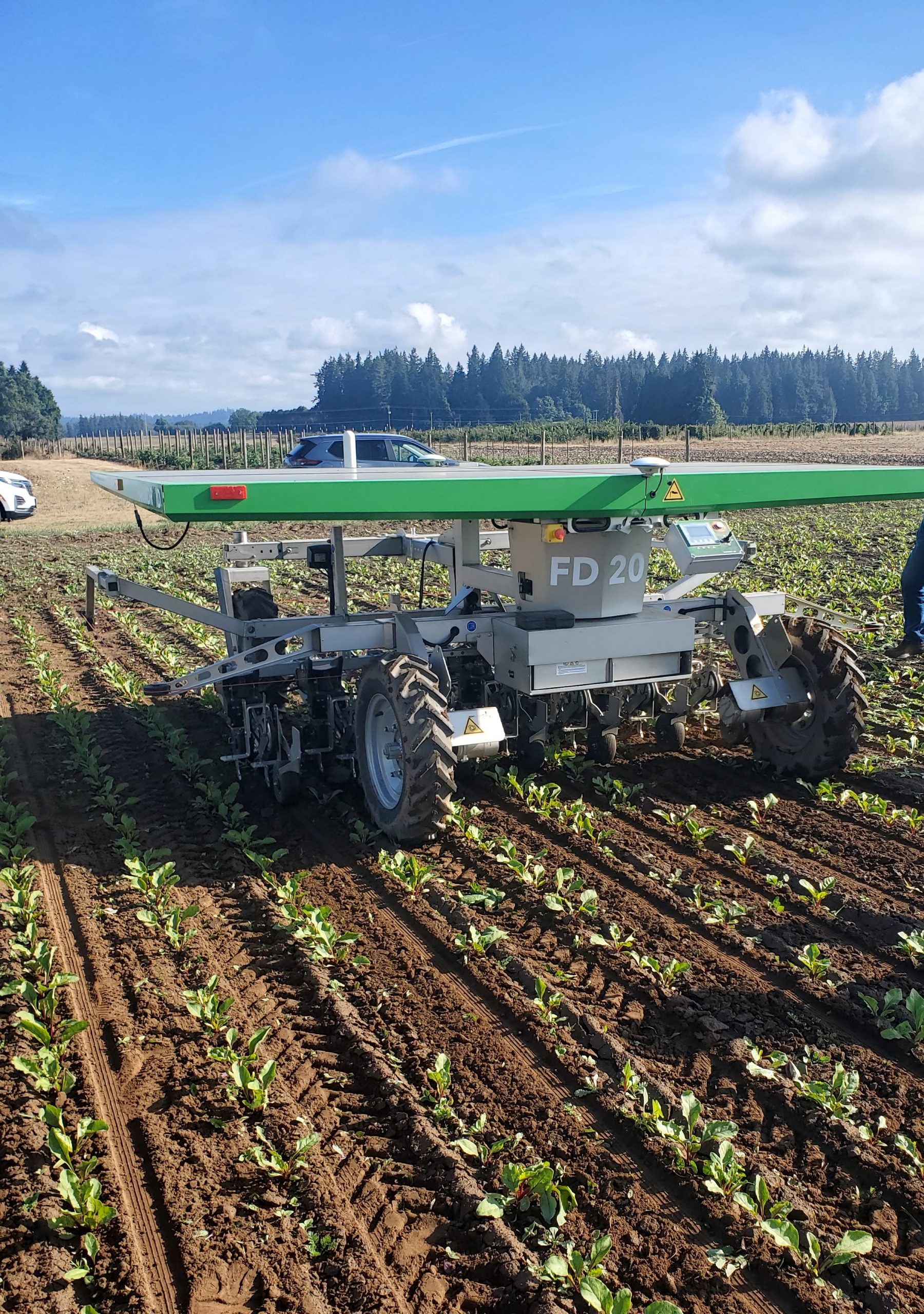
Figure 1. Farmdroid FD20 weeding a garden beet field which it also seeded at the North Willamette Research and Extension Center in Aurora, OR. (photo credit: Aaron Becerra-Alvarez)
The benefits observed with the technology may include reduced CO2 emissions from tractor use, earlier cultivation timing with minimal crop injury, and potential to reduce labor costs. Some of the technical challenges observed this season included a learning curve to fully engage the new technology with remote technical service based in Denmark, relatively slow speed in the field, and the availability of seed plates (the company manufacturers seed plates specficially for each seed lot so prior coordination is required). To be able to use the weeding capabilities, the robot has to also sow the seeds and should be the only equipment in that field for best performance.
There is potential for this new technology to be effective in western Oregon. The FarmDroid FD20 was able to remove many weeds but not all (Figure 2); however, it takes a couple passes to clean the field. (See video link below). Similarly, currently available methods like tractor cultivation and handweeding also take several passes. Crop injury appeared minimal. This raises questions on when the best application timings are for the best results? How many passes are necessary? What is the performance of the cultivator knives after some time? What weeds are easier to control (broadleaf vs. grasses)? How much can handweeding time and costs be reduced? What are the effects of this technology toward achieving sustainable agriculture goals? How can it be incorporated into an integrated pest management plan for weeds?
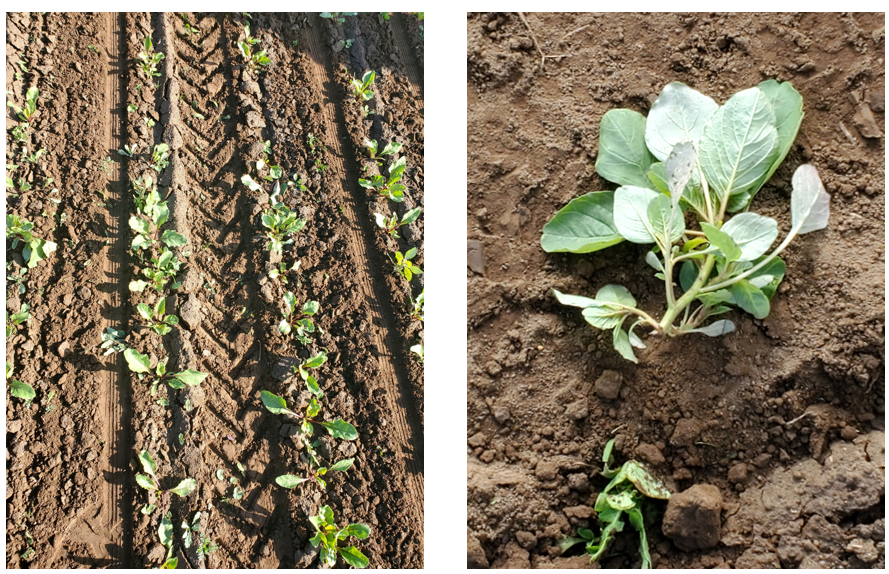
Figure 2. On the left, the garden beet field after a cultivation pass with the FarmDroid FD20 at the North Willamette Research and Extension Center in Aurora, OR. On the right, a relatively large pigweed cut at the stem by the cultivator knives in the FarmDroid FD20. (photo credit: Aaron Becerra-Alvarez)
From a technical standpoint, we have yet to observe how well it can perform in the fall to early spring weather of western Oregon, which can be very rainy. Soils also tend to harden during this time, which prevents and discourages growers from entering the fields for tillage and cultivation. Many fields in western Oregon are also on slopes that could be a challenge for the robot. We have yet to find out.
We hope to address many of these questions in future research. The growers are interested in new technology, as some of the funding was provided from the Specialty Seed Growers of Western Oregon and the Oregon Processed Vegetable Commission. Our research will help us learn the strengths and weaknesses of the new technology and how to properly incorporate it into an integrated pest management plan and will provide guidance for growers who are interested in pursuing the technology on their farm.