Contributed by Judit Barroso, Oregon State University
It seems that my colleague Doug Finkelnburg from University of Idaho and I can’t stop talking about grass weed germination. When I wrote about it last March, grass weeds were still emerging. Now that the season is further along, we have more data to examine. So, what do the numbers tell us? Were the weeds this year really worse because of the warm winter or did they just seem that way? Let’s look beyond perception and see what the data tell us.
Before we begin, keep in mind that the data presented here come from the research station where I work near Pendleton, Oregon. Weather patterns, temperatures, and precipitation distribution may have been different in your area. Starting with the weather, precipitation during September and October was 53% and 22% above the 30-year average respectively (Table 1). In addition, September and October accumulated 16% and 10% more growing degree days (GDD; the total heat available for plant development) than normal. Although fall conditions favored early crop and weed development, December stood out as the warmest month relative to the 30-year average, accumulating 23% more GDDs than normal. That trend continued through the winter and into spring, resulting in crops that were approximately 20% ahead of a typical year. While rapid crop development can be beneficial, it also created challenges for spring weed management. By the time nighttime temperatures were consistently warm enough for safe herbicide applications, crop canopies had closed more than usual which reduced spray coverage. At the same time, grass weeds had also reached more advanced growth stages, making them less responsive to herbicides and more difficult to control.
Table 1.
Monthly weather summary for the 2025-2026 growing season and comparison with the 30-year average (1991-2020) at the Columbia Basin Agricultural Research Center (CBARC), Adams, Oregon.
| Month | 2025-2026 Precip (in) | 1991-2020 Precip (in) | Comparison (%) between precipitation this season and 1991-2020 | Comparison (%) between accumulated GDD this season and 1991-2020 |
| Sep 2025 | 0.92 | 0.60 | 153% | 116% |
| Oct 2025 | 1.57 | 1.29 | 122% | 110% |
| Nov 2025 | 1.87 | 1.95 | 96% | 113% |
| Dec 2025 | 2.00 | 2.03 | 99% | 123% |
| Jan 2026 | 0.44 | 1.90 | 23% | 121% |
| Feb 2026 | 1.89 | 1.53 | 124% | 120% |
| Mar 2026 | 1.31 | 1.83 | 72% | 120% |
| Apr 2026 | 1.83 | 1.66 | 110% | 116% |
| May 2026 | 0.26 | 1.90 | 14% | 114% |
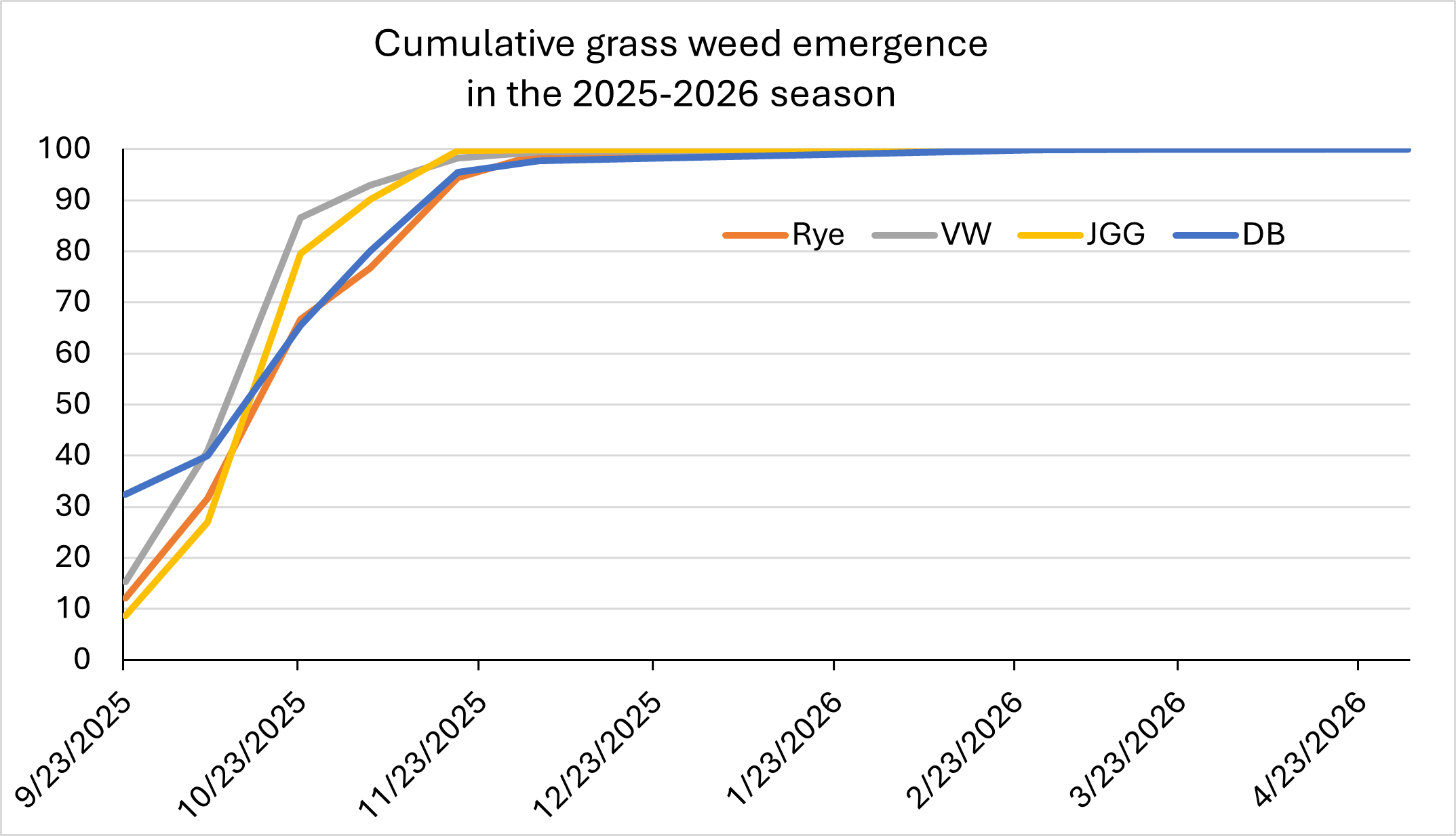
The accumulated grass weed germination from the trial I described in my previous post last March showed that very little germination occurred in spring (less than 2%; Figure 1). However, a small percentage does not necessarily mean a small problem. When the soil seedbank is large, even 2% germination can result in a significant number of plants. For example, if a field has 100 weed seeds per square foot in the soil, a 2% germination would still produce about 2 plants per square foot.
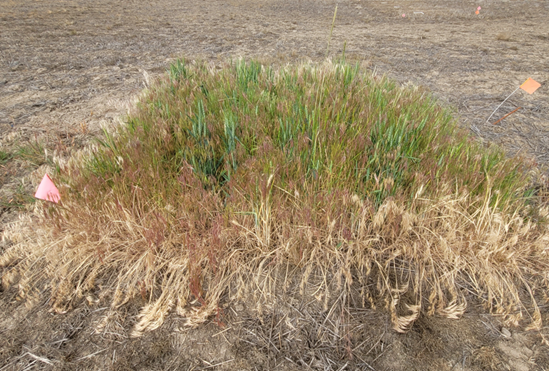
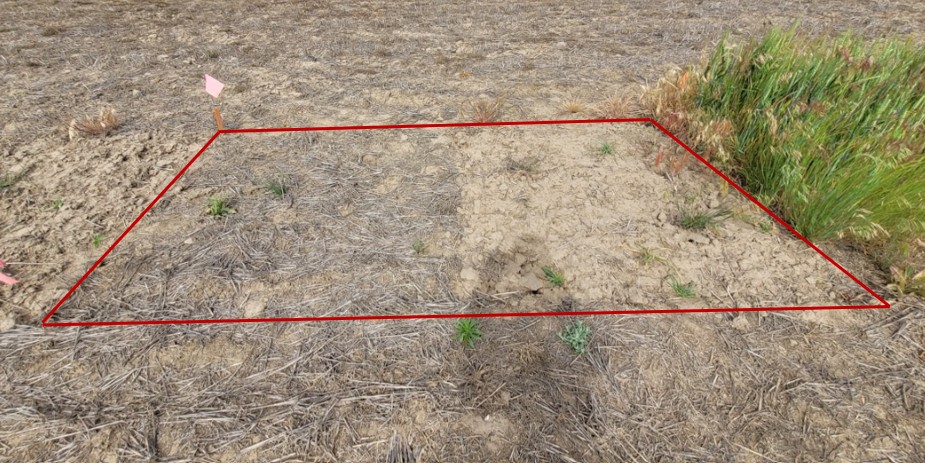
Another trial that we presented during our Field Day also examined grass weed emergence timing, but this time under two different control practices: herbicide applications and tillage (Image 1). In this study, we applied control practices every three weeks, starting on September 16, to capture successive flushes of emergence throughout the season. The result showed that very little germination occurred after the December 9 control timing, regardless of whether weeds were managed with herbicide or tillage. On average, only 2.3 plants per square foot emerged after the December 9 treatment. In contrast, untreated plots and plots where control was applied before October 28, 2025, averaged 106.2 plants per square foot by the end of May 2026, indicating that the soil seedbank had at least that many seeds per square foot. If we assume a soil seedbank of approximately 120 seeds per square foot, then the 2.3 plants that emerged after December 9 represent about 1.9% of spring germination. This estimate closely matches the results from our other trial where less than 2% of total grass weed germination occurred in the spring.
Coming back to the question of whether fall-germinating annual grass weeds were worse this year than in previous years, my answer is: “It depends”. However, if I were asked whether I think there was more fall germination than usual, my answer would be “yes”. But that is not necessarily a bad thing. For growers who were able to control weeds before winter, greater fall emergence means that more of the soil seedbank was depleted before spring. In addition, the favorable fall growth conditions allowed the winter wheat to establish well, making it more competitive with later-emerging weeds. In contrast, growers who were unable to control weeds before winter, I agree with the general perception that they likely experienced greater weed pressure this year. Higher fall germination resulted in more established weeds entering the spring and those larger plants were more difficult to control with spring herbicide applications.
Overall, this season reinforces an important principle: weather influences weed emergence, but management determines the outcome. The warm, wet fall created conditions for greater fall germination, yet our research showed that very little additional germination occurred in the spring. However, spring germination of winter annual grasses—such as downy brome, jointed goatgrass, feral rye, or rattail fescue—may be more pronounced following dry fall conditions. We plan to continue studying weed germination in the coming years with the ultimate goal of developing predictive germination models. While it is relatively easy to understand what has happened after the fact, predicting it ahead of time is much more challenging—reading the crystal ball, so to speak, is not that straightforward. Please stay tuned and feel free to leave comments on this blog, they are greatly appreciated.