Contributed by Victor Ribeiro and David Maliszewski, Oregon State University
Talinor is a pre-mixed herbicide containing two active ingredients: bicycolopyrone (Group 27) and bromoxynil (Group 6). It is a post-emergence herbicide used to control broadleaf weeds in cereal crops, including wheat (Triticum aestivum L.) and barley (Hordeum vulgare L.). Our group recently began evaluating Talinor in grasses grown for seed, particularly tall fescue (Festuca arundinacea) and perennial ryegrass (Lolium perenne L.), with a focus on crop safety and weed control, especially for mayweed chamomile (Anthemis cotula L.).
At the 2025 Hyslop Farm Field Day at Oregon State University, I presented our trials assessing Talinor in tall fescue and perennial ryegrass. Although Talinor is not labeled for use in these crops, the data were generated from experimental trials conducted to assess its potential fit. After the presentation, a stakeholder approached me and asked whether Talinor is effective on Sharppoint fluvellin (Kickxia elatine (L.) Dumort.).
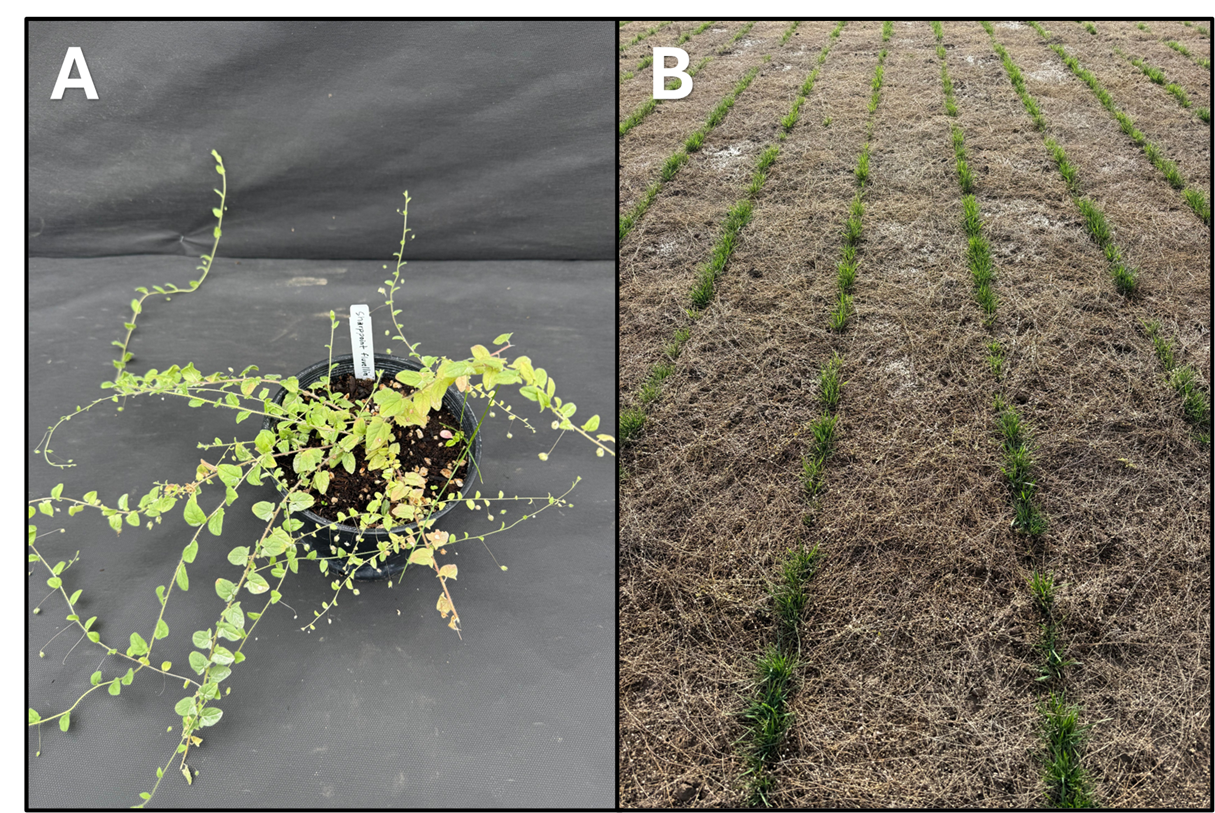
Sharppoint fluvellin is a problematic weed in spring-planted tall fescue in the Willamette Valley, Oregon. It is an annual plant that begins as an upright seedling but quickly develops prostrate, mat-forming stems as it matures (Figures 1A and B). The species has a taproot that is fibrous in young plants and becomes woody in older individuals, supporting its persistence under hot, dry conditions. It reproduces by seed and typically flowers from June through September, though flowering may extend later in the season in the Willamette Valley. Sharppoint fluvellin is tolerant to many herbicides, which makes it particularly difficult to control. Figure 1B shows an example where herbicides failed to control Sharppoint fluvellin in spring-planted tall fescue in 2025; the plants formed a dense mat between the crop rows. In this field, the crop survived, but the weed completed its life cycle and likely deposited seeds into the soil, creating a significant problem for the following season. Additionally, this dense barrier prevents herbicides from reaching the soil and may protect small weeds from being contacted by post-emergence herbicides, making the application ineffective.
To address this question, we conducted a herbicide screening trial on a bare-ground site at Hyslop Farm with a Sharppoint fluvellin infestation in late spring. Treatments included Talinor applied at two rates (13.7 and 18.2 fl oz/A), each applied with the adjuvants CoAct+ (2.75 and 3.6 fl oz/A, respectively) and COC at 1% v/v, Huskie (15 fl oz/A) applied with NIS at 0.25% v/v, and an untreated check were included for comparison. The rates of Talinor and CoAct+ used in this trial corresponded to the lower and higher recommended label rates for wheat and barley. The Huskie rate was based on the recommendations for grass grown for seed. Treatments were applied on May 30 using a CO2-backpack sprayer calibrated to deliver 20 GPA, targeting Sharppoint fluvellin plants at the 4- to 6-leaf stage.
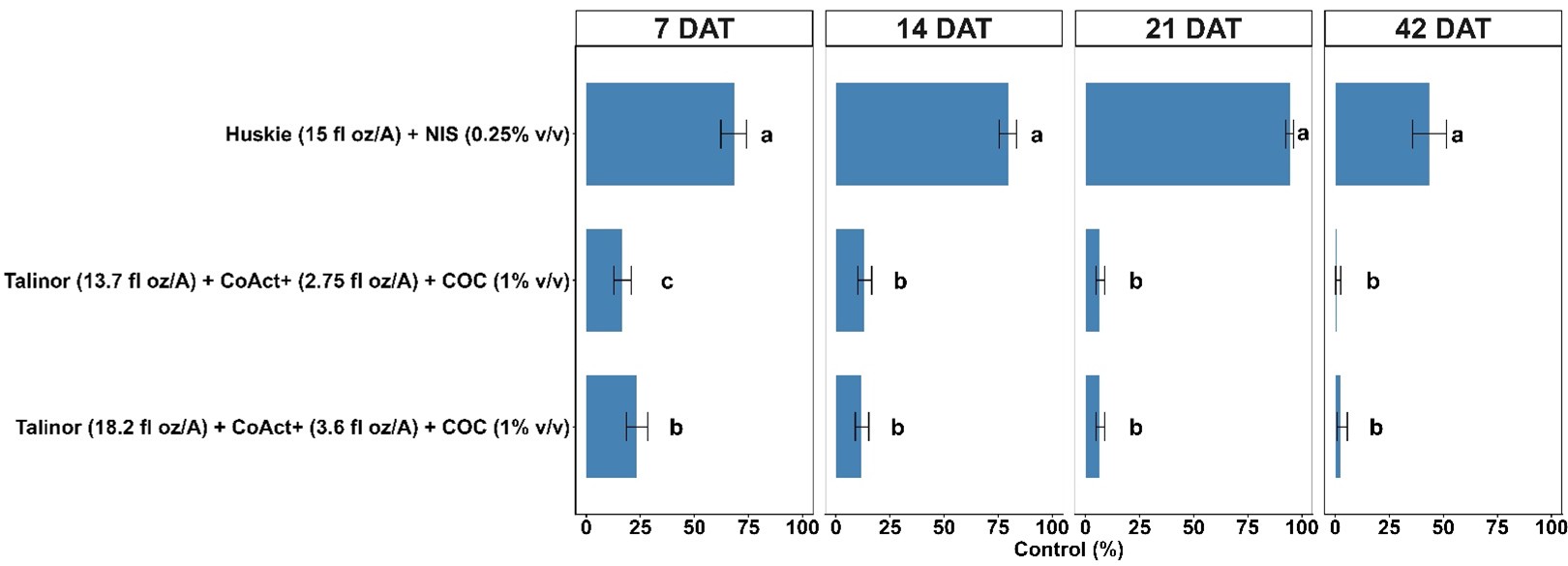
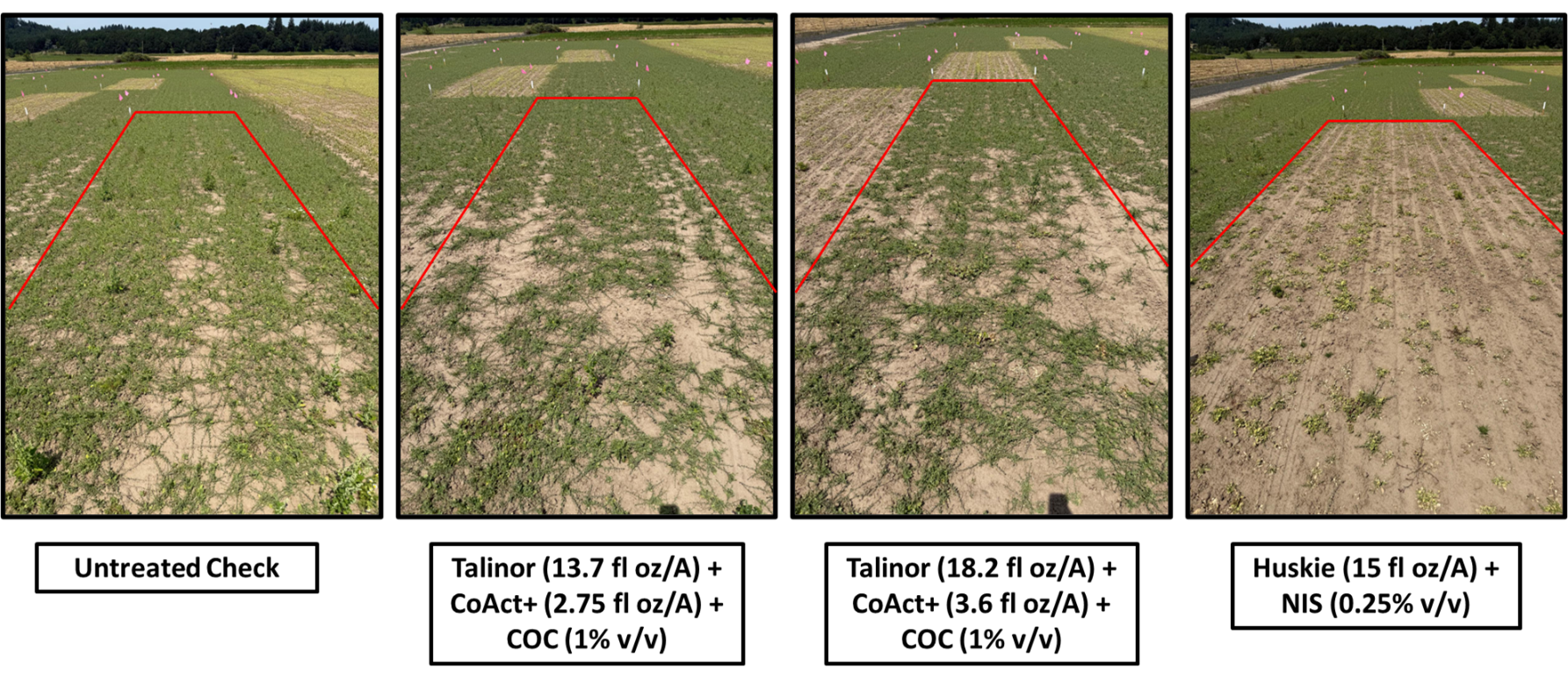
Talinor did not provide effective control of Sharppoint fluvellin at either of the rates tested (13.7 and 18.2 fl oz/A) (Figure 2). Control levels ranged from 6-16% for 13.7 fl oz/A and 6-23% for 18.2 fl oz/A between 7 and 42 days after treatment.
We observed some herbicide injury, including chlorosis and leaf necrosis at 7 and 14 days after treatment (Figures 3 and 4).
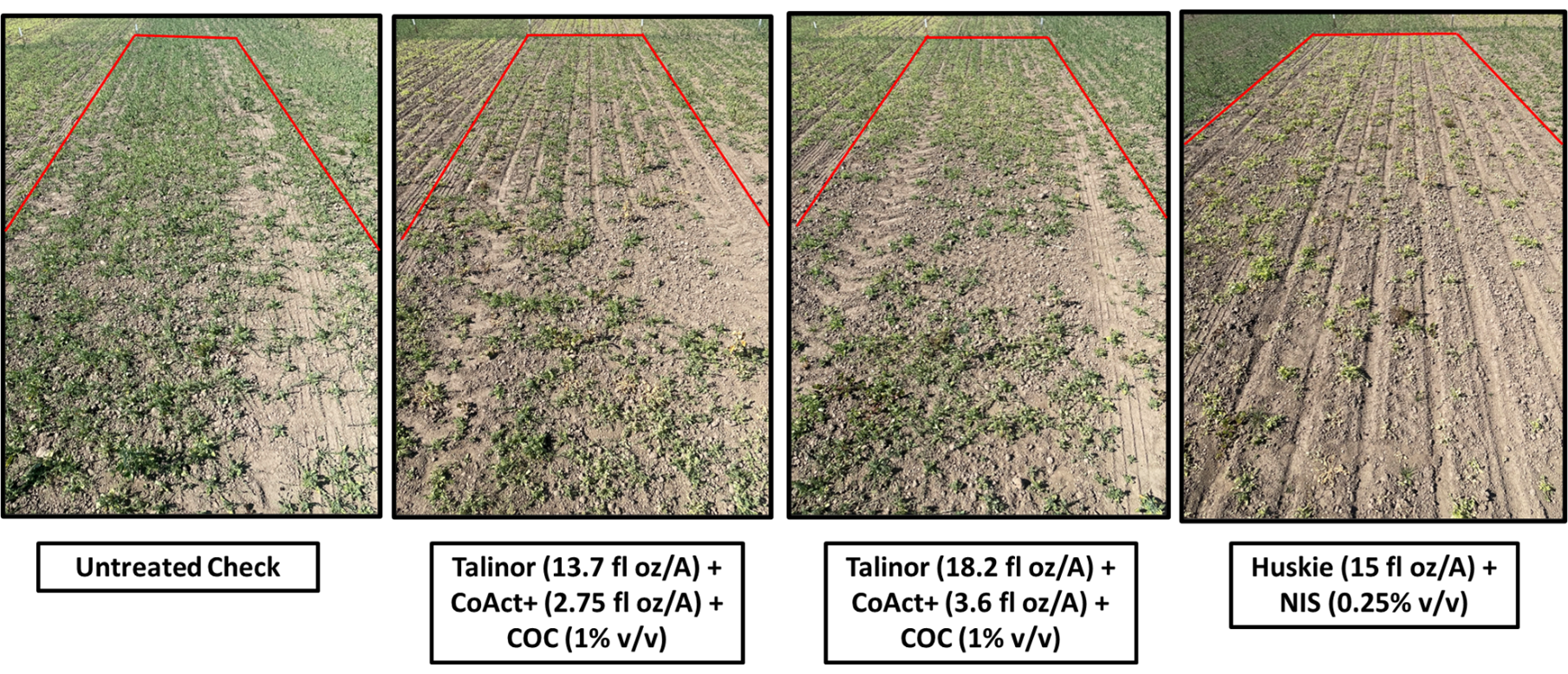
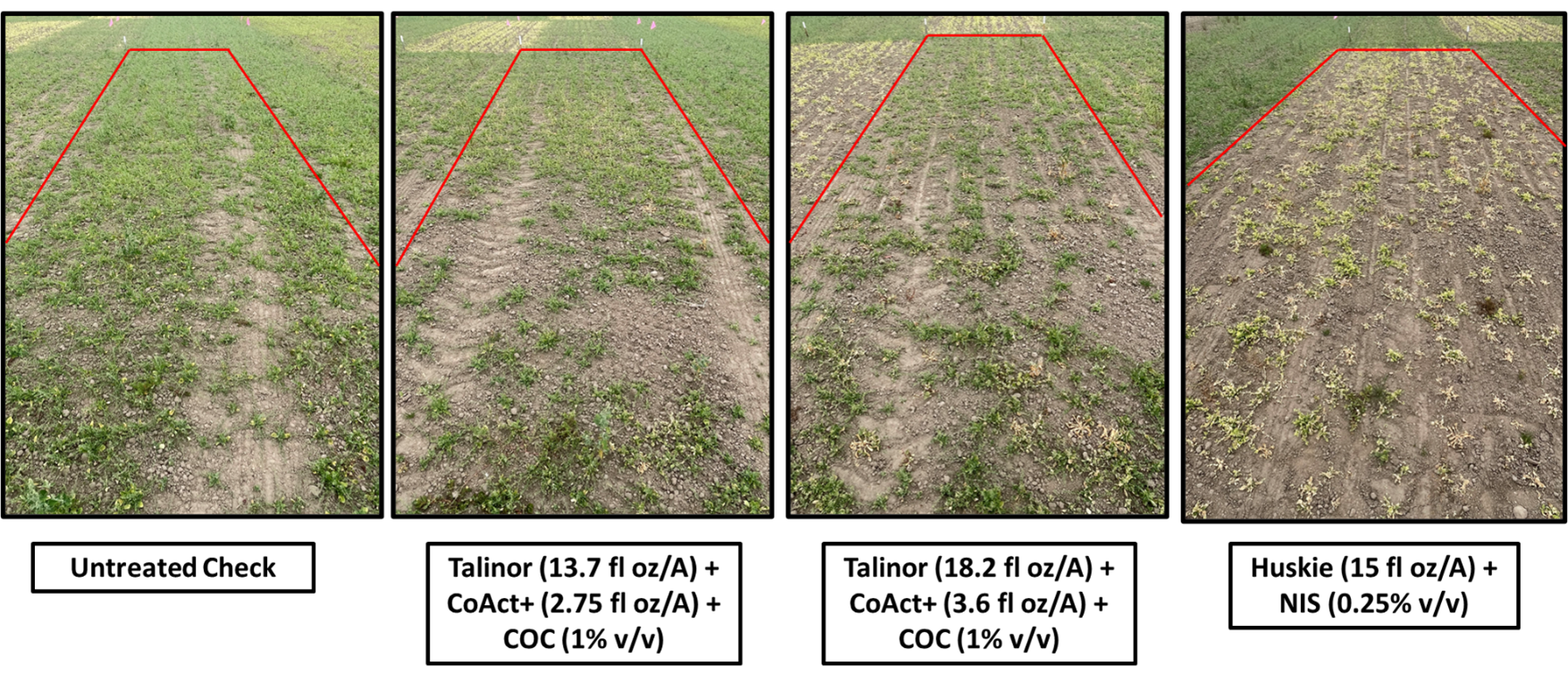
However, by 21 days after treatment, the plants recovered and resumed growth, forming dense mats similar to the untreated check (Figure 5). In contrast, Huskie applied at 15 fl oz/A with NIS (0.25% v/v) showed substantial early-season control, with control levels ranging from 68-94% between 7 and 21 days after treatment (Figures 2, 3, 4, and 5).
Interestingly, during conversations with fieldmen and other stakeholders in the region, I learned that Huskie is not commonly used to control this species because it is generally considered ineffective, with plants often regrowing after application. In our plots, we also observed some regrowth, but the main challenge was the emergence of additional flushes of seedlings. Figure 6 illustrates this issue, showing an additional flush of established plants 42 days after treatment, which reduced control to 43% (Figure 2).
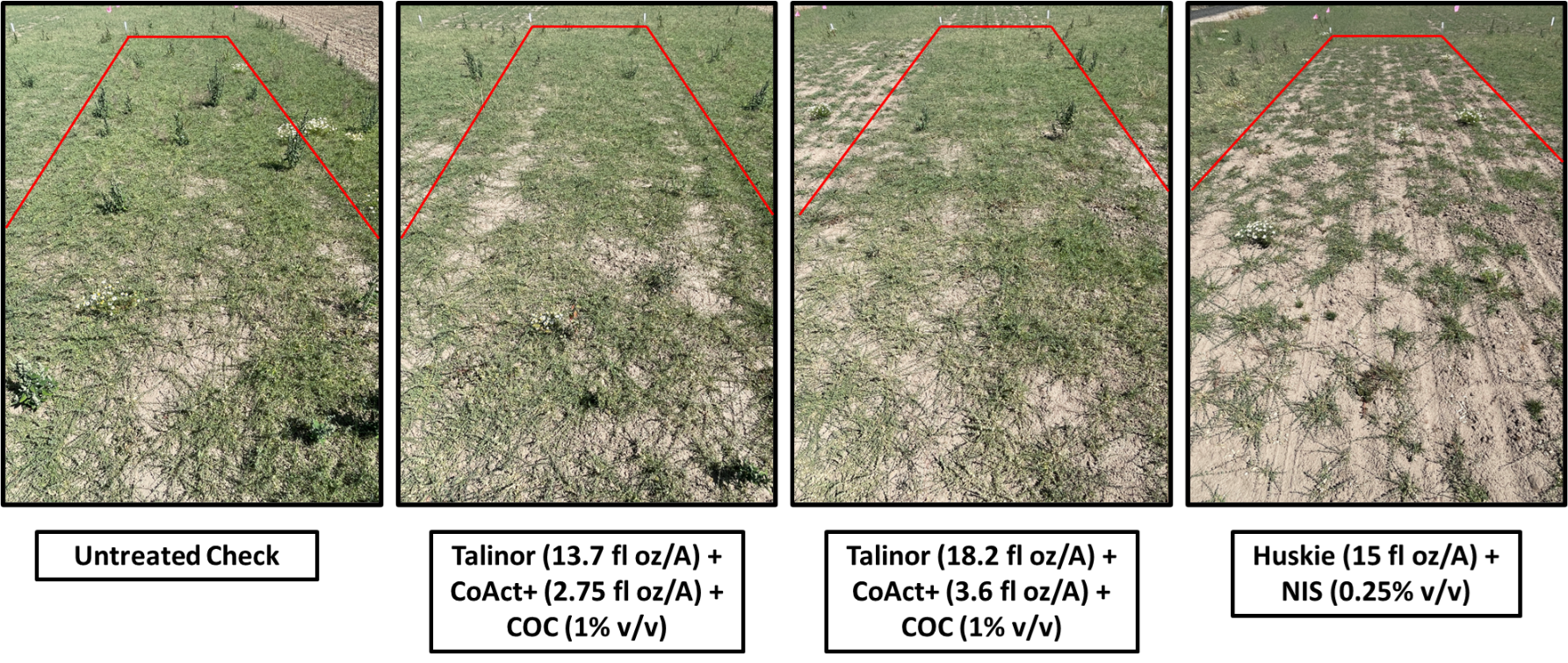
These observations suggest that while Huskie can offer some control shortly after application, additional management strategies, including follow-up treatments or herbicides with residual activity, may be necessary to achieve extended control of Sharppoint fluvellin.
Our group is currently researching the biology of Sharppoint fluvellin, focusing on its germination requirements, including temperature, light, and moisture conditions. In addition, we plan to evaluate additional herbicide treatments to identify effective options for controlling this challenging weed in grass seed crops in the Willamette Valley.