Contributed by Judit Barroso, Oregon State University
Even though you might be hearing more about the green-on-green precision sprayers these days, in my opinion, green-on-brown precision sprayers might be more useful in the region due to the number of fallow acres where these sprayers can be used. I do not know the percentage of wheat growers that already have a precision sprayer to control weeds in fallow, but I think this percentage will increase this year and the following years due to the increasing problem of herbicide resistance and the government programs [e.g. Conservation Stewardship Program (CSP) Enhancements] that can help growers with the initial investment. The use of real-time precision sprayers—where weed detection and spraying occur simultaneously—offers several advantages, the most important being the reduction in herbicide use, which consequently lowers application costs. However, this technology also has some disadvantages, such as the risk of missing some weeds and the possible need for increased spraying frequency.
To try to learn how to optimize the use of green-on-brown precision sprayers, I conducted a couple of experiments this postharvest season (August 2025) to understand the importance of different equipment settings. The study was conducted with a Weed-IT sprayer bought in 2017 (Image 1) that requires the user to indicate the margin (or buffer) that refers to the distance before and after a detected weed that the system will spray (it can be set between 8 to 12 inches) and the sensitivity that refers to the system’s ability to detect weeds. My hypothesis was that the ideal sensitivity setting to balance herbicide savings and efficacy was going to depend on the specific field conditions. In both trials, I compared broadcast application with spot spraying by running the Weed-IT sensors at low and high sensitivity. The margin was always set up with the highest value to compensate for wind and uneven terrain.
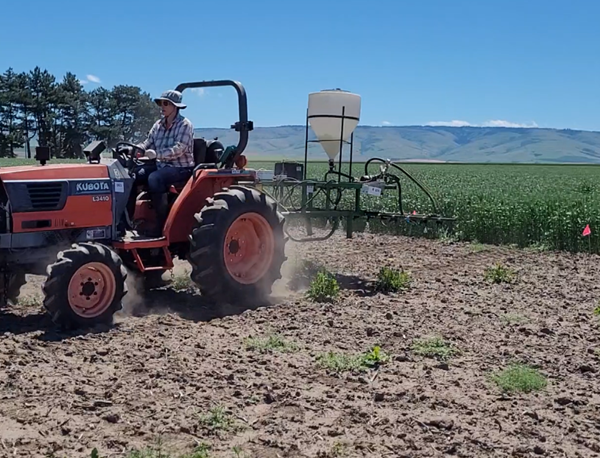
High sensitivity indicates that the sensor is able to detect smaller weeds but can be triggered by false positives (e.g. reflections) and low sensitivity indicates that the sensor will detect bigger weeds and can lead to greater herbicide savings. In a weed-free fallow field with low residue cover (20-30%) due to minimum tillage conducted earlier in the summer, the sensors were not triggered at the high or low sensitivity. However, when the weed-free field had standing up wheat stubble, the high sensitivity setting triggered the Weed-IT sensor at least 10% more times than the low sensitivity setting with some variable results depending on running the sprayer parallel or perpendicular to the stubble and also depending on the solar radiation at the time of application.
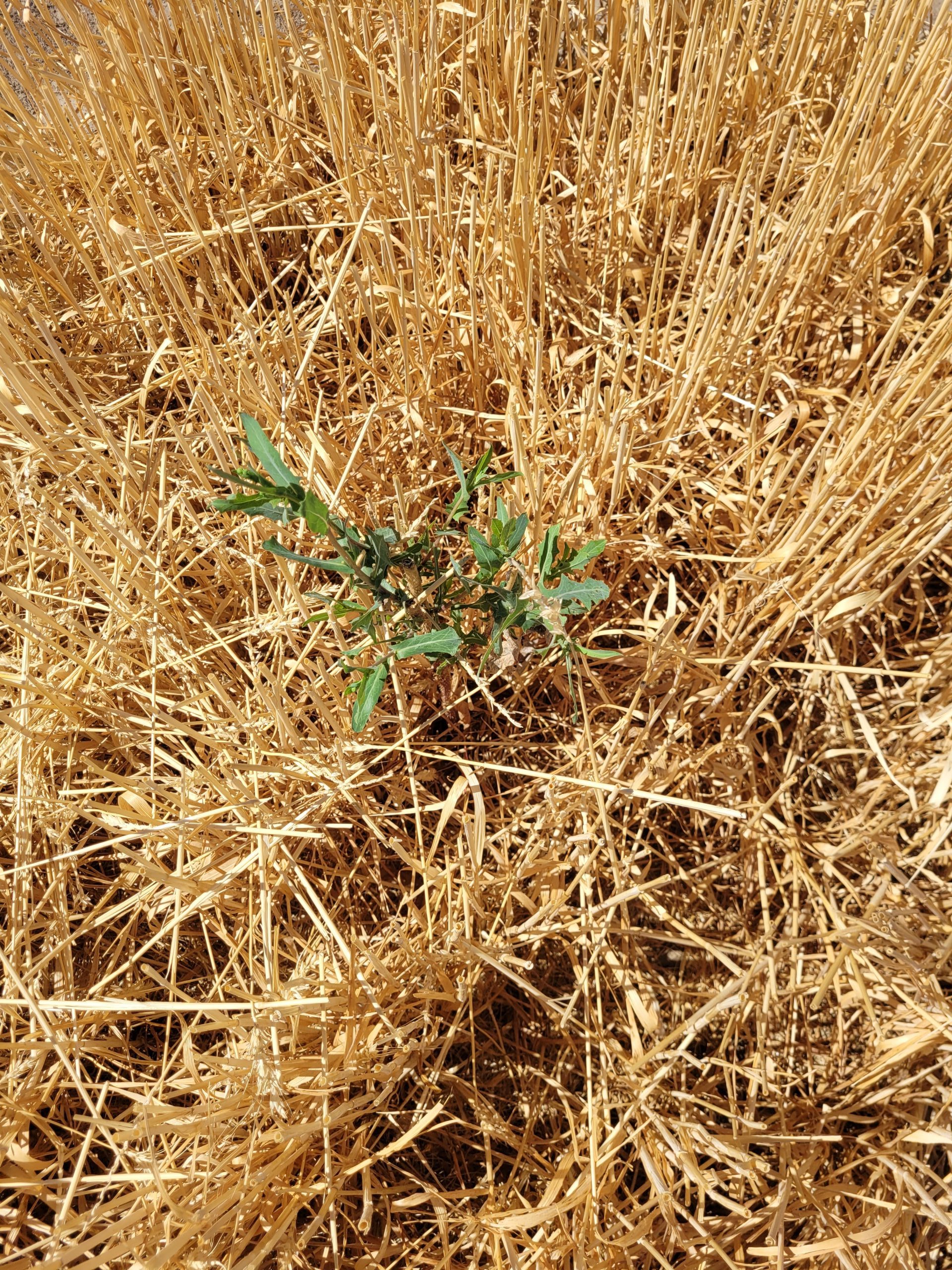
In a no-till fallow field with big weeds in general, herbicide savings were similar between the low and high sensitivity settings. Likewise, in one of the postharvest trials where weeds were generally big (Image 2 shows a relatively small weed compared to the majority in that field) both sensitivities provided weed control equivalent to the broadcast application. However, this trial had a tall, thick winter wheat stubble and the spray volume used by the precision sprayer when it was set up with high sensitivity was much higher than when it was set up with low sensitivity. So, despite getting similar weed control, the herbicide savings with high and low sensitivity compared to the broadcast application were 45% and 98% respectively.
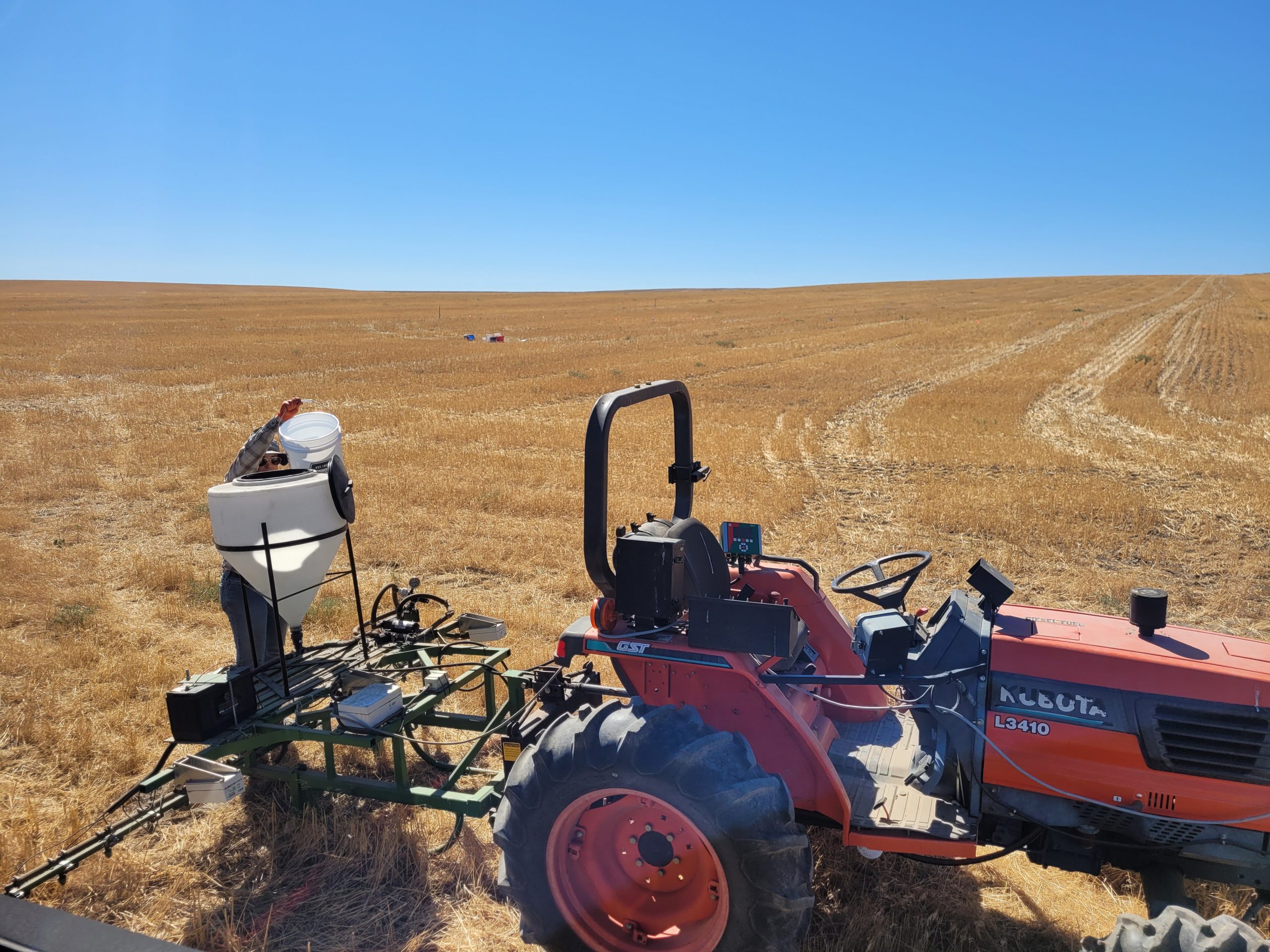
In the other postharvest trial that we conducted this year, the circumstances were different and so were the results. This second trial was established in a spring wheat stubble and it was sprayed six days after harvest (Image 3). Weeds had germinated in spring and did not have much time to regrow between harvest and the herbicide application. Consequently, many were practically a stick, particularly the prickly lettuce (Lactuca serriola) which was the most predominant weed in that trial. Under those circumstances, we found that only the high sensitivity produced results that were not significantly different from the broadcast application (50-75% control) and that the low sensitivity, even though it saved the most amount of herbicide, the control was significantly lower (25%).
Precision weed control with optical chlorophyll-detection sensors (green-on-brown), as the one described, can provide a great opportunity to manage weeds during fallow periods by saving herbicide and costs. However, as we found in this study to optimize its use (saving the most amount of herbicide without compromising weed control), attention should be given to the setup of the equipment before spraying.
It is possible that these settings that I have to manually adjust might be somehow automatically adjusted in the new generation of Weed-IT, I am not sure. Nonetheless, learning the performance of the different settings might be beneficial if you need to prioritize your balance towards the most savings possible or towards the best control possible. If any of you have experience with your own precision sprayers and are willing to share your observations, please do not hesitate to do so, it could be very helpful to others. My plan is to conduct additional trials this coming season. If you are interested in collaborating on a field trial (fallow or postharvest) to target a specific challenging weed, please contact me.
Note: Mention of trade names in this article is solely for the purpose of providing specific information and does not imply recommendation or endorsement by Oregon State University.