Contributed by Drew Lyon, Washington State University
I will be retiring from Washington State University in December, 37 years after receiving my Ph.D. in agronomy/weed science from the University of Nebraska-Lincoln. The 1980s were an exciting time to be a graduate student studying weed science. New herbicides were entering the marketplace with dizzying frequency. The ALS-inhibiting herbicides (Group 2), specifically the sulfonylureas and imidazolinones, were introduced in the 1980s. I’m sure some of you remember how transformational Glean herbicide was for weed control in wheat when it was released in the early 1980s.
The 1980s were also an exciting time for weed scientists and their graduate students because herbicide resistance was beginning to become a major topic of interest. In Nebraska and the U.S. corn belt, weeds were developing resistance to atrazine. Many of my graduate student buddies were studying the phenomenon. Atrazine at that time was a low cost, highly effective herbicide for the control of a wide range of weeds in many grass crops. It was also the herbicide that supported the early adoption of many no-till cropping systems. Of course, when an herbicide is affordable and effective, it gets used on many acres and many weeds are exposed to the selection pressure that results in the evolution of herbicide resistance. I have watched this same process repeat itself after glyphosate went generic in 2000.
To me, the 2020s look to be another exciting time for weed science. However, unlike the 1980s, herbicides are not what is making this an exciting time to be a weed scientist. The introduction of new herbicide active ingredients has slowed to a trickle, and this trend does not look like it will change anytime soon. What makes the 2020s exciting is the convergence of new technologies like drones, robotics, machine learning, and AI with weed science and production agriculture.
A case in point, I was recently serving as a local host for a group of Australian farmers and their spouses as they traveled across Washington on the tail end of their U.S. tour. One of the farmers showed me a video of his recently purchased robot pulling his spot sprayer through a fallow field. The robot was controlled by an app on his phone. When the spraying was completed, the spray tank was empty, or the robot needed fuel, it returned “home”. He seemed very pleased with his new piece of equipment. I was impressed! When I returned home, I did a browser search for more information on these robots. You can see a video here or do your own web search.
And the above example is just a marriage between new technology, robotics, and old technology, pesticide sprayers. Now think about combining two or more new technologies such as drones, robots, and lasers. Combine these technologies with machine learning and AI, and these technologies can learn what weeds you have, where they grow in each field each year and concentrate their time and effort where needed. The possibilities for research and practical solutions are seemingly endless.
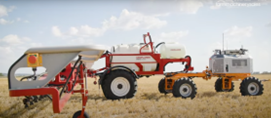

My fellow Weeders of the West (WoW) bloggers have discussed some of these new technologies in earlier posts. Doug Finkelnburg, for example, talked about this exciting time in his post on The Future of Weed Control. Aaron Becerra-Alvarez and Kristine Buckland discussed The Potential of Robotic Weed Control for Vegetable Farming in Western Oregon and Joel Felix talked about the pros and cons of using drones for applying herbicides in his post Drone Pesticide Application: the second take. Aaron Beccerra-Alvarez and Marcelo Moretti introduced the concept of using electricity to terminate a cover crop in Exploring Electric Weed Control as a Cover Crop Termination Tool for No-Till Organic Systems.
Oh, to be young again! But alas, I had my opportunity for excitement. Now it is time for a new generation of weed scientists and farmers to work together to map the path forward. My advice after nearly four decades of work is to remain open to new possibilities but realize that no single technology is likely to provide enduring benefits. Weeds have proven themselves to be highly adaptive to the practices of man, which makes the study of weed science all the more interesting.