Contributed by Aaron Becerra-Alvarez, Department of Horticulture, Oregon State University
Sweet corn (Zea mays L.) is an important vegetable crop in Oregon and Washington grown for processing and fresh market. While there are various effective herbicides available in sweet corn and different mixtures of pre-emergence herbicides can be used for effective programs, I noticed one area with poor grass control in post emergent options.
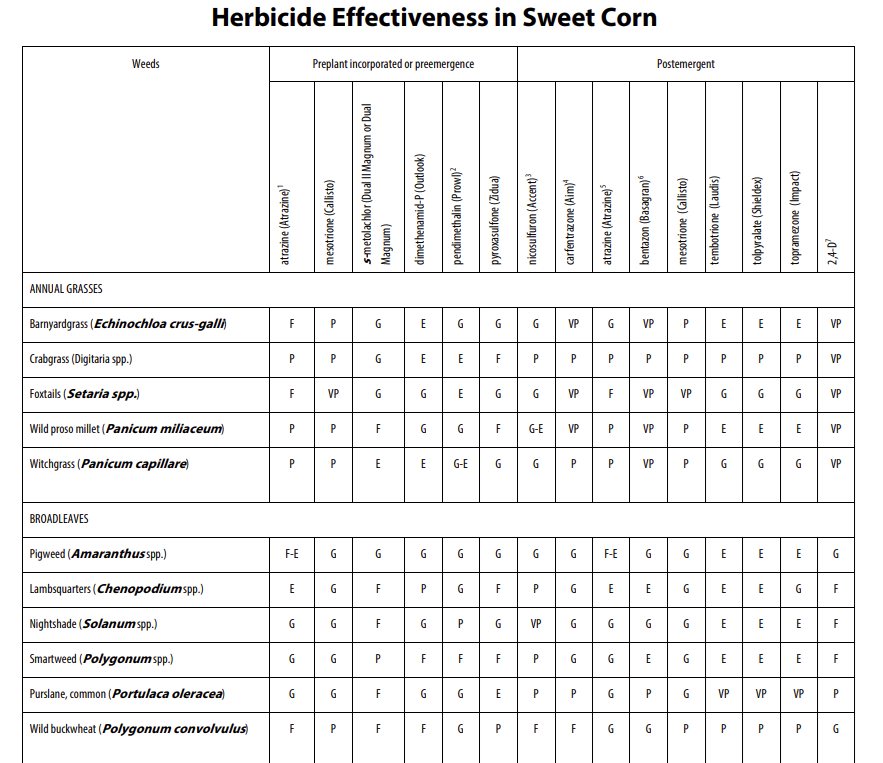
Mesotrione (Callisto) and atrazine (various trade names) can be both applied preemergence (PRE) and postemergence (POST). However, they have similar weak points in grass control, in particular crabgrass (Digitaria spp.), wild proso millet (Panicum miliaceum), and witchgrass (Panicum capillare) (Figure 1). Crabgrass is a species with poor control from all available POST options (Figure 1).
The POST HPPD-inhibitors, tembotrione, tolpyralate, and tropramezone are effective on grasses like wild proso millet and witchgrass but not crabgrass (Figure 1). These herbicides also have reduced soil persistence compared to other available options (Peachey and Donaldson, 2018). Therefore, I was interested in seeing if different adjuvants could improve the spectrum of control of these HPPD-inhibitors when applied in POST. This could give producers flexibility for fall cover crop planting or crop rotations by avoiding use of other herbicides with longer soil carryover.
I conducted a study in 2024 and 2025 at the OSU Vegetable Research Farm. The objective of this study was to evaluate weed control efficacy of tembotrione (Laudis, Bayer), topramezone (Armezon, BASF), and tolpyralate (Shieldex 400SC, ISK BioSciences) alone and in mixture with urea ammonium nitrate (UAN), methylated seed oil (MSO) and crop oil concentrate (COC) adjuvants.
Procedures: Sweet corn cultivars ‘Coronado’, ‘Placer’, ‘Natalie’ and ‘Nicole’ were planted on 30-inch rows in July 2024 and May 2025 (Table 1). The rows each had an individual variety, and plots included all the varieties. The herbicides used were Laudis at 3 fl oz/A, Armezon at 1 fl oz/A, and Shieldex 400SC at 1.35 fl oz/A. The adjuvants used were UAN 32% (Simplot), MSO (Renegade-EA, Wilbur Ellis), and COC (Navigator, Innvictus Crop Care LLC). Nonionic surfactant (NIS) (Voyager 90/10, Innvictus Crop Care LLC) was also included only with Shieldexx based on label suggestions. These adjuvant products were chosen based on label suggestion and because these products were available at the research farm. A treatment with atrazine (Atrazine 4L) at 4 pt/A with COC was applied POST for comparison. Plots were arranged in a randomized complete block design with four replications.
Table 1. Application details of POST HPPD-inhibitors on sweet corn study conducted at the Vegetable Research Farm in Corvallis, OR in 2024 and 2025.
| Date | 2024 July 30 |
2025 July 8 |
| Crop stage | V4 | V4 |
| Start/end time | 7:30/8:45 am | 10:00/11:30 am |
| Air temp | 69 F | 82 F |
| Rel humidity (%) | 69 | 39 |
| Wind direction | 2.3 mph SW | 1.2 mph N |
| Cloud cover (%) | 90 | 0 |
| Soil moisture | moist | Dry to moist |
| Plant moisture | some dew | Dry |
| Mix size | 2-L | 2-L |
| GPA | 20 | 20 |
| Nozzle type | 6-XR8002 | 6-XR8002 |
| Nozzle spacing and height | 20/20 | 20/20 |
The plots had no pre-emergence herbicide application, and the treatments were applied at V4 sweet corn stage and when crabgrass was at 2-leaf. In our fields, we were able to test efficacy on weeds we had previous suggestions of poor control including crabgrass both years, horsetail (Equisetum arvense) and bindweed (Convolvulus arvensis) in 2024 and purslane (Portulaca oleracea) in 2025. Visual weed control compared to the nontreated on a 0 to 100 scale was collected at 7 and 14 DAT. Data were analyzed with ANOVA and Tukey’s HSD α=0.05.
Results and Discussion: No differences in sweet corn variety response across treatments besides the nontreated were observed both years. Yield was not collected for both years.
In 2024, the field was largely infested with field horsetail and bindweed. Some areas did have crabgrass, pigweed, and lambsquarters. Originally, we had an additional 14 treatments applied at the V8 stage with 8-leaf crabgrass; however, minimal to no crabgrass injury was observed at this stage and is not shown here. The additional application involved timings not permitted by the product labels and were conducted for research purposes only. The timing was not repeated in 2025.
Pigweed and lambsquarters control were relatively adequate both years from all treatments with adjuvants and no clear differences were observed across adjuvants. These results won’t be discussed here as I am interested in discussing the weeds not typically controlled. The full report of this study can be found on my lab website.
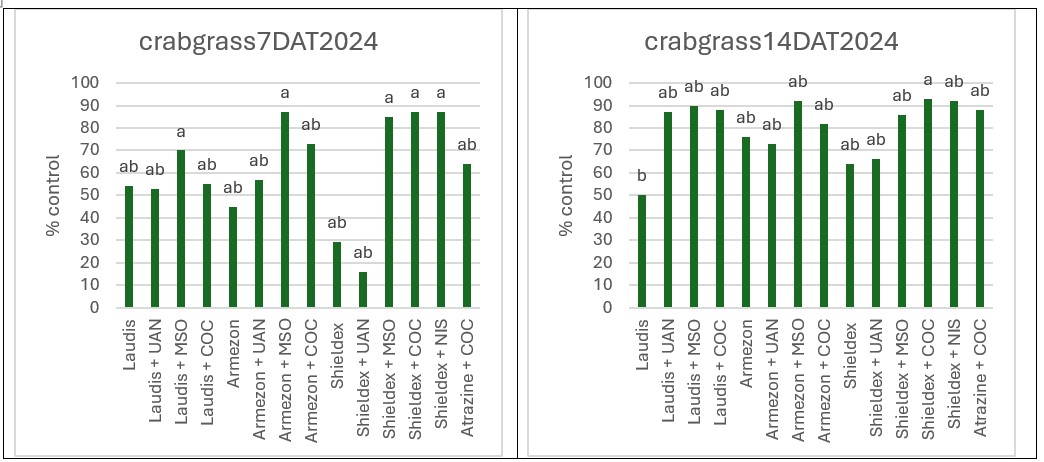
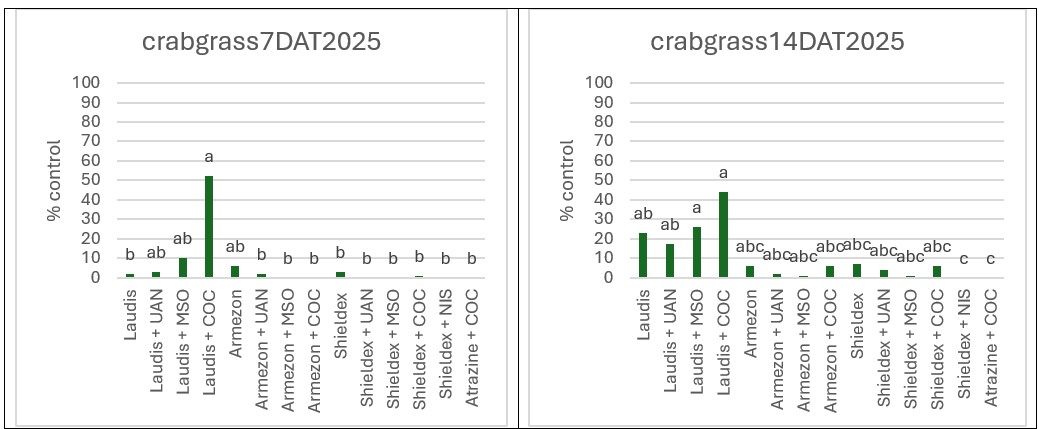
The crabgrass population was sparse in 2024, and the sweet corn established faster outcompeting various weeds. Even atrazine appeared to show improved control of crabgrass. Control was improved when an adjuvant mixture was used most noticeably with Laudis (Figure 2).
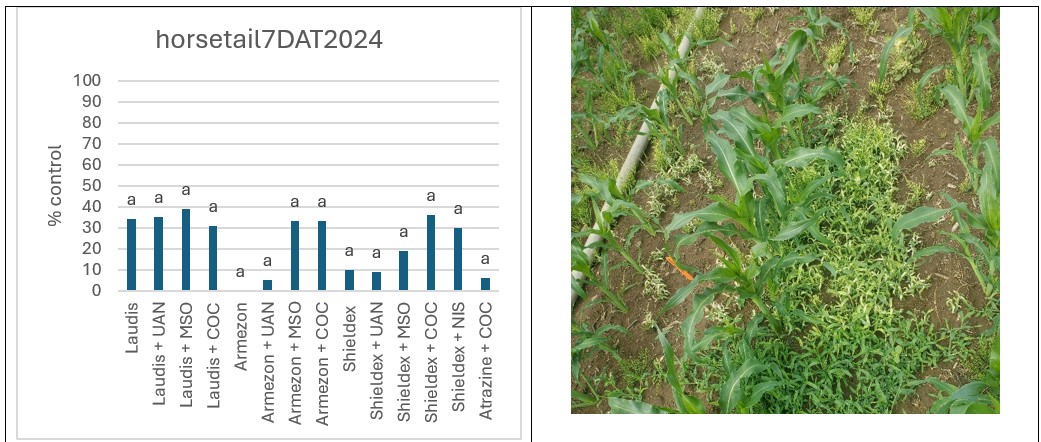
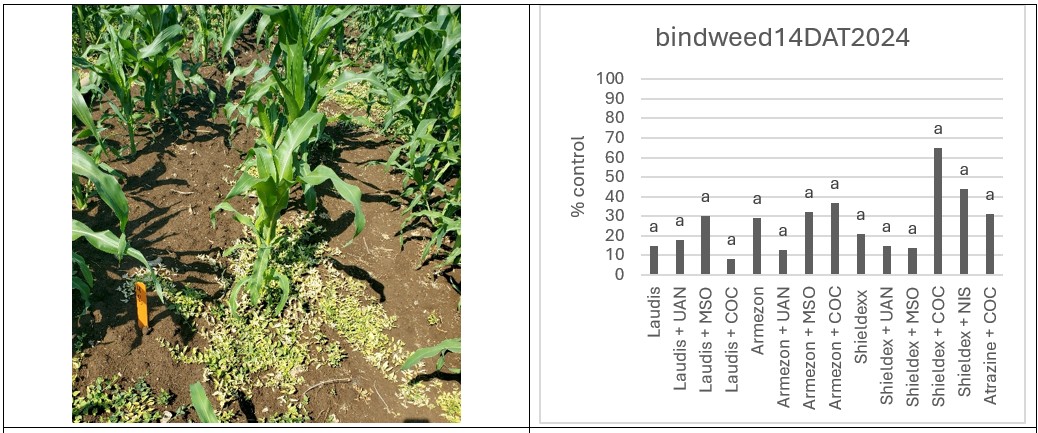
Horsetail was not controlled with any of treatments; however, at 7 DAT bleaching injury was nearly 40% with most treatments with COC and MSO mixtures except atrazine plus COC but it was not significantly different (Figure 3). By 14 DAT all treatments had below 10% control of field horsetail (Figure 3). Similarly, bindweed control was no different across treatments and ultimately recovered from injury; however, bleaching injury was observed (Figure 3).
In 2025, the study was moved to a different field on the research farm. The new field had a higher weed density of pigweed, lamsbquarters, crabgrass, and purslane in the field.
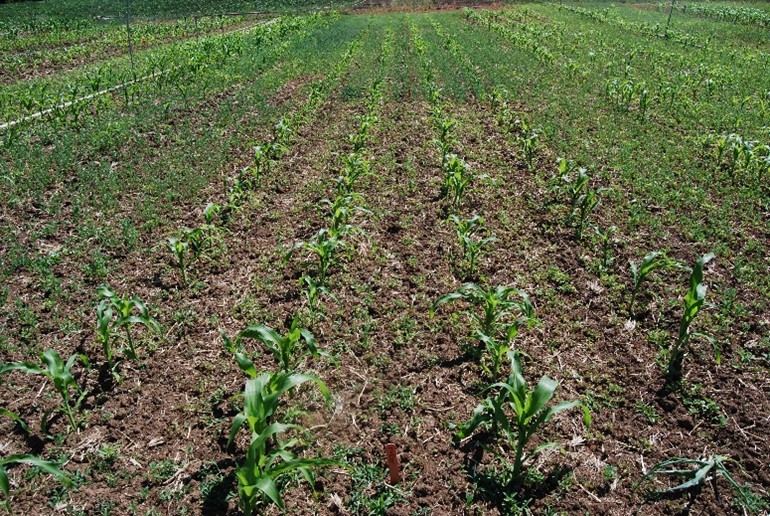
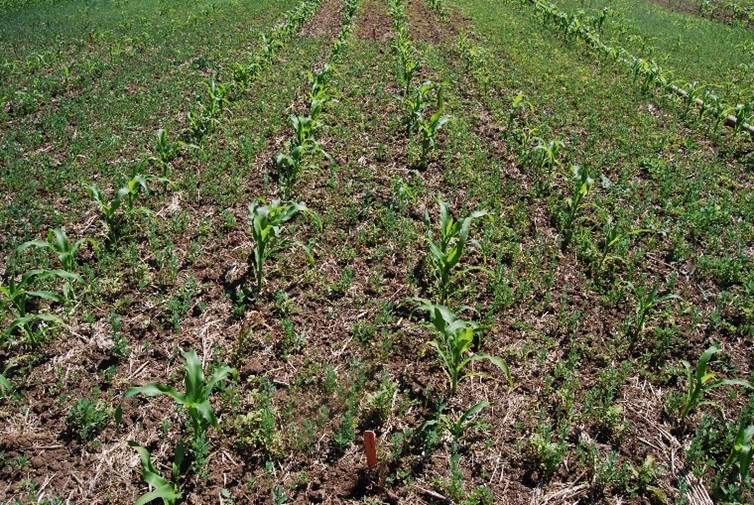
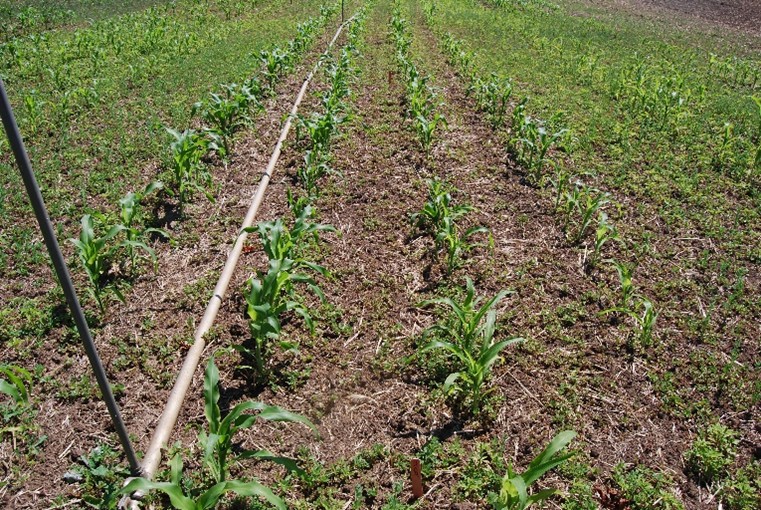
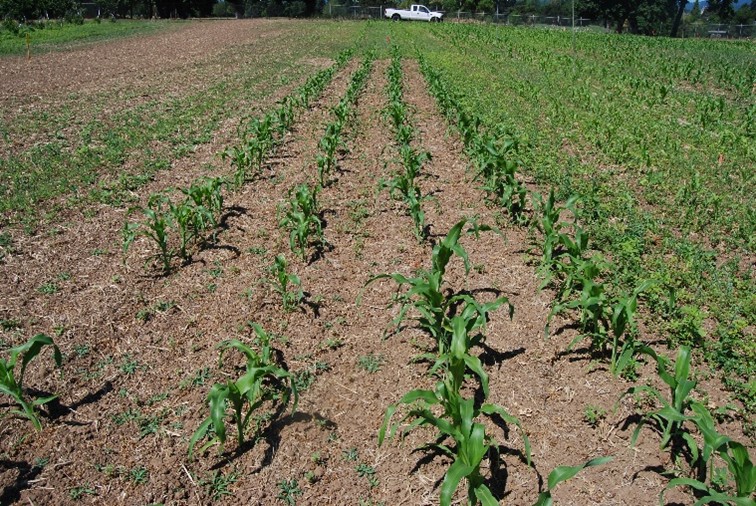
Crabgrass control in 2025 was not like 2024 and control appeared to be reduced (Figure 2). The Laudis + COC treatment was the only one that resulted in up to 50% control (Figure 2 and 4). The high weed density may have caused competition among the weeds themselves resulting in overall low control levels. The sweet corn was also stunted in this field because of the high weed pressure (Figure 4).
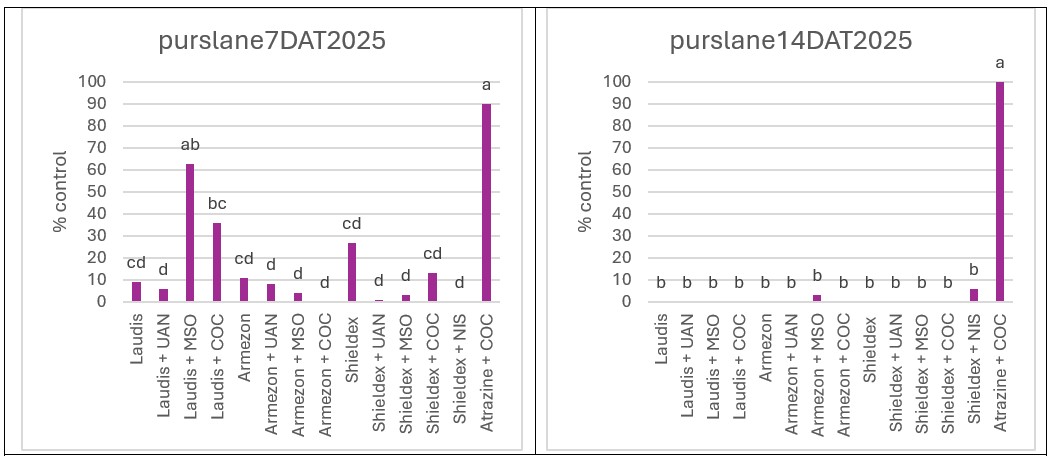
Purslane was present in the field which was another weed that previous research mentioned to be very poor control from the HPPD-inhibitors in POST (Figure 1). At 7 DAT various treatments caused significant injury; however, all plants appeared to recover by 14 DAT and only atrazine gave excellent control (Figure 5). Most noticeably, Laudis + MSO increase injury on purslane up to 60% compared to other treatments (Figure 5).
While my goal here was to see the extent of efficacy from the POST applications, an herbicide program with pre-emergence programs would be crucial to reduce the weed populations and improve overall control levels at the POST timing. The main objective here was to evaluate crabgrass control so a future research plan may be to apply Atrazine or Callisto PRE on all plots in a field we know has crabgrass populations to ensure an adequate population for the POST applications.
The weather characteristics at the application timings were relatively different and could have affected overall performance. This may be an area to explore in future research. Adjuvant research in our Pacific Northwest environment could improve efficacy of our available products in various crops.
In conclusion, the different adjuvant mixtures on Laudis, Armezon, and Shieldex did not improve the weed spectrum control; however, the adjuvants did increase injury on the different weed species which may still be useful for the sweet corn by providing an advantage to outcompete the weeds in certain scenarios.
References
Becerra-Alvarez, A. (2025). Sweet corn (Fresh, Processing, and Seed). (Becerra-Alvarez, A., Ed.) Pacific Northwest Weed Management Handbook [online]. Oregon State University Extension Communications. Accessed December 1, 2025.
Peachey, E. and Donaldson, A. (2018). Potential carryover of Shieldex (tolpyralate) and other PRE and POST herbicides on establishment of potential interseeded cover crops (PDF). Department of Horticulture, Oregon State University. Accessed December 1, 2025.