Contributed by Albert Adjesiwor and Sushmita Sharma, University of Idaho
Introduction to a weed that needs no introduction
Wild oats (Avena fatua)–they’re fast, sneaky, and persistent. If you’re a small grain grower, you probably already know this grassy weed can rob you of yield, quality, and profits. Wild oats are one of the worst grassy weeds in small grains. A single wild oat plant can produce up to 250 seeds–and these seeds can survive in the soil for up to 8 years! Even a small patch can explode into a big problem if left unchecked. Wild oats compete hard with small grains, especially if they emerge with crops. Just ten wild oat plants per square foot can reduce barley yield by 18% and wheat yield by more than 24%. Aside from crop yield reduction, they increase production costs (e.g., herbicide and application, seed cleaning, etc.), delay harvest due to slowed crop maturity, increase harvest time, produce dockage due to seed contamination (especially in malt barley), act as host to other pests, decrease grain quality, and increase transportation fees for contaminated grain. Wild oat can host cereal cyst nematode, stem nematode, rhizoctonia, crown rot, and root lesion nematode. Plus, they complicate harvest, contaminate grain, and reduce wheat quality. Herbicide resistance is also a major factor influencing the spread and impact of wild oats in small grains. In the Pacific Northwest alone, wild oat has developed resistance to at least four herbicide modes of action, including ACCase inhibitors (group 1), ALS inhibitors (group 2), microtubule inhibitors (group 3), and inhibitors of very-long-chain fatty acid synthesis (group 15). Populations with resistance to more than one herbicide mode of action have also been reported.
Resistance screening updates
There was considerable variability in wild oat response to the 1X rate of the herbicides we tested. Wild oat survival to ethalfluralin and fenoxaprop was 68 and 52%, respectively (Table 1). Survival declined with quizalofop (28%), pinoxaden (26%), and triallate (22%), showing these herbicides may still provide better control of wild oat, but with a significant proportion of wild oat uncontrolled. Very low survival rates were observed with mesosulfuron (8%), glyphosate, and clethodim (4%), demonstrating that these herbicides provided the highest levels of wild oat control among the herbicides evaluated. Overall, the levels of wild oat survival to the herbicides tested were concerning, and continued monitoring would be essential to track changes in resistance levels.
Table 1. Summary of wild oat survey and resistance screening results
Farms surveyed: 130
| Selected herbicide | Wild oat survival to 1X rate of selected herbicide |
| ethalfluralin | 68% |
| fenoxaprop | 52% |
| quizalofop | 28% |
| pinoxaden | 26% |
| triallate | 22% |
| mesosulfuron | 8% |
| glyphosate | 6% |
| clethodim | 4% |
Wild oat and preemergence herbicides
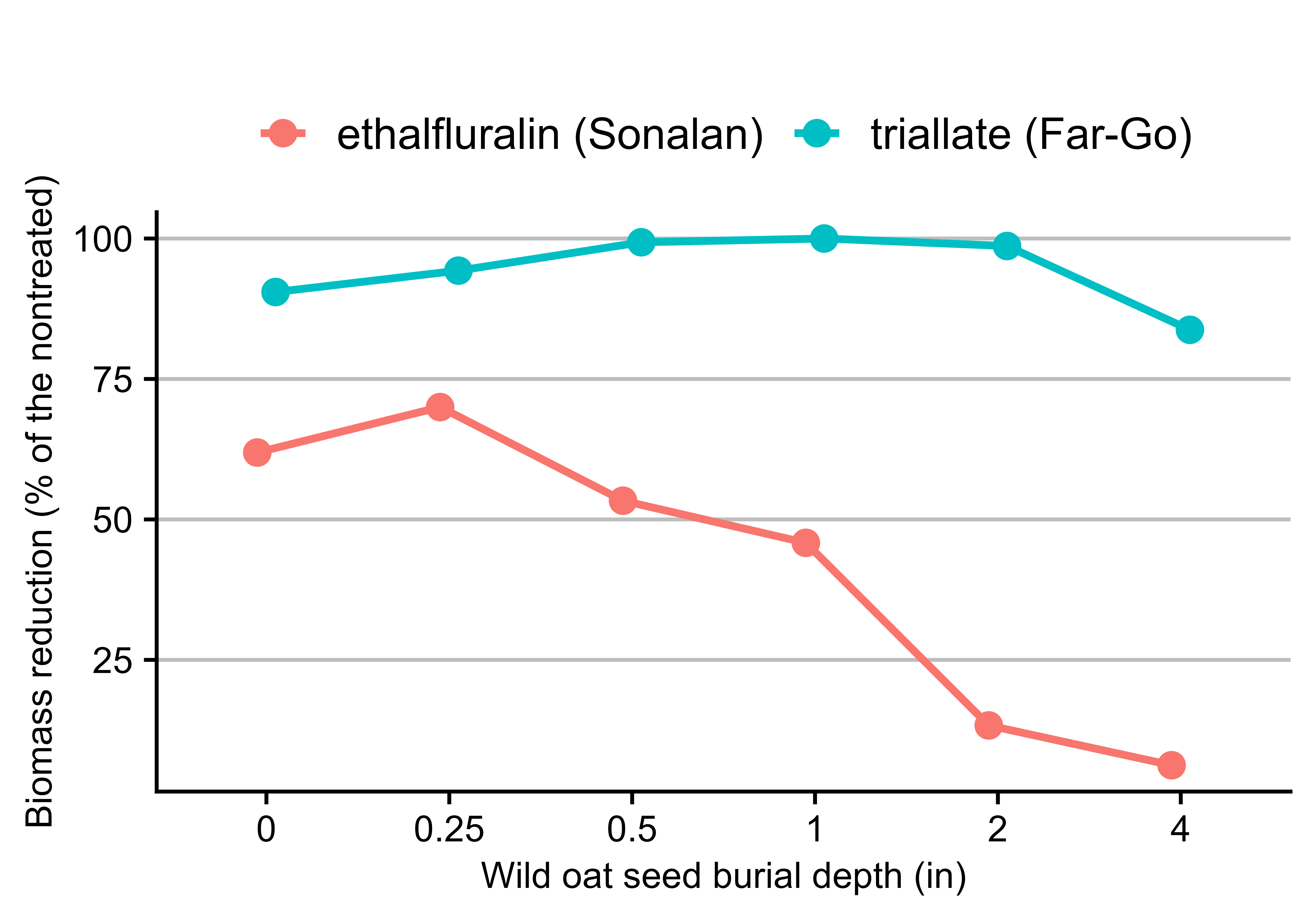
If you are surprised by the level of wild oat survival to ethalfluralin and triallate (Table 1), you are not alone. Growers have long suspected that wild oat seed placement depth (and by extension tillage) may have something to do with the efficacy of soil-applied herbicides. With this in mind, we wanted to test what role seed burial depth plays in wild oat response to herbicides such as ethalfluralin and triallate? To our surprise, ethalfluralin efficacy was very variable with wild oat seed burial depth (Figure 1). Although the seeds we used for the experiment were susceptible to ethalfluralin, the best control of wild oat was achieved when the seeds were 0.25 inches below the soil surface. Beyond 0.25 inches, ethalfluralin efficacy declined significantly. Although triallate was more effective, wild oat seeds on the soil surface, 0.25 or 4 inches deep, were not as effectively controlled (Figure 1). What this means is that in both tilled and no-till systems, it will be very difficult to rely solely on preemergence herbicides for wild oat control.
There are still a number of herbicide options, but beware of resistance
Several herbicides are labeled for selective control or suppression of wild oat in small grains. However, wild oat with resistance to some of these herbicides is now commonly found in the PNW. Some of these options and what to be aware of are summarized in Table 2.
| Herbicide Group | Examples | Notes |
| Group 1 (ACCase) | pinoxaden (Axial XL, Axial Bold); clodinafop (Discover NG) | Good post-emergence control: resistance is common in Idaho. |
| Group 1 (ACCase) | quizalofop (Aggressor) | CoAXium varieties only; Resistance has been confirmed in Idaho, but not widespread. |
| Group 2 (ALS) | sulfosulfuron (OutRider), mesosulfuron-methyl (Osprey, Osprey Xtra), propoxycarbazone (Olympus), flucarbazone (Everest 3.0 AG), and pyroxsulam (PowerFlex HL, GoldSky). | Effective if applied correctly, resistance is common in Idaho. |
| Group 2 (ALS) | imazamox (Beyond) | Clearfield varieties only; Good control if properly applied.
Resistance has been confirmed in Idaho, but it is not widespread. |
| Group 15 (VLCFA) | triallate (Far-GO, Avadex) | Good pre-emergence control; must be mechanically incorporated. Resistance has been confirmed in Idaho, but it is not widespread. |
| Group 15 (VLCFA) | pyroxasulfone (Zidua, Anthem Flex) | Suppression of wild oat if applied preemergence. |