Contributed by Marcelo Moretti, Oregon State University; Joshua Miranda, Michigan State University; Todd Gaines, Colorado State University
Why annual bluegrass?
Poa annua is no ordinary weed. It is:
- Cosmopolitan – found worldwide, from golf greens to hazelnut orchards.
- Flexible – grows as an annual or short-lived perennial, depending on conditions.
- Prolific – produces abundant seeds with little dormancy, ensuring constant emergence.
- Genetically diverse – capable of adapting quickly to repeated management practices.
These traits make it the “perfect storm” species for herbicide resistance evolution.
The findings
Our research team collected P. annua plants from Oregon hazelnut orchards where growers reported failures of indaziflam. In greenhouse and field experiments, we confirmed:
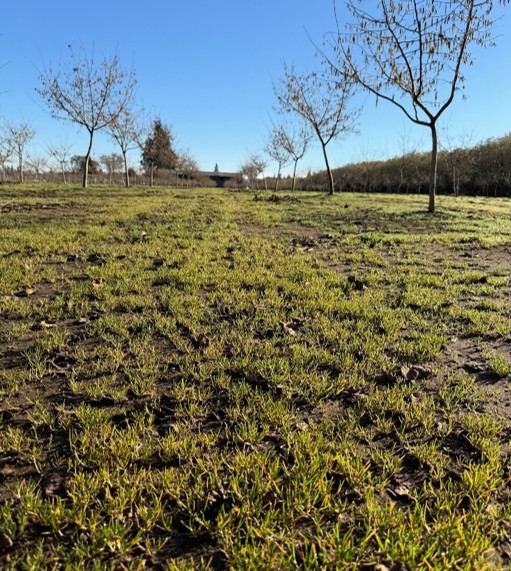
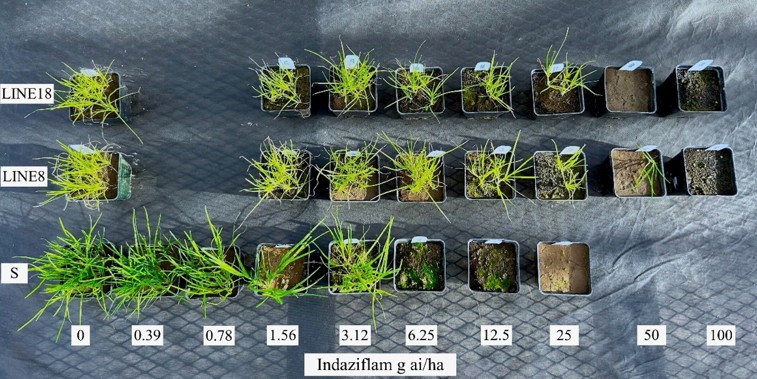
- Resistance at multiple timings: Plants survived indaziflam applied both preemergence (before weeds emerge) and early-postemergence (to young seedlings). Some populations withstood up to four times the labeled rate.
- Lower temperature makes it worse: At cooler temperatures (common in Oregon winters), indaziflam efficacy dropped sharply and resistant plants were unharmed.
- Likely not metabolism-based: Enzyme inhibitors that usually reverse metabolic resistance did not restore sensitivity, pointing to a novel mechanism.
- Multiple resistance is common: Several populations also showed reduced response to other herbicides, shrinking the list of effective chemical options.
Why it matters for growers
Indaziflam has been widely used in perennial systems because of its long soil residual activity, sometimes providing season-long weed control. But this same feature creates strong selection pressure: every year, seedlings that survive continue to set seed, gradually shifting populations toward resistance.
For growers, the consequences are clear:
- Overreliance on indaziflam will accelerate resistance spread.
- Once established, resistant Poa annua can dominate orchard floors.
- Chemical options are narrowing, especially with new regulatory restrictions.
What can be done
Resistance doesn’t mean defeat, but instead it means adaptation. Our findings reinforce several key strategies:
- Rotate herbicide modes of action: Avoid repeated use of indaziflam or any single product.
- Tank-mix or sequence residuals: Zidua, Chateau, Brake-On!, and others may be used in strategic combinations.
- Scout and test early: Catch resistance before it spreads. Resistant patches often start small.
- Avoid winter-only reliance: Since cold temperatures worsen resistance expression, consider adjusting timing to periods of higher herbicide efficacy.
This is not just about one herbicide or one weed. The Poa annua–indaziflam case illustrates how long-lived, soil-active herbicides can select for resistance faster than expected. It also highlights the role of environmental factors (like temperature) in shaping how resistance is expressed in the field.
Ultimately, sustainable weed management will require integrated strategies, not silver bullets. By combining herbicides with cultural and mechanical practices growers can slow resistance and preserve the tools we still have.
Our research shows that herbicide-resistance is associated with the adaptability of weeds. But there is also a silver lining: early detection of resistance gives us the opportunity to act proactively. By diversifying our strategies now, we can protect the effectiveness of indaziflam and other herbicides for years to come.