Contributed by Doug Finkelnburg, University of Idaho
Recent survey results from the Pacific Northwest Herbicide Resistance Initiative (PNWHRI) highlight how much weed pressure and complexity have grown over the past decade from the perspective of producers. In winter 2024–2025, PNWHRI researchers launched an anonymous survey to learn how weed control challenges have shifted for producers in Idaho, Oregon, and Washington. The survey was distributed at grower meetings, through Extension and industry newsletters, and conservation district communications. Eighty-one responses from 29 counties provided a window into farm realities across a diverse range of crops—wheat, pulses, oilseeds, forages, potatoes, sugar beets—and rainfall zones spanning 7 to 40 inches annually. Most respondents farmed without irrigation, and the majority operated at a commercial scale, with nearly 60% managing more than 1,000 acres.
A Growing List of Weeds
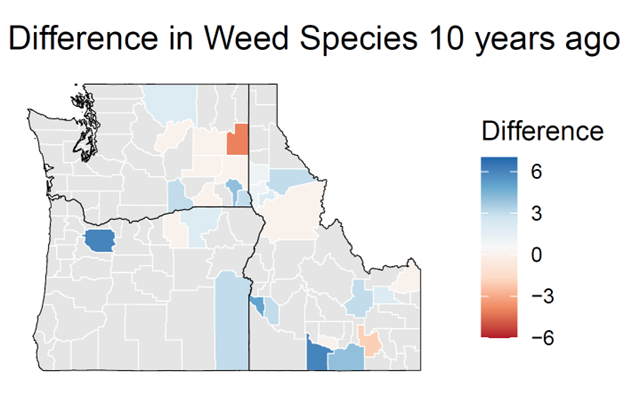
More than half of producers (58%) reported an increase in the number of problem weed species compared to 10 years ago. Only 13% saw fewer problem weed species, while the remainder noted no change. The survey defined “problem weeds” as those that directly reduce yields, cause dockage, or interfere with farm activities such as harvest or haying.
The increase wasn’t just from new weeds. Many reported existing weeds becoming more prevalent (42%) or a combination of new and existing species (41%). Proximity to unmanaged areas such as roadsides, ditches, and neighboring fields was the most common reason cited for problem weed issues, followed closely by herbicide resistance.
Weed Budgets Keep Climbing
Nearly 9 out of 10 farmers reported higher weed management costs than a decade ago. Rising herbicide prices topped the list of reasons, but many also cited the need for more applications, higher use rates, or switching to more expensive products. In many cases, farmers are layering multiple strategies simply to maintain control.
Herbicide Resistance Ranks High Among Challenges
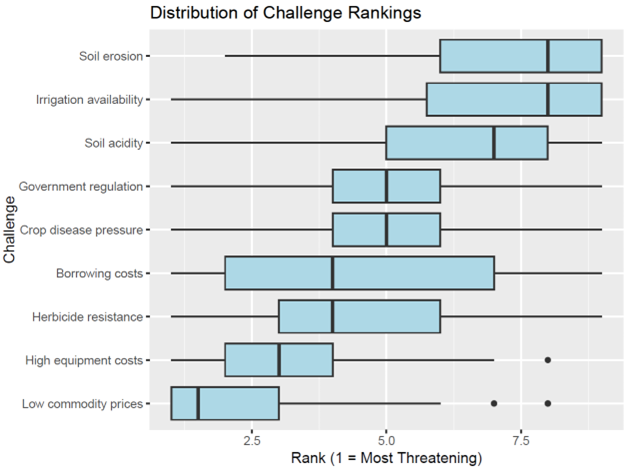
When asked to rank threats to their operations, farmers placed herbicide resistance third overall—behind only low commodity prices and high equipment costs. Resistance was viewed as more concerning than crop disease, government regulation, or limited irrigation access.
For many, herbicide resistance has already changed day-to-day management. Farmers reported turning to:
- More tillage and other mechanical weed control
- Crop rotations that open up new timings and tools
- Multiple herbicide modes of action in a single year
- Increased reliance on herbicide-resistant crops
Yet barriers remain. Limited herbicide options, lack of effective non-chemical tools, and poor weed management by neighbors all complicate resistance management. Some farmers also pointed to gaps in knowledge and understanding of resistance as challenges to long-term success.
Takeaway
The PNWHRI survey indicates that weed management is becoming more difficult, more expensive, and more central to the sustainability of farming in the Pacific Northwest. Farmers are adapting with creativity and persistence—but they face rising costs and shrinking options. These early results underscore the importance of new research, better coordination, and practical tools to help growers stay ahead in the fight against weeds.