Contributed by Victor Ribeiro, Oregon State University
Herbicide resistance in weeds is a biological phenomenon in which plants evolve the ability to survive herbicide applications that were previously effective on the original, susceptible population. Herbicides are classified into groups based on their mode of action, and from an applied perspective, resistance can manifest as single, cross, or multiple resistance. Single resistance occurs when a plant is resistant to one herbicide. Cross-resistance refers to resistance to more than one herbicide from the same group but from different chemical families (e.g., resistance to imidazolinone [Beyond] and sulfonylurea [Osprey] herbicides, both in Group 2). Multiple resistance occurs when a plant is resistant to herbicides from more than one group (e.g., resistance to SelectMAX [Group 1] and Beyond [Group 2]).
Italian ryegrass (Lolium multiflorum Lam.) is a challenging weed to manage in seed production systems of the Willamette Valley, Oregon. The evolution of herbicide resistance in this species has further complicated its control. To date, resistance in Italian ryegrass in Oregon has been reported to at least seven herbicide modes of action: Group 1 (ACCase inhibitors), Group 2 (ALS inhibitors), Group 5 (PSII inhibitor), Group 9 (EPSPS inhibitor), Group 10 (GS inhibitor), Group 15 (VLCFA inhibitor), and Group 22 (PSI inhibitor). Traits such as obligate outcrossing and wind pollination make Italian ryegrass highly conducive to the evolution and spread of herbicide resistance.
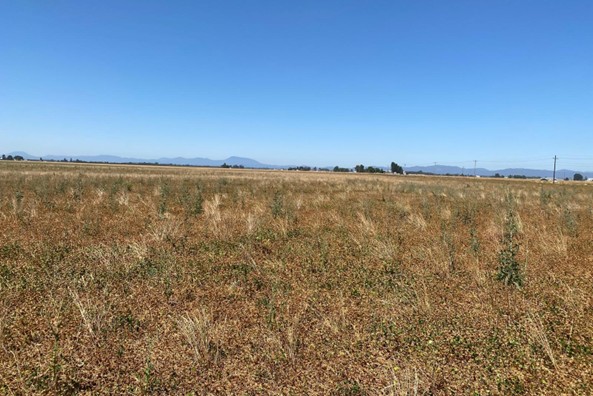
In the summer of 2024, we collected spikes from 20 individual Italian ryegrass plants (population OR13) in a white clover (Trifolium repens L.) field in the Willamette Valley, Oregon, where two applications of SelectMAX (clethodim) at 16 fl oz/A had failed to provide control (Figure 1). The field had been previously cropped with winter wheat (Triticum aestivum L.), where Group 2 herbicides had been used.
To determine whether OR13 was herbicide-resistant, we screened this population for resistance to SelectMAX and other herbicide modes of action commonly used in rotational crops in the region. A known herbicide-susceptible population (Gulf) was included in the resistance screenings for comparison.
Herbicide screenings experiments were conducted in a greenhouse at Oregon State University, Corvallis, OR. Ten representative herbicides, including eight postemergent and two preemergent, from five modes of action (Groups 1, 2, 3, 9, and 15) were tested based on their relevance to seed production cropping systems in western Oregon (Table 1). Each herbicide was applied at 0, 1, and 2 times (×) the labeled field rate. These products are not registered for greenhouse use, and most were applied at rates higher than those allowed for the representative crops listed in Table 1. All applications were conducted under controlled experimental conditions and are not intended as application recommendations. Always follow pesticide label directions for legal and appropriate use. Application rates for SelectMAX and Kerb SC were based on the recommended rates for white clover, while the rates for Assure II, Axial XL, Beyond, Osprey, PowerFlex HL, Zidua, and glyphosate were based on labeled rates for representative rotational crops grown in the region.
Table 1. Herbicides, active ingredients, timings, modes of action (MOA), and rates used in the screenings.
| Herbicide | Trade name | Timing | MOA (Group)a | Chemical family | 1× Rate (oz/A)b | 2× Rate (oz/A)b |
| Clethodimc,e | SelectMAX | POST | ACCase (1) | cyclohexanedione | 16 | 32 |
| Quizalofopc | Assure II | POST | ACCase (1) | aryloxyphenoxy- propionate | 12 | 24 |
| Pinoxaden | Axial XL | POST | ACCase (1) | phenylpyrazoline | 16.4 | 32.8 |
| Imazamoxd,f | Beyond | POST | ALS (2) | imidazolinone | 4 | 8 |
| Mesosulfurond | Osprey | POST | ALS (2) | sulfonylurea | 4.75 | 9.5 |
| Pyroxsulamd | PowerFlex HL | POST | ALS (2) | triazolopyrimidine | 2 | 4 |
| Glyphosated,g | Rodeo | POST | EPSPS (9) | organophosphorus | 48 | 96 |
| Pronamide | Kerb SC | PRE | MTI (3) | benzamide | 40 | 80 |
| Pyroxasulfone | Zidua SC | PRE | VLCFA (15) | isoxazoline | 3.25 | 6.5 |
| aACCase, acetyl-coenzyme A carboxylase; ALS, acetolactate synthase; EPSPS; 5-enolpyruvylshikimate-3-phosphate; MTI, microtubule inhibitor; VLCFA, very-long-chain fatty acid. Assure II label rate was based on recommendation for peas (Pisum sativum). Axial XL, Beyond, Osprey, PowerFlex HL, and Zidua label rates were based on the recommendation for wheat (Triticum aestivum). Glyphosate label rate was based on recommendation for controlling most existing vegetation prior to renovating turfgrass areas or establishing turfgrass grown for seed or sod.
bRates: 1×, label rate; 2×, two times the label rate. cCrop oil concentrate (1% v/v) was added to the spray solution. dNonionic surfactant (0.25% v/v) + ammonium sulfate (2.5% v/v) was added to the spray solution. eSelectMAX is labeled for use with nonionic surfactant at 0.25% v/v and 2.5 to 4 lb/A of ammonium sulfate for clover. fBeyond is only labeled for Clearfield and Clearfield Plus wheat. |
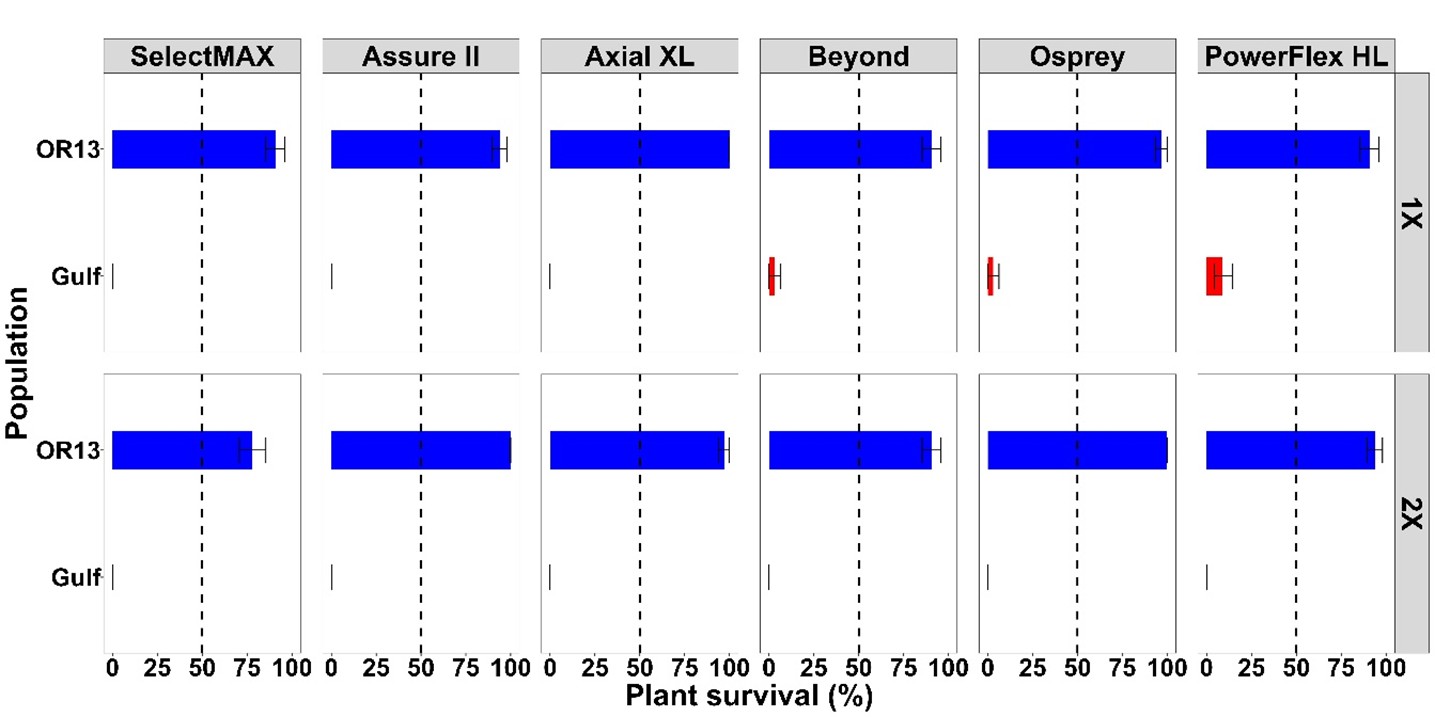
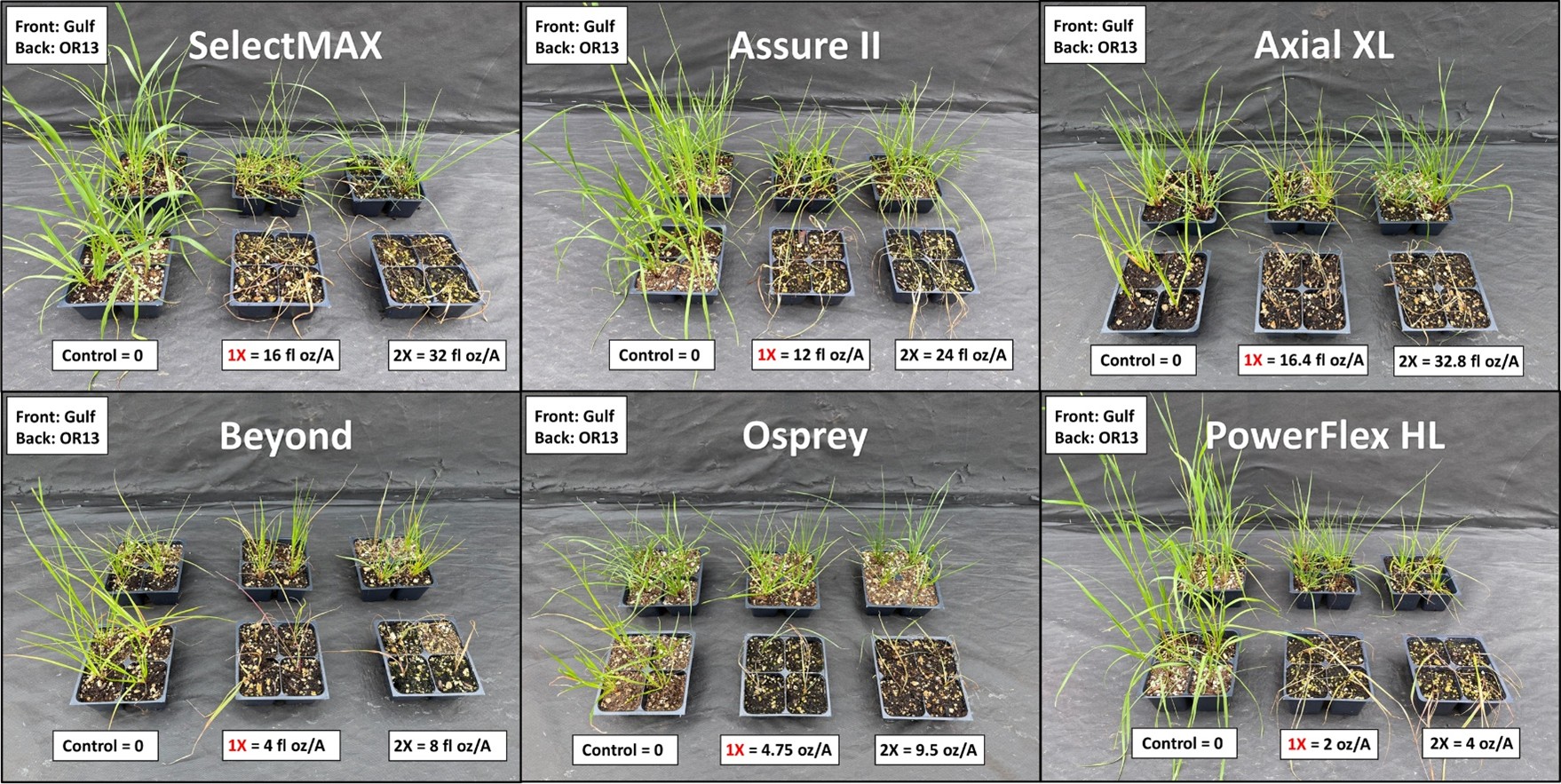
Herbicide screenings confirmed that population OR13 was resistant to the Group 1 herbicides SelectMAX, Assure II, and Axial XL, as well as the Group 2 herbicides Beyond, Osprey, and PowerFlex HL (Figure 2). Survival data showed that OR13 exhibited at least 91% survival following treatment with the 1× rate of these herbicides. At the 2× rate, survival declined slightly to a minimum of 78% but remained above 50% across all treatments. These results illustrate a clear case of cross-resistance within Groups 1 and 2, and multiple resistance across both herbicide groups (Figure 3).
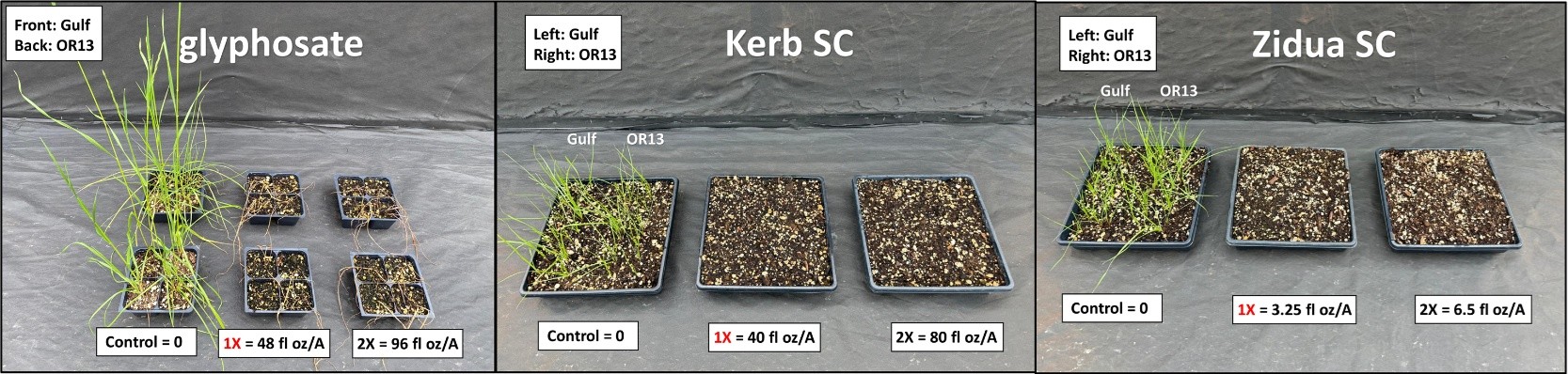
Conversely, population OR13 was susceptible to glyphosate and the preemergence herbicides Kerb SC and Zidua SC, with 0% survival at both the 1× and 2× rates (Figure 4).
Resistance to SelectMAX limits the use of one of the few effective options for selective Italian ryegrass control in white clover. Furthermore, the occurrence of cross- and multiple-resistance to Group 1 and Group 2 herbicides complicates the management of this species in key rotational crops grown in the region. On a positive note, Kerb SC remains a viable option for selective preemergence control of Italian ryegrass control in white clover. Zidua SC is also an effective tool for managing Italian ryegrass in rotational crops such as winter wheat and grass seed crops. Similarly, glyphosate continues to play an important role in site preparation and renovation areas within seed production systems. However, resistance to glyphosate in Italian ryegrass population has been increasing, underscoring the need for careful stewardship.
Effective herbicide resistance management relies on a foundation of diverse control strategies. Rotating herbicide modes of action and using tank mixes with multiple effective sites of action can help delay the evolution of resistance. Equally important are non-chemical practices such as crop rotation, cultivation, cover cropping, and mowing, which reduce weed pressure and disrupt the weed life cycle. Consistent scouting is essential for detecting early escapes before they contribute to the seedbank.