Contributed by Judit Barroso, Oregon State University Columbia Basin Agricultural Research Center
As you may know, downy brome (Bromus tectorum L.), also known as cheatgrass, is a difficult weed species to control in the dryland wheat production region of the inland Pacific Northwest. It is highly competitive and if left uncontrolled can cause winter wheat yield losses of up to 92%. The management of this species has become more challenging in recent years due to the widespread herbicide-resistant populations in the region.
To help with downy brome management, in 2022, we initiated an experiment to study how cultural practices at seeding time might alleviate the problem. The particular objectives of this research were to determine the effect of the seeder type, winter wheat density [regular (90 lbs/ac) vs. high (135 lbs/ac)], winter wheat variety [upright (Bobtail) vs. more prostrate plant architecture (Dagger)], and crop (winter wheat vs. winter peas) on downy brome infestation. We also included soil disturbance caused by the seeders without planting seed (hereafter referred to as false seeding).
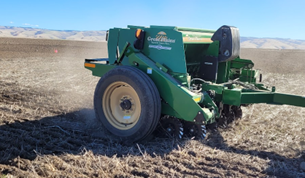
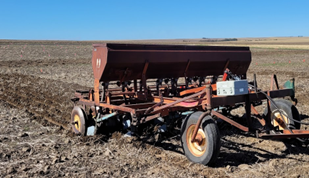
The study was a randomized complete block design with three replications established in 2022-2023, 2023-2024, and 2024-2025 at the Columbia Basin Agricultural Research Center in Adams, Oregon. The two drills we used were a conventional seeder with chisel-type openers and 14 inches of inter-row space and a no-till drill with disc openers and 7.5 inches of inter-row space (Figure 1). Plot size was the width of the drill (7.5 or 11.5 ft) by 60 ft long. Downy brome infestation was evaluated three times during each growing season by counting seedlings, estimating percentage cover, and in 2023-2024 and 2024-2025 by taking plant biomass as well. We used analysis of variance to compare the means among treatments and find differences.
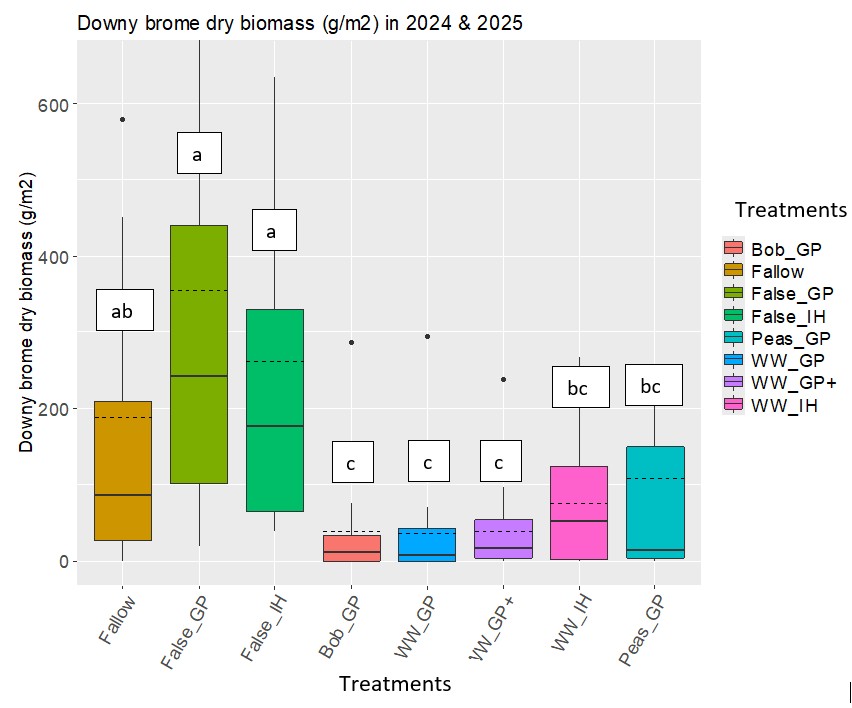
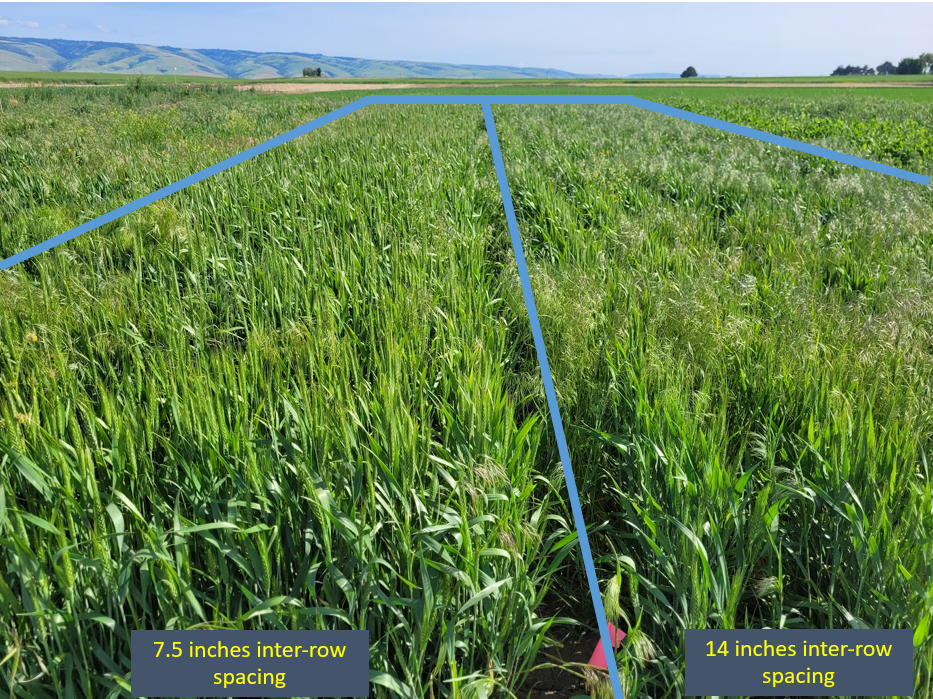
Surprisingly, results indicated no significant differences regarding downy brome emergence in any of the treatments. In relation to downy brome cover evaluated in spring (March-April), the presence of a crop (wheat or peas) reduced downy brome cover, but only the wheat seeded at narrow inter-row spacing produced a statistically significant reduction. Downy brome biomass, collected at peak biomass in May, showed results similar to downy brome cover, with significant reductions compared to fallow when the wheat was seeded at 7.5 inches inter-row spacing (Figures 2 & 3). In relation to peas, they seemed to be slightly less competitive than wheat against downy brome. While they were seeded at 7.5 inches of inter-row space, the downy brome infestation was similar to the one in wheat when the wheat was seeded at 14 inches. The peas or the wheat seeded at 14 inches seemed to suppress downy brome biomass slightly, but the results were not significantly different from the fallow treatments.
An important and unexpected result was that differences in winter wheat variety or wheat density did not affect downy brome infestations in any of the studied years. Finally, yet importantly, is that the false seeding practice did not significantly increase downy brome density. However, the average number of downy brome plants in the false seeding treatments tended to be higher than in fallow with undisturbed soil, particularly in the fall of 2023 when we used the no-till drill and there was moisture in the soil.
Based on the findings from this study, the use of narrow inter-row spacing and a well-established competitive crop will help to suppress downy brome in the wheat cropping systems of the region.
The researcher thanks the Oregon Wheat Commission for funding this study.