Contributed by Doug Finkelnburg, University of Idaho
Last April, Dr. Drew Lyon published a post here titled, “Creative Weed Management Approaches Using Forage Crops” outlining how forages can be useful tools in annual grassy weed management. He pointed out how spring planted forages can aid weed control when forages are swathed before annual grassy weeds set viable seed–a neat weed seedbank depletion trick. He also pointed out that forages tend to deplete less water than other spring crops harvested for seed, potentially leaving a more favorable fall seeding environment. I absolutely agree with Drew’s comments on forages as a potential weed control tool for annual grassy weeds. In fact, we did some research on the productivity of different annual forages in northern Idaho at the behest of the Idaho County Cattlemen’s Association and I think it’s worth revisiting the results in hopes anyone looking to utilize this production practice may have some productivity and performance expectations.
The information represented here is from on-farm trials in Idaho County (18” avg ppt) and Lewis County (21” avg ppt) in northern Idaho, 2018-2020. Planting occurred when conditions for spring cereal grains were optimal, typically early to late April. Using soil tests, we targeted 90 lbs of plant available nitrogen and supplemented P and S when deficient. The goal of this study was not to evaluate weed control but rather to identify an alternative forage to timothy hay, the most common source of hayed forage in this region. Swathing occurred at heading/anthesis (with different variety maturation dates and limited resources we had to shoot for an average timing to cut the trial).
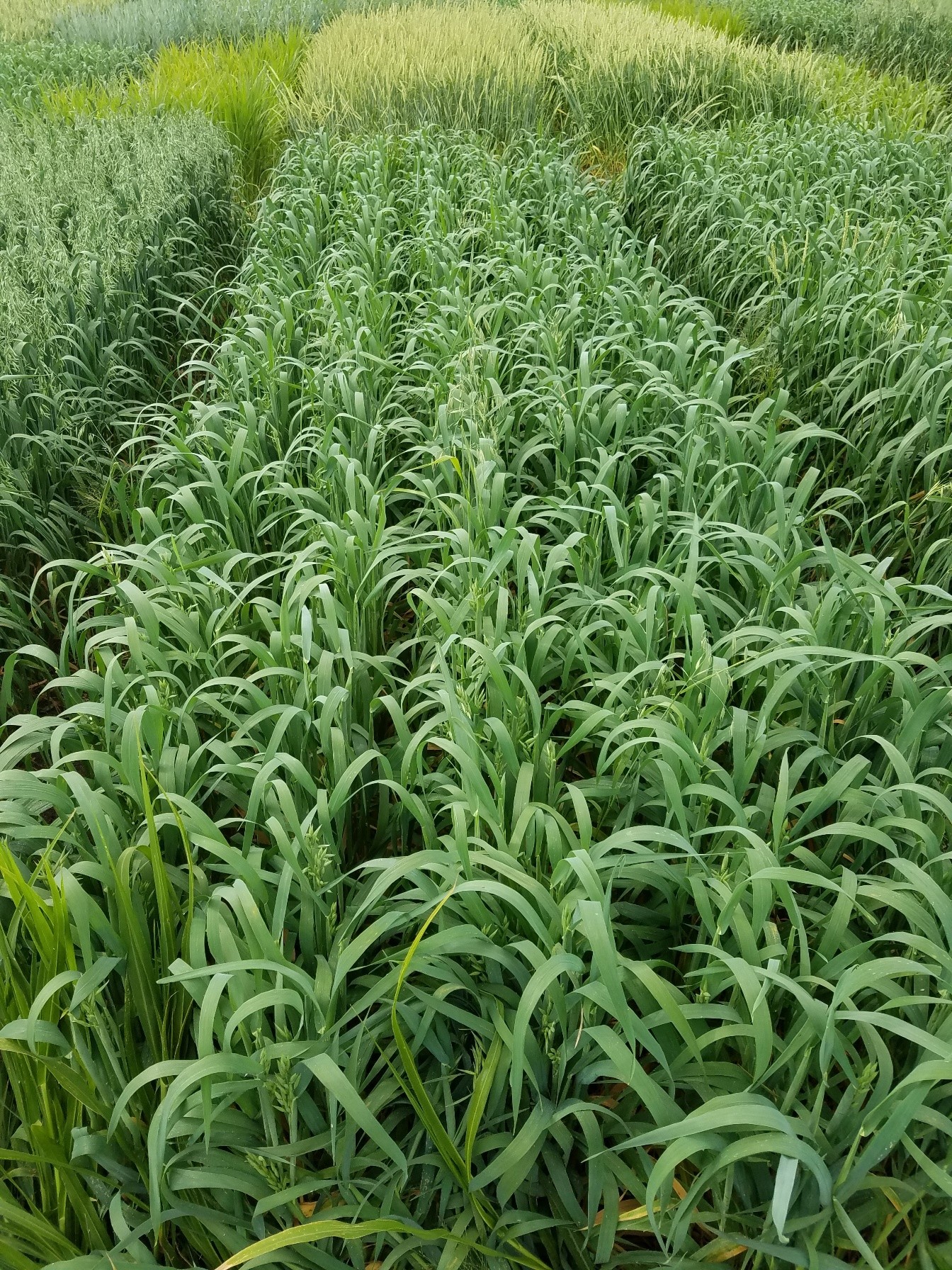
We learned that we could produce a respectable volume of forage (2.4-3.2 dry tons per acre) of higher forage value than timothy hay. Forage tests of timothy hay in this area typically have 6-8% protein, 44%-48% total digestible nutrients (TDN) and a relative feed value (RFV) in the mid to upper 80’s, considered a poor-quality grade. The barley and oat varieties in our trial averaged 9.2% protein, 57% TDN and had a RFV of 95.
Spring annual forage results for Idaho and Lewis Counties, ID.
| Entry | Forage Type | Yield Dry Ton/Acre |
CP % |
TDN** % |
RFV*** |
|---|---|---|---|---|---|
| Otana | Oats | 3.17 a**** | 9.1 abc | 55.9 de | 90 cd |
| Proleaf 234 | Oats | 3.04 a | 9.0 bc | 55.0 e | 87 d |
| Everleaf 114 | Oats | 2.85 ab | 9.5 ab | 57.6 abc | 97 b |
| Proleaf 234/Flex | Oats/Pea | 2.84 ab | 9.8 a | 57.7 abc | 86 d |
| Everleaf 126 | Oats | 2.82 ab | 9.1 bc | 56.6 cd | 94 bc |
| Stockford | Barley | 2.53 bc | 8.8 c | 57.1 bc | 106 a |
| NZA 4.14 | Oats | 2.49 bc | 9.3 abc | 58.1 ab | 98 b |
| Stockford/Flex | Barley/Pea | 2.40 c | 9.1 bc | 58.4 a | 105 a |
| Average | N/A | 2.77 | 9.2 | 57.1 | 95 |
*Trials ran between 2018 and 2020 (April and May plantings) at two locations and during five site-years, as conditions allowed. Entries were replicated at least three times per trial. Samples were run at Dairyland Labs using NIR and Wet Chemistry analysis.
**Total Digestible Nutrients
***Relative Feed Value
****Within-column means, followed by the same letters, are not different, according to a least significant difference test.
While this wasn’t a weeds focused study, we did make some observations I think are very relevant to successfully using this management tool. First, as with almost any situation, good pre-plant weed control is essential for later crop success. Second, herbicide options are more limited for oat and barley forage crops than other cereals. We decided to use 2,4-D amine in the cereals only treatments applied prior to row closure. This was mostly effective for broadleaf weed control. These cool-season annuals grew rapidly and were very competitive after the rows closed.
However, not included in these data are the two varieties of Proso and German Millet we trialed. We ignorantly planted these warm season annuals with the rest of the trial and suffered predictable results. When we got into the field early enough to optimize the cool season forage species production, we had poor results with the millets. They just sat there until the soil warmed up and those plots were the weediest by far. When conditions delayed our planting into late April or early May, the millet’s performance improved in terms of speed of emergence, completeness of emergence, speed to row closure and yield.
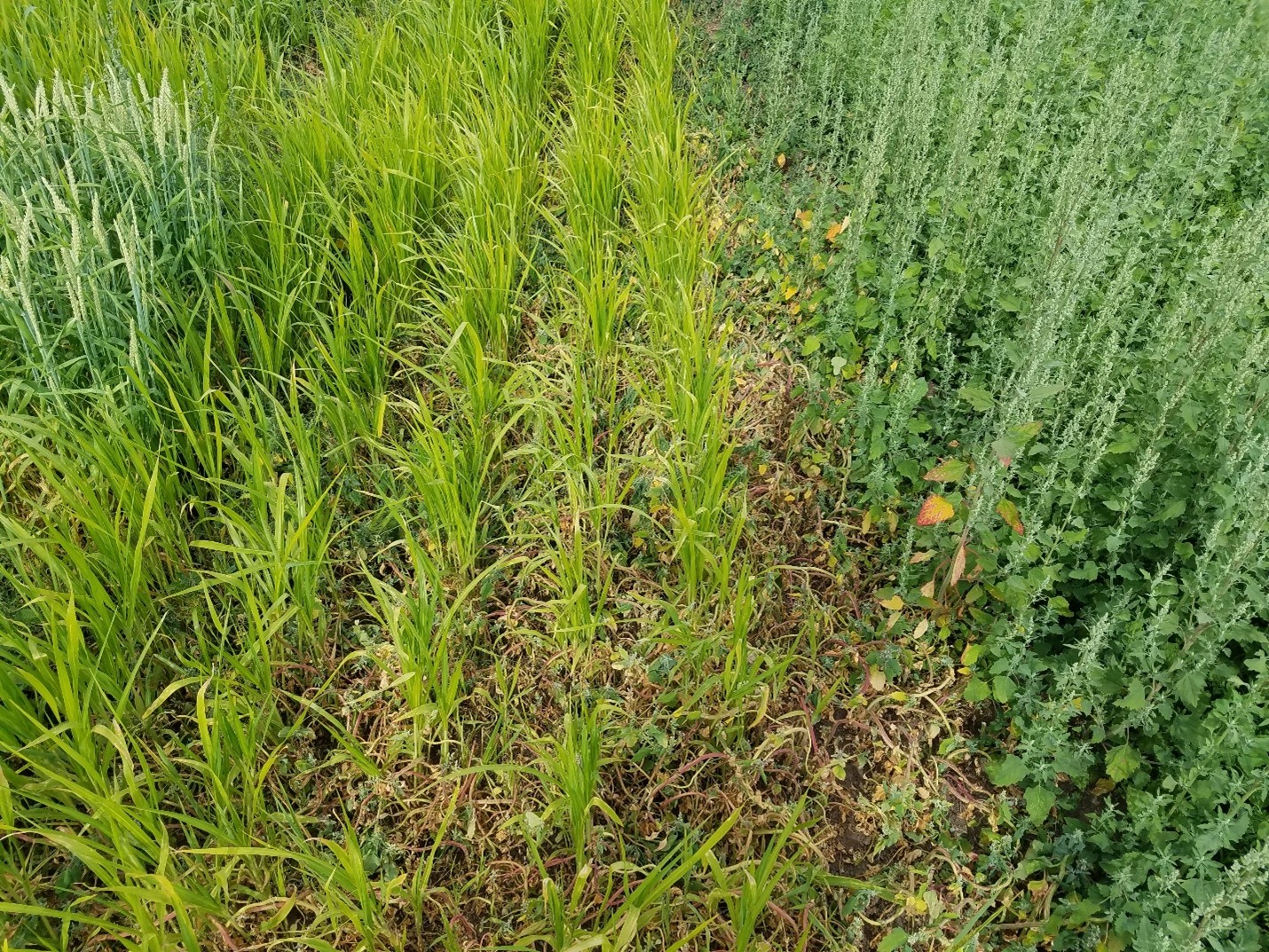
Ultimately, we decided the millet data was too variable to include in the publication, but we can still learn an important lesson. Waiting for optimal conditions to plant warm-season forage species allows for additional weed emergence and control opportunities as well as the weed control provided from swathing when compared with a spring grain, oilseed or legume crop.
In summary, I echo Dr. Lyon’s view that forages can be valuable tools for weed management and crop diversification. Additionally, they can provide increased utility for grazers in need of higher quality forage than common alternatives.
For more information on this study, see BUL1013 Spring Annual Forage Hay Production in North-Central Idaho.