Contributed by Aaron Becerra-Alvarez, Department of Horticulture, Oregon State University
The Pacific Northwest Weed Handbook has been a staple resource for weed management practitioners in the states of Oregon, Idaho, and Washington. The handbook is designed as a quick and ready reference for weed control practices and herbicides used in various cropping systems or sites in the Pacific Northwest (PNW). The handbook is useful to Extension agents, company field representatives, commercial spray applicators and consultants, herbicide dealers, teachers, students, and producers.
The history of the handbook
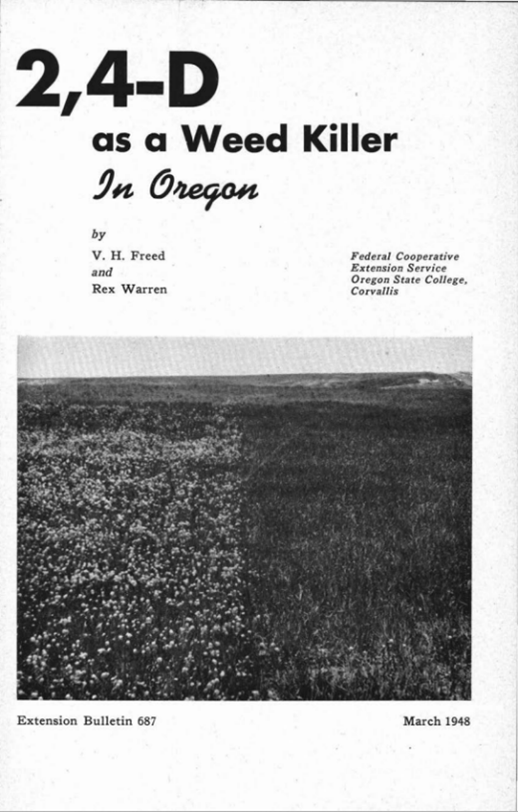
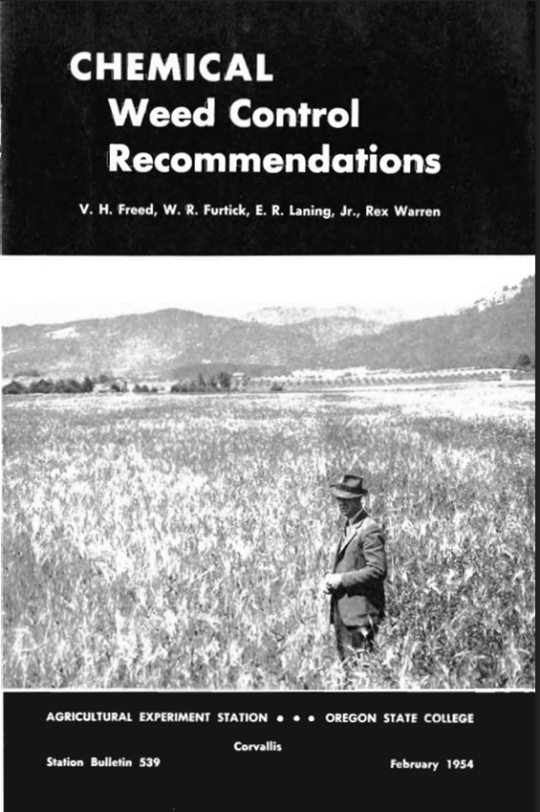
The PNW Handbooks were in their origins a compilation of research reports, newsletters, and briefs in the 1940s (Pscheidt 2023). An Oregon State College extension bulletin on the first widely used herbicide, 2,4-D, was available in 1948, presenting the new technology and its uses while acknowledging the knowledge gaps of the herbicide (Figure 1; Freed and Warren 1948). By 1954, the first “handbook” can be found with the title “Chemical Weed Control Recommendations.” The publication provided an overview of the available herbicide products, which were few, among a variety of crops, aquatic areas, and natural areas (Figure 2; Freed et al. 1954). In the opening paragraph, the authors present the foundational idea for the need of such extension publication: “This bulletin is an attempt to bring together some generalized recommendations on weed control on the basis of present knowledge. The bulletin will be revised periodically to bring the recommendations up to date in light of new discoveries.”
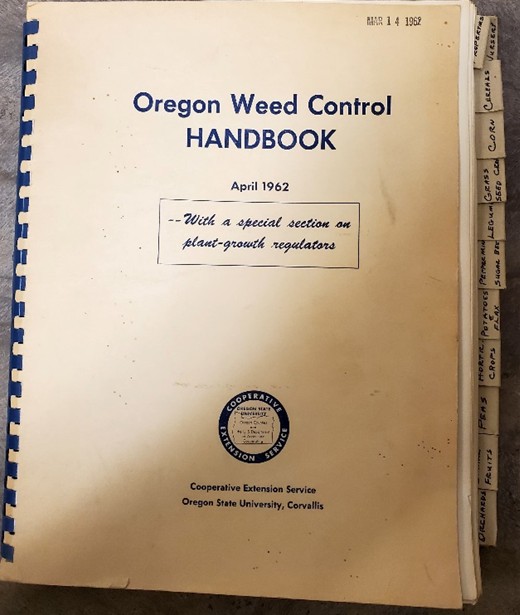
The weed handbook was called the “Oregon Weed Control Handbook” by the early 1960s and revised annually (Figure 3). It was until 1985, that the handbook changed its name to the “PNW Weed Control Handbook” and encompassed the three states of the region: Oregon, Idaho, and Washington. A group of editors from each corresponding land-grant university from each state were the leads in carrying out the annual revisions; however, the list of contributors is long including many regional experts from each cropping system and natural areas. If you were a weed science researcher in the PNW at some point in your career, you most likely were a contributor to the handbook at some point.
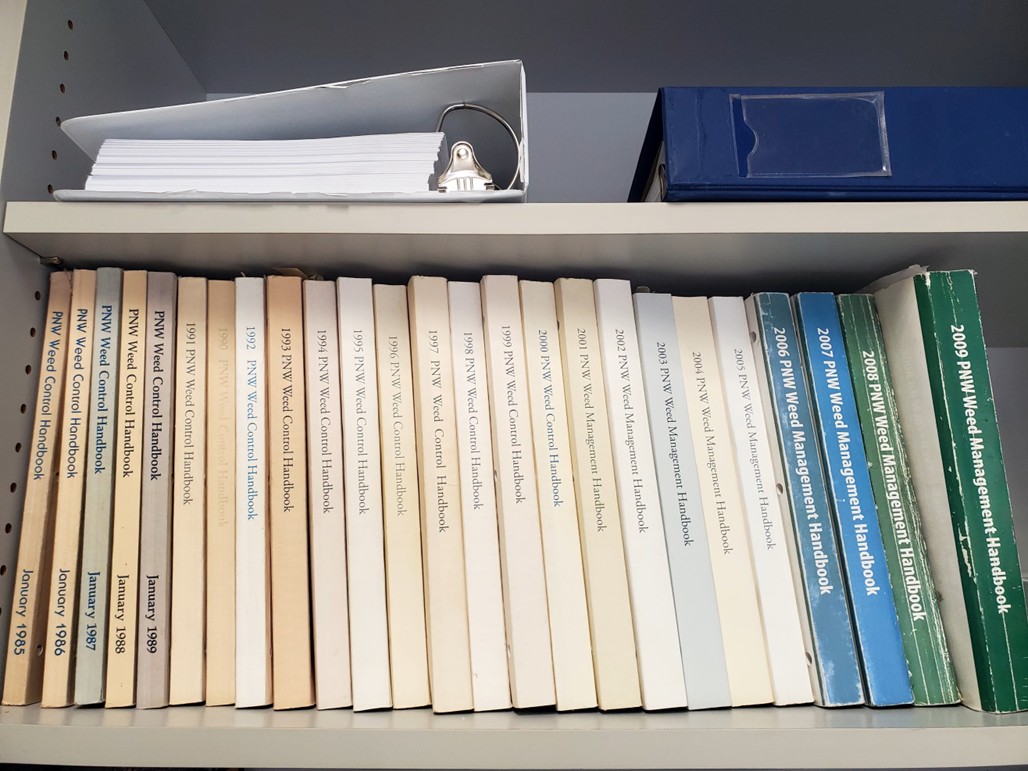
The handbooks grew in page thickness with more and more pages added, as more crops and products were added (Figure 4). By 2010, the handbooks were printed as non-bound 3-hole punched format to then be placed in a binder by the reader. At that moment, OSU Extension Communications began the development of the website for the three PNW Handbooks. The website now houses all three handbooks: the Plant Disease Management Handbook, the Insect Management Handbook, and the Weed Management Handbook.
Present and future of the handbook
The handbook is now entirely available online free of charge. Individual chapters can be downloaded and printed for your personal reference. Each chapter will have the latest revision date. Given the costs and size of the handbook, it will most likely remain online only, and further efforts to improve the handbook will be focused on the online version. Not all chapters were revised in this past revision, but we aim to have all chapters updated soon and consistently reviewed.
In the past year, as a new extension specialist and new editor of the handbook, I have been collecting input from Oregon stakeholders regarding the Weed Handbook in my various presentations. While the survey results are not extensive yet (n=54), we do find up to 60% of participants find the handbook moderately useful to extremely useful, and about 45% use the handbook every so often in their job. However, it is apparent that practitioners with less than 5 years of experience find greater value in the resource and those with over 15 years of experience find lesser value (data not shown). This presents the handbook’s impact for early-career professionals is crucial as they begin to develop their wealth of knowledge.
I am extending the survey to other practitioners and users in the PNW and would like to hear your input. Please contribute to the survey and provide your experience with the handbook. Your feedback will help us understand the impact of the weed handbook and develop current and future needs the handbook can help address. If you feel there is a need not covered or discrepancies in the handbook, feel free to contact me directly at a.becerraalvarez@oregonstate.edu.
References
Becerra-Alvarez, A., (Editor) (2025). Pacific Northwest Weed Management Handbook [online]. Oregon State University Extension Communications. Accessed April 3, 2025, from https://pnwhandbooks.org/weed
Lyon, D. (2025). Cereal and grain crops: Winter wheat. (Becerra-Alvarez, A., Ed.) Pacific Northwest Weed Management Handbook [online]. Oregon State University Extension Communications. Accessed April 3, 2025, from https://pnwhandbooks.org/weed/agronomic/cereal-grain/spring-wheat
Freed, V.H., Warren, R. (1948). 2, 4-D for Weed Control in Oregon. Oregon State College Extension Bulletin 687. Accessed March 19, 2025, from the State Library of Oregon Digital Collections, https://digitalcollections.library.oregon.gov/nodes/view/285839
Freed, V.H., Furtick, W.R., Laning, E.R. Jr., Warren, R. (1954). Chemical Weed Control Recommendations. Oregon State College, Agricultural Experiment Station Bulletin 539. Accessed March 19, 2025, from the State Library of Oregon Digital Collections, https://digitalcollections.library.oregon.gov/nodes/view/175878
Pscheidt, J.W., (2023). History of the PNW Plant Disease Management Handbook. In: Pscheidt, J.W., and Ocamb, C.M., senior editors. 2024. Pacific Northwest Plant Disease Management Handbook [online]. Oregon State University Extension Communications. Accessed March 19, 2025, from https://pnwhandbooks.org/plantdisease/history-handbook