Contributed by Albert Adjesiwor and Chandra Montgomery, University of Idaho
Recommended reading:
Why do they [weeds] keep coming back? Well, weeds save a lot in the weed seedbank
Problematic weeds produce a lot of seeds every single year. However, because they grow in very unpredictable environments and may not be able to produce enough seeds every single time, they “save” a lot of the seeds they produce in the only bank they have, the weed seedbank. Thus, our ability to successfully manage problematic agricultural weeds over the long term (especially annual weeds) depends almost entirely on our understanding of and ability to deplete the seedbank.
Most weeds produce seeds that choose when they come up. A significant portion of the seeds produced by most annual weeds are dormant, meaning the seeds will not germinate even when conditions are optimal (Figure 1). This means that even if we manage to kill 100% of all emerged weeds at a particular location this will not cause local extinction. This is the primary reason weeds keep coming back.
The non-dormant weed seeds will germinate and emerge every year. Some of the seedlings may die through various means: competition, tillage, and herbicide application, among others. Some may survive and produce seeds to add to the weed seedbank (Figure 1). The cycle continues every single season. You might be thinking, why don’t we just kill all the seeds in the soil? It is not that simple!
The closest we have come to killing weed seeds in the field is through the use of preemergence herbicides. However, preemergence herbicides only kill germinating (non-dormant) weed seeds. Yes, there’s fumigation but it is not very effective and not commonly used in most cropping systems because of toxicity concerns. Put differently, we currently have no practical way of controlling dormant weed seeds in the soil.
This leaves us with nature; we rely on seed-eating bugs, rodents, and pathogens to do this for us. This is where crop rotation and the choice of crops play a significant role in depleting the weed seedbank.

In a research project funded by the Idaho Wheat Commission since 2021, we are attempting to answer the following questions: (1) What happens to the weed seeds in the soil when wheat is planted in rotation with alfalfa? (2) Is it better to rotate wheat with alfalfa or other annual crops to manage troublesome weed seeds in the soil?
To answer these questions, we established a field study in Kimberly, Idaho in 2021 with the following crop rotations: spring wheat-alfalfa (3 years), spring wheat-corn-spring wheat-corn, spring wheat-dry bean-spring wheat-dry bean, spring wheat-corn-dry bean–spring wheat. In addition, we added three herbicide treatments: nontreated check, postemergence (POST) only, and preemergence (PRE) + POST herbicide.
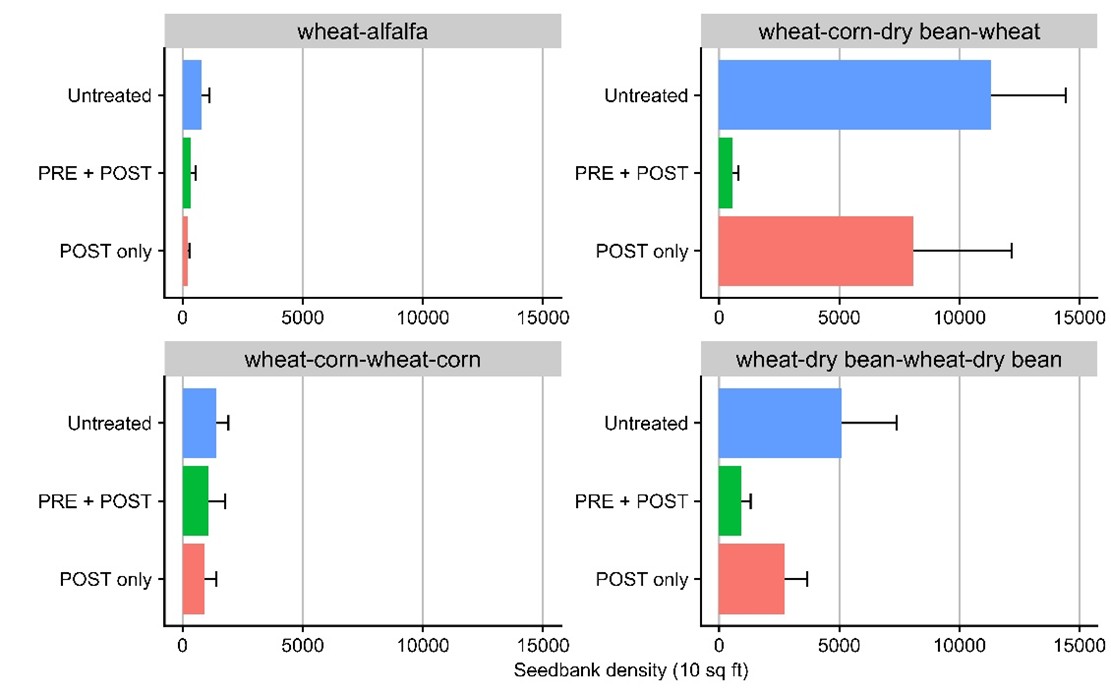
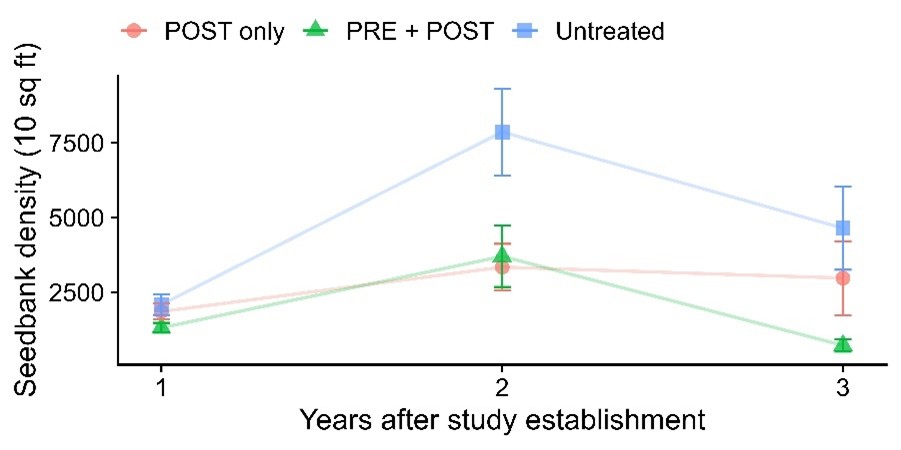
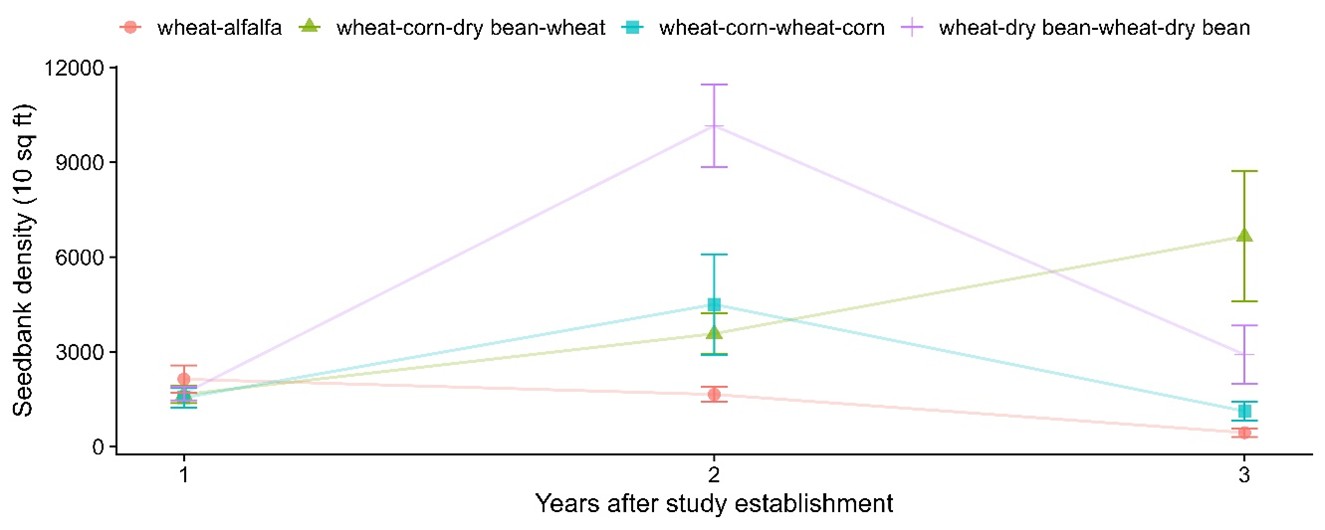
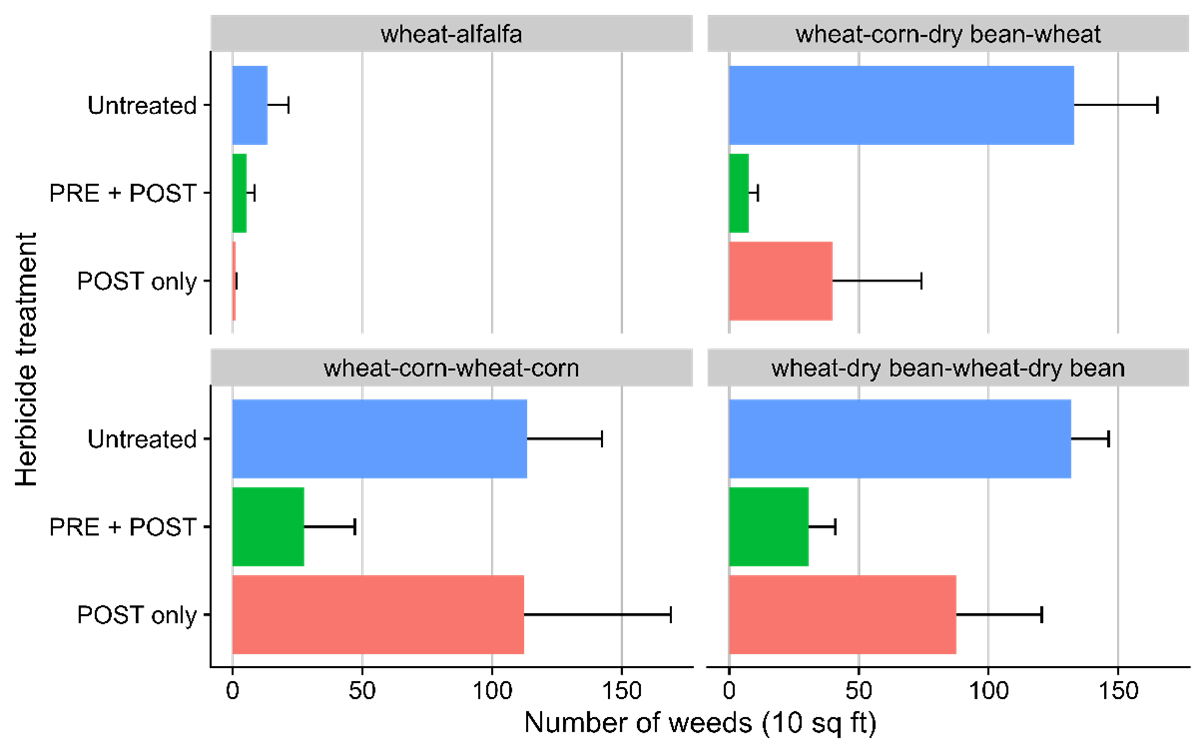
Most of what we found was expected but there were a few fascinating results! Although weed seedbank density tended to be higher in the nontreated checks (which we expected), there was a trend of preemergence + postemergence treatments reducing weed seedbank density compared to postemergence-only treatment (Figures 2 & 4). Including alfalfa in the crop rotation significantly reduced weed seedbank density, irrespective of the herbicide treatment (Figure 3). On the contrary, dry bean in the rotation significantly increased weed seedbank density (Figures 2 & 3). Weed density within the crops during the growing season was influenced by the type of crop as well as the herbicide treatment. Both the postemergence-only and preemergence + postemergence treatments reduced weed density compared to the nontreated and the preemergence + postemergence treatments reduced weed density in nearly all the crop rotations compared to the postemergence-only treatment. We strongly believe that the combination of fewer weeds and greater crop yields in the preemergence + postemergence treatments holds promise for reducing weed seedbank and potentially improving crop productivity and economics. Also, if the intent is to deplete the weed seedbank of problematic weeds, including alfalfa in the crop rotation is more effective than intensive annual crop rotation.
Acknowlegment: this project was funded by the Idaho Wheat Commission and the PNW Herbicide Resistance Initiative