Contributed by Joel Felix, Oregon State University
Background
There are few herbicides registered for weed control in onion. To make the matters worse, registration for one of those herbicides, Dacthal (Dimethyl tetrachloroterephthalate or DCPA), was recently cancelled. On October 22, 2024, U.S. Environmental Protection Agency announced the cancellation of all products containing DCPA under the Federal Insecticide, Fungicide and Rodenticide Act (FIFRA). The announcement indicated the cancellation was related to health issues associated with the product. Scrutiny of DCPA dates back to 2013 when EPA issued a data call-in to AMVAC, the sole manufacturer (the details of which can be found in the link above), to address identified health issues. There was a back-and-forth discussion between EPA and the registrant that culminated in the cancellation of the product.
Before cancellation, DCPA was registered for use to manage weeds in both agricultural settings, primarily on crops such as broccoli, Brussels sprouts, cabbage, and onion, but also in non-agricultural settings. I remember in the 1990s DCPA being a mainstay for managing weeds in above mentioned crops in the muck soil fields in Ohio and elsewhere. The use rate was as high as 12 lbs/acre! The product had received scrutiny in the early 2000s when Michigan Department of Agriculture planned to cancel registration of products containing DCPA. At about the same time, Oregon DEQ detected DCPA metabolites in groundwater and onion growers in the Treasure Valley of eastern Oregon and southwestern Idaho moved away from using it. But the product continued to be used in parts of western Oregon, California, and other places. So, DCPA registration cancellation will be felt in some areas and not others.
To fill the void for weed control in dry bulb onions, we are working with the IR-4 Project to evaluate the suitability of pyraflufen-ethyl to manage weeds in onion. Pyraflufen-ethyl is marketed as ET by Nichino. Pyraflufen-ethyl is a contact herbicide/defoliant and an inhibitor of protoporphrinogen IX oxidase (PPO inhibitor, HRAC group 14) in susceptible plants. It is mainly used as a pre-emergence herbicide to manage broadleaf weeds in various crops, as a defoliant before potato or cotton harvest, and sucker/side shoot management in vines. So, post-emergence applications to manage weeds in onion is a novel use and different from Dacthal, which is applied pre-emergent in onion.
Methods
The field study was conducted at the Malheur Experiment Station, Ontario, OR in 2024. It followed a randomized complete block design with 4 replications. Individual plots measure 7.33 ft wide x 27 ft in length. The study evaluated onion cultivar ‘Vaquero’ response to post-emergence application of pyraflufen-ethyl at 1, 2, 2.75, 4, and 5.5 fl oz/acre, equivalent to 0.026, 0.052, 0.0715, 0.104, and 0.143 oz ai/acre, respectively, when seedlings were at the 2-3 leaf growth stage. Each treatment included a non-ionic surfactant at 0.25% v/v. A grower standard sprayed with Brox 2EC at 12 fl oz/acre (bromoxynil 0.188 lb ai/acre) + GoalTender 4 fl oz/acre (oxyfluorfen 0.125 lb ai/acre) was included. Treatments were applied in 30 gallons of water/acre. Duplicate studies were conducted in Washington state and California (not reported here).
Results
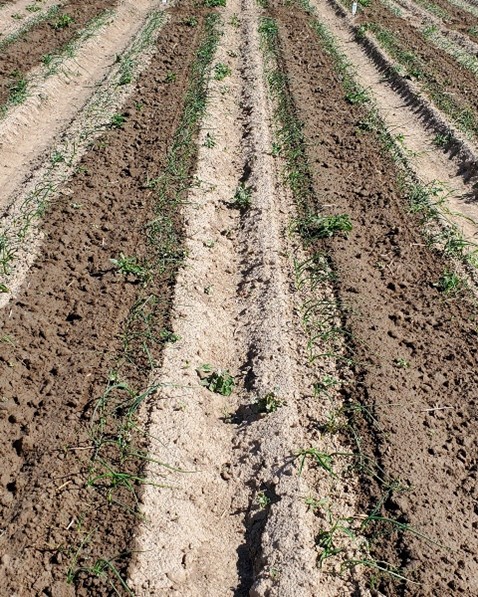
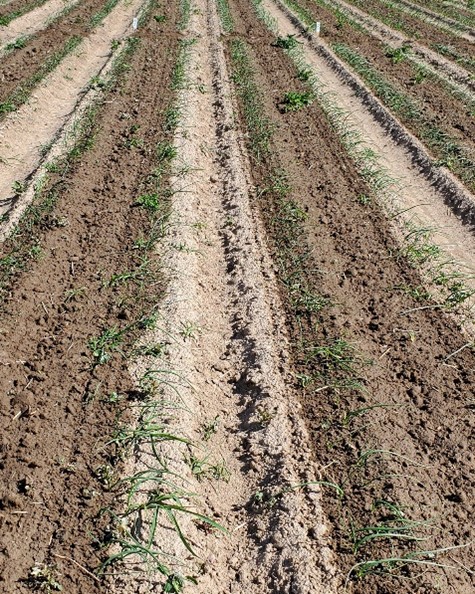
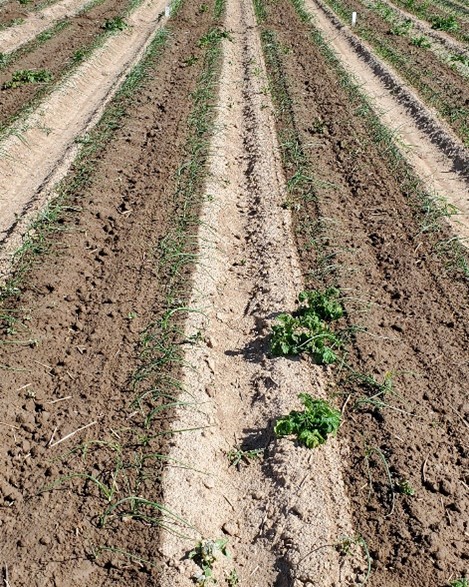
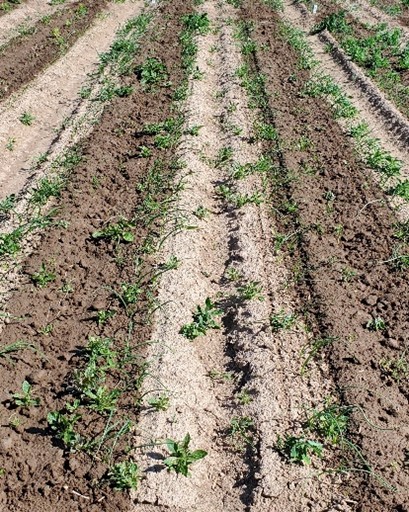
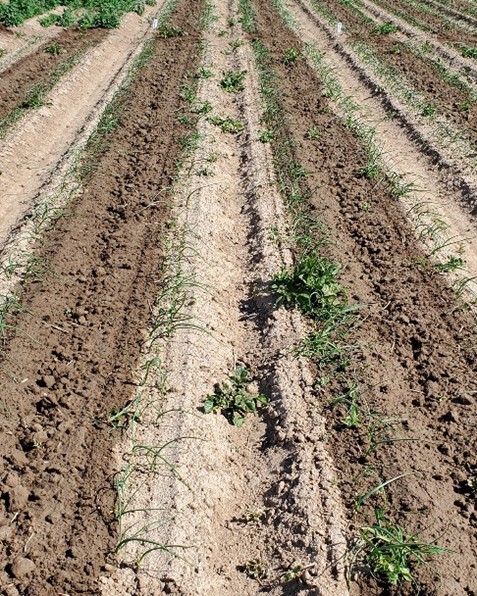
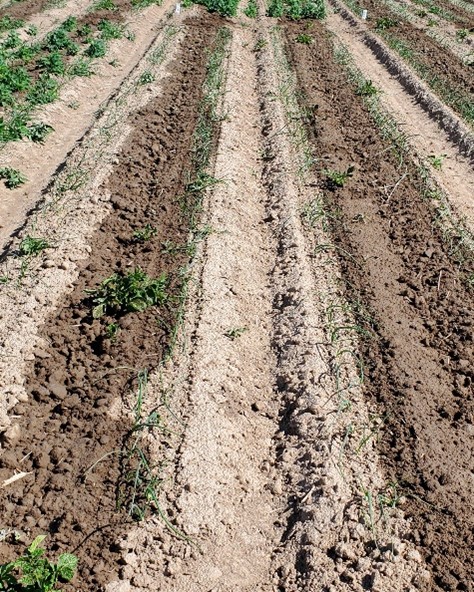
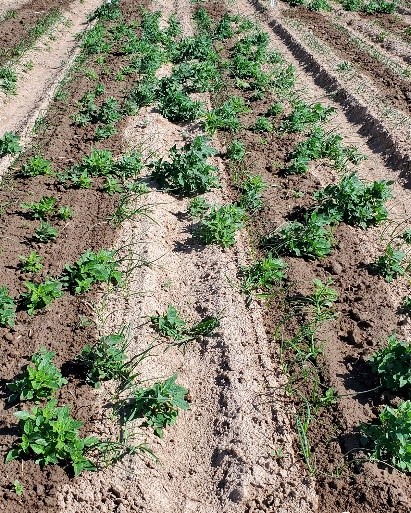
Onion response was noticed beginning <24 hours after application. Onion injury was characterized by scorched leaves with necrotic tissue on treated leaves visible at 7 days after treatment (DAT) (Figure 1). Observations at 14 and 21 DAT showed injury restricted to lower treated leaves with newer leaves devoid of injury symptoms (data not shown). This is not entirely surprising given the contact nature of this herbicide. Transitory early-stage onion injury did not affect onion yield (Figure 2). U.S. No. 1 yield composed of medium bulbs (2¼–3 inches) and higher ranged from 1,186.8 to 1,249.9 cwt/acre across pyraflufen-ethyl treatments compared to 1,135.6 cwt/acre for the grower standard.
A
C
E
G
B
D
F
Figure 1. Weed control and onion cultivar ‘Vaquero’ response to pyraflufen-ethyl herbicide applied at 1, 2, 2.75, 4, or 5.5 fl oz/acre (A, B, C, D, E, F, respectively), at 7 days after application at Malheur Experiment Station, Ontario, OR in 2024. Note the untreated control (F) and the grower standard of Brox 2EC at 12 fl oz/acre + GoalTender 4 fl oz/acre (G). Pictures courtesy of Joel Felix, Oregon State University.
These results suggested onion tolerance of pyraflufen-ethyl applied post-emergence to seedlings at 2- to 3-leaf stage. It is likely the performance could be influenced by the level of leaf waxy layer buildup, which tends to vary across sites/regions depending on the prevailing weather. The study will be repeated in 2025 to confirm these results.
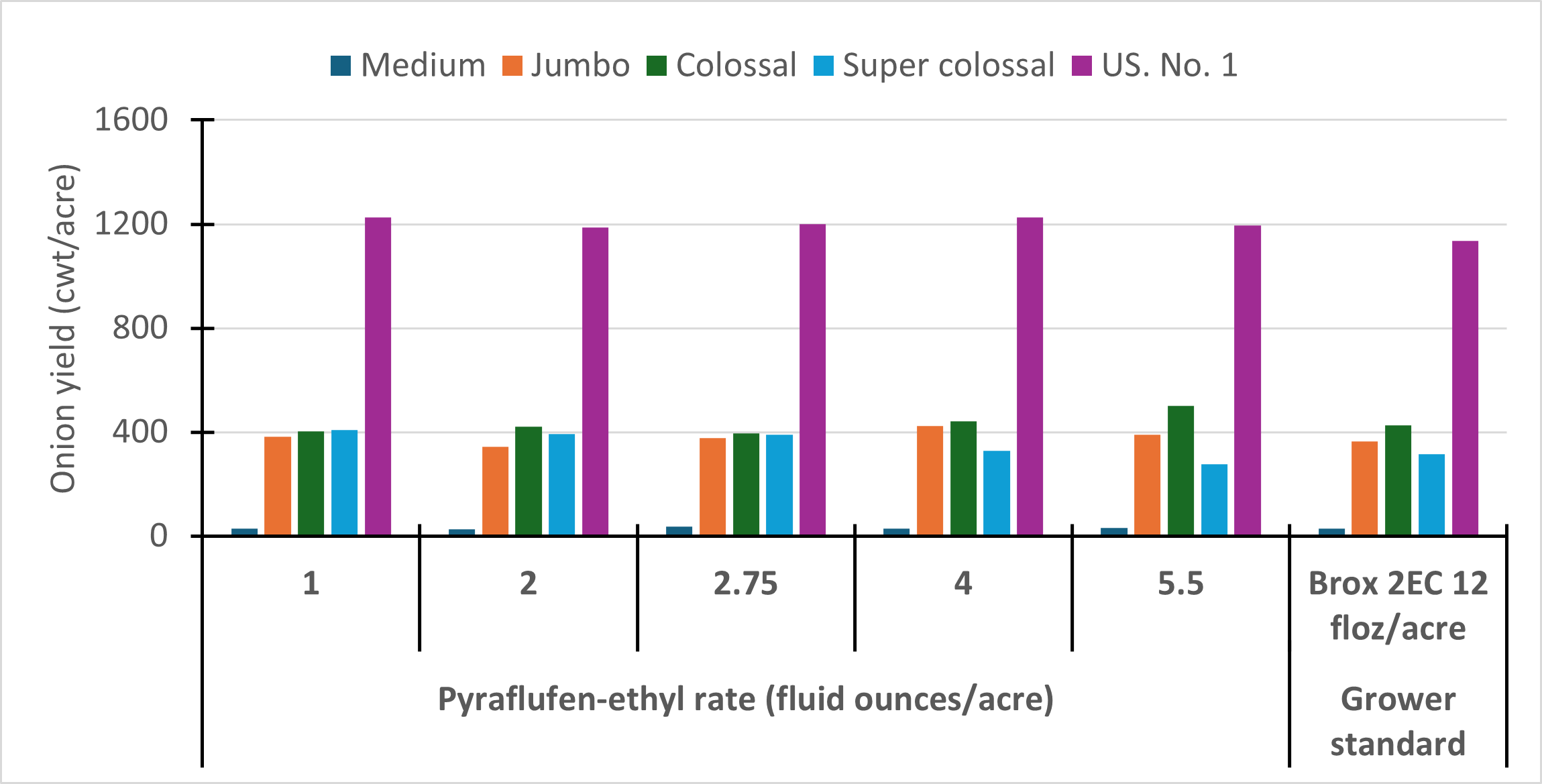
Figure 2. Onion yield (CWT/acre) in response to pyraflufen-ethyl herbicide applied at various rates to plants at 2-3 leaf stage at Malheur Experiment Station-Oregon State University, 2024. Onion bulbs were grouped according to USDA standards; medium (2¼–3 inches), jumbo (3–4 inches), colossal (4–4¼ inches), and super colossal (>4¼ inches). U.S No. 1 yield consisted of all bulbs greater than 2¼ inches in diameter. There was no significant difference across herbicide treatments (Turkey’s HSD (P=0.05)) for any of the categories.