Contributed by Doug Finkelnburg, University of Idaho
The Pacific Northwest Herbicide Resistance Initiative (PNWHRI) has an audacious mission: to make weeds a minor threat to crop production and farm enterprise viability. This collaboration between the three Pacific Northwest land grant universities and USDA-ARS is starting to yield real results. A comprehensive overview of what has been accomplished can be found on the PNWHRI website, but here are a few highlights.
Capacity Building
The first of three planned USDA-ARS weed science positions has been filled with two more on deck, to be filled within the coming year. These researchers, and the programs they build, will bring critical additional capacity to basic and applied aspects of understanding how our weeds work. In Pullman, Dr. Olivia Landau has hired two post-doctoral researchers to assist with herbicide resistance mechanism characterization, key knowledge to building mitigation strategies.
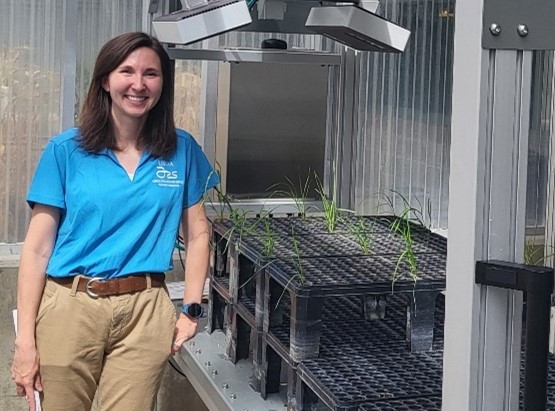
Dr. Olivia Landau, USDA-ARS, uses a Phenospex machine purchased with PNWHRI funds for high-throughput phenotyping of soil-applied herbicide effects on plants, such as pyroxsulam-resistant Italian ryegrass populations, to help determine the mechanisms conveying resistance.
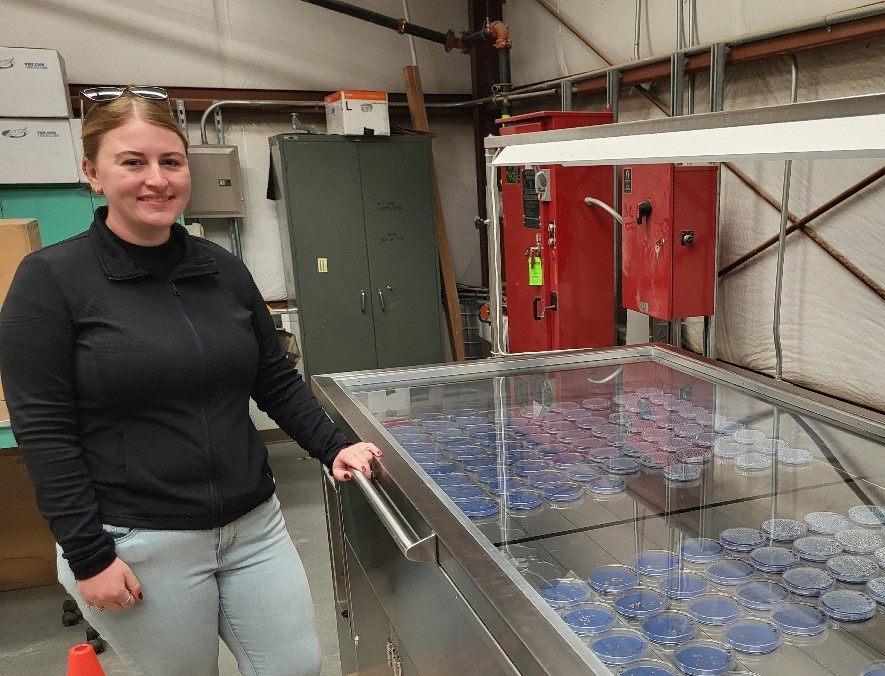
UI-PhD student Chandra Montgomery operates a thermogradient table to determine conditions that promote, or delay weed seed emergence in Dr. Albert Adjesiwor’s laboratory at Kimberly, ID. Dr. Adjesiwor is screening weed populations from across the PNW to add this key knowledge to the initiative’s efforts.
PNWHRI funds have been used by weed scientists at UI, OSU and WSU to build more robust research programs, helping fund students and staff as well as new and novel research tools.
At WSU, Dr. Ian Burke’s lab is using an elutriator to rapidly separate weed seeds from multiple soil samples simultaneously. They have developed a machine learning assisted technique to identify and count weed seeds from these samples–a novel technique that will greatly increase weed seed bank sampling efficiency.
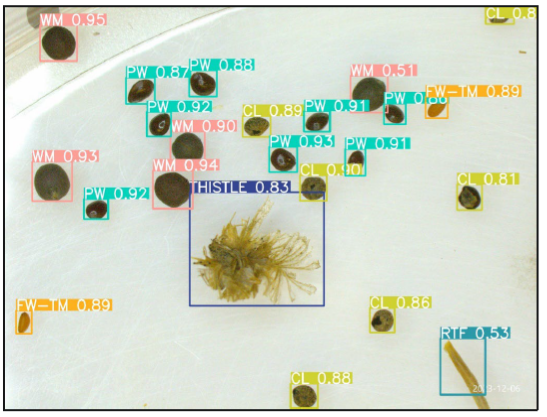
Example detection results generated by the model, with bounding boxes drawn around different weed seeds. Each bounding box indicates the location and size of a detected seed with a confidence score.
Resources and Videos
We are compiling weed management information related to commonly problematic weeds in our region on our PNWHRI website to ensure those dealing with these weeds have a one-stop shop of resources. We are also in the process of creating a series of short videos on specific weed management issues utilizing the expertise of PNWHRI researchers. Check out our videos on managaing Russian thistle in wheat-fallow, prickly lettuce, and Palmer amaranth.
Want to know more specifics on where herbicide resistant weeds have been found and which herbicide active ingredients they have been found resistant to? You are in luck! Check out our Herbicide Resistance Tracking Map, but if you notice some missing species, be patient, as we are in process of updating it with results from UI, OSU, & WSU herbicide resistance screening programs and it will only improve with time.
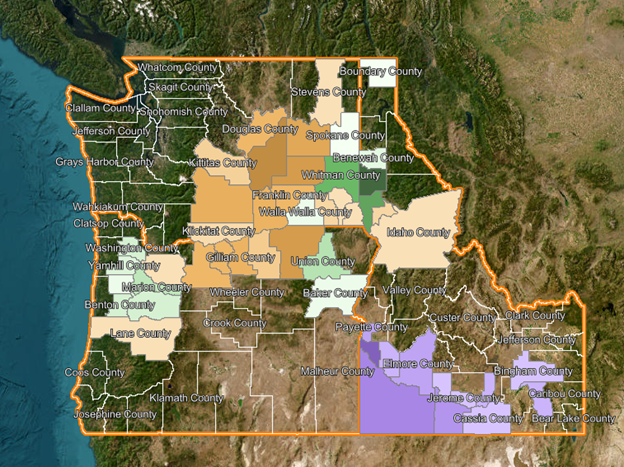
These brief highlights are exciting but only a quick overview of what is in motion. Not shown in this post is the work being done on agronomy, soil microbiology, remote sensing, social science, and ag economics, among other disciplines, now supporting our efforts. Much may be found on the PNWHRI.org website, which will continue to be built out as projects mature and results are shared. From the integration of long-term crop rotation research sites across the region into PNWHRI efforts to a grower run network of novel research trials involving out of the box rotation crops, to evaluating efficacy of harvest weed seed control tools, the PNWHRI is bringing a new focus and collaborative effort to weed management in the PNW and getting things done.