Contributed by Judit Barroso, Stewart Wuest, and Nicole Durfee, Oregon State University
As you all may know, the pace of discovering new herbicides is much slower than the pace for weeds to develop resistance and no-till agriculture is being threaten by herbicide-resistant weeds. Another thing you might already know is that, even though being proactive normally takes more initiative than being reactive (in other words, the prevention of resistant weeds versus dealing with the problem once it has occurred), proactive management can have economic benefits. And you might wonder, what am I talking about, and you are right, I will get to the point.
In the weed program at the Columbia Basin Agricultural Research Center (CBARC; Adams, OR), we are studying how strategic tillage can possibly reduce the problem of resistant weeds without causing other past problems (e.g. soil erosion, water erosion, soil compaction). We are studying different weed management practices in the fallow year of the common winter wheat-fallow rotation to see how those practices affect physical soil properties (water storage, water infiltration and soil compaction) and weed control. The main plots are to study the effect of weed management in fall and/or spring (Table 1; Image 1) and the subplots (each main plot is divided in two) are to study the effect of two different weed managements in late summer (chemical vs. mechanical), and it is this late summer weed control where I will be focused. In this late summer weed control, half of each main plot gets an undercutter sweep pass about 3-3.5 inches deep followed by a rod weeding pass right before seeding. The undercutter sweep is a shallow, non-inversion tillage with narrow, low-pitch, overlapping blades (Image 2). This late summer weed control was done perpendicular to the fall and/or spring weed control to be able to differentiate both effects. Getting to the point and talking about the results from 2023, they indicated greater differences from the late summer weed control practices than from the fall and/or spring weed control practices (the ones indicated in Table 1). The weed infestation in the winter wheat crop following the different fallow management strategies was greater in the subplots with chemical control in late summer (orange boxes in Figure 1, 2, and 3) than in the subplots with mechanical control at that time (blue boxes in Figure 1, 2, and 3).
The crop yield followed the observations for weeds. The late summer weed control (herbicides vs. undercutter) impacted the yield significantly; higher yield was found in the area where weeds were controlled mechanically compared with the chemical control (Figure 2). But more surprising than those results is the result from the soil sampling conducted in September of 2023 after crop harvest. The soil gravimetric water content (GWC) in the upper 90 cm of soil profile after the crop (Figure 3), indicated no significant differences among the main plots (treatments in the fall and/or spring), but significant differences between subplots (herbicides vs. undercutter), showing higher soil GWC in the subplots with the undercutter than with chemical control, despite having greater yield following the undercutter.
Overall, what I wanted to share with you is that this study suggests that the sweep operation (conducted with an undercutter (Image 2), in the late summer has been beneficial for weed control, crop yield, and soil water despite slowing down the water infiltration (data not shown). However, these are results from just one year and more years of data are necessary to confirm these results. Results from the 2024 season will be available soon. Do not hesitate to contact me if you want to know or receive information about this study (email: Judit.barroso@oregonstate.edu).
I do not have much experience using the undercutter other than what I am gaining in this study, and I do not think it is a piece of tillage equipment that has been used much in this region. Therefore, I was wondering if any of you could share previous experiences using this tillage equipment? I heard that it is problematic if the field has rocks, but I am not aware of any other problem that the soils in the region may have.
| Treatment ID | Fall treatment to main plots | Spring treatment to main plots | Summer treatment to subplots |
| 1 | — | Herbicide | 1a. Herbicide 1b. Undercutter |
| 2 | Herbicide | Herbicide | 2a. Herbicide 2b. Undercutter |
| 3 | Herbicide | Turbo-Max* | 3a. Herbicide 3b. Undercutter |
| 4 | — | Herbicide + Turbo-Max | 4a. Herbicide 4b. Undercutter |
| 5 | — | Turbo-Max | 5a. Herbicide 5b. Undercutter |
| 6 | Turbo-Max | Turbo-Max | 6a. Herbicide 6b. Undercutter |
*Turbo-Max is a vertical tillage machine with 20” turbo blades spaced 7.5” apart
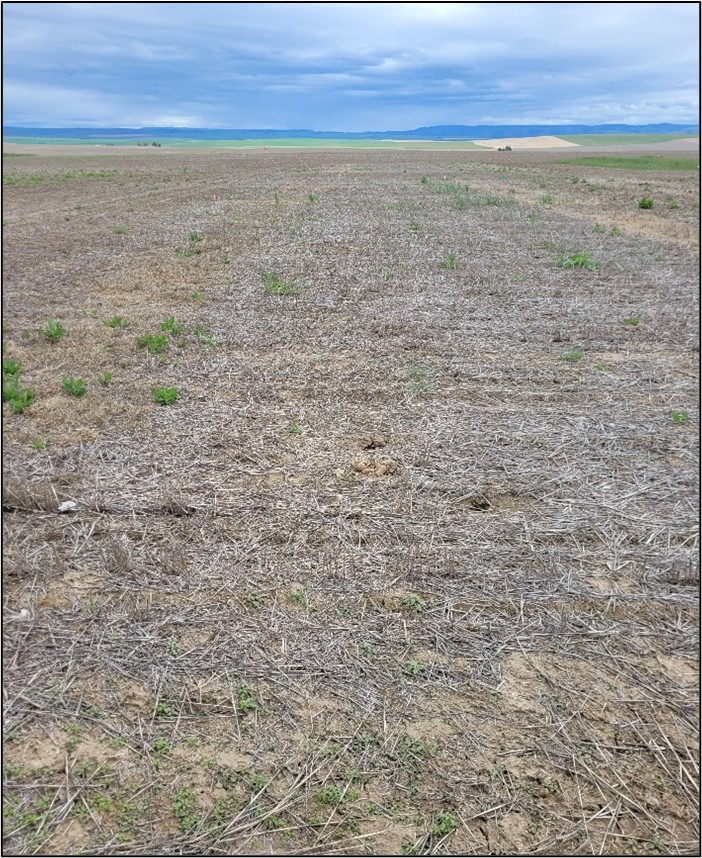
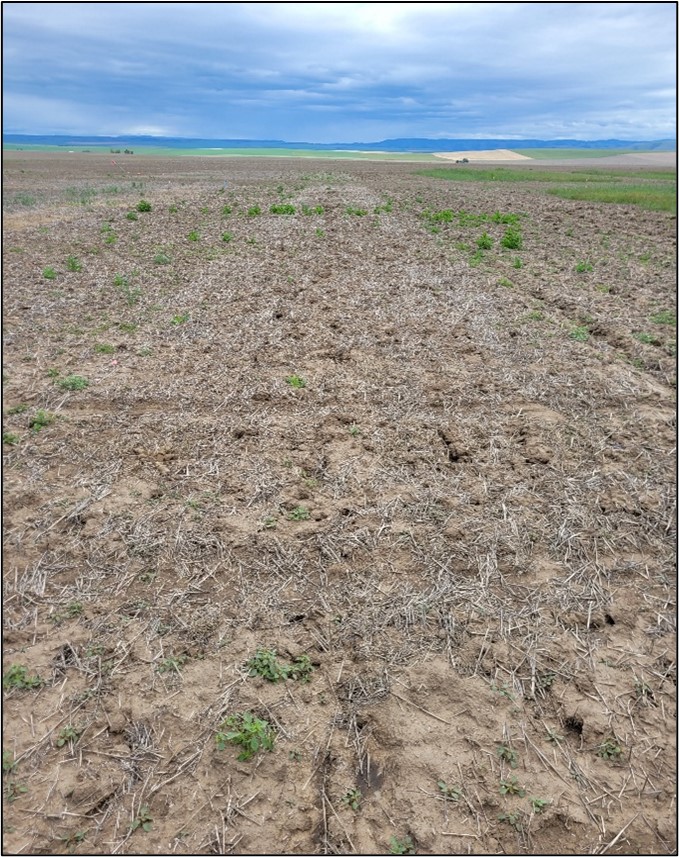
Image 1. View of the trial at CBARC on June 4 of 2024: a) Treatment 2 and b) Treatment 4, both photos were taken around one month before the summer late control.
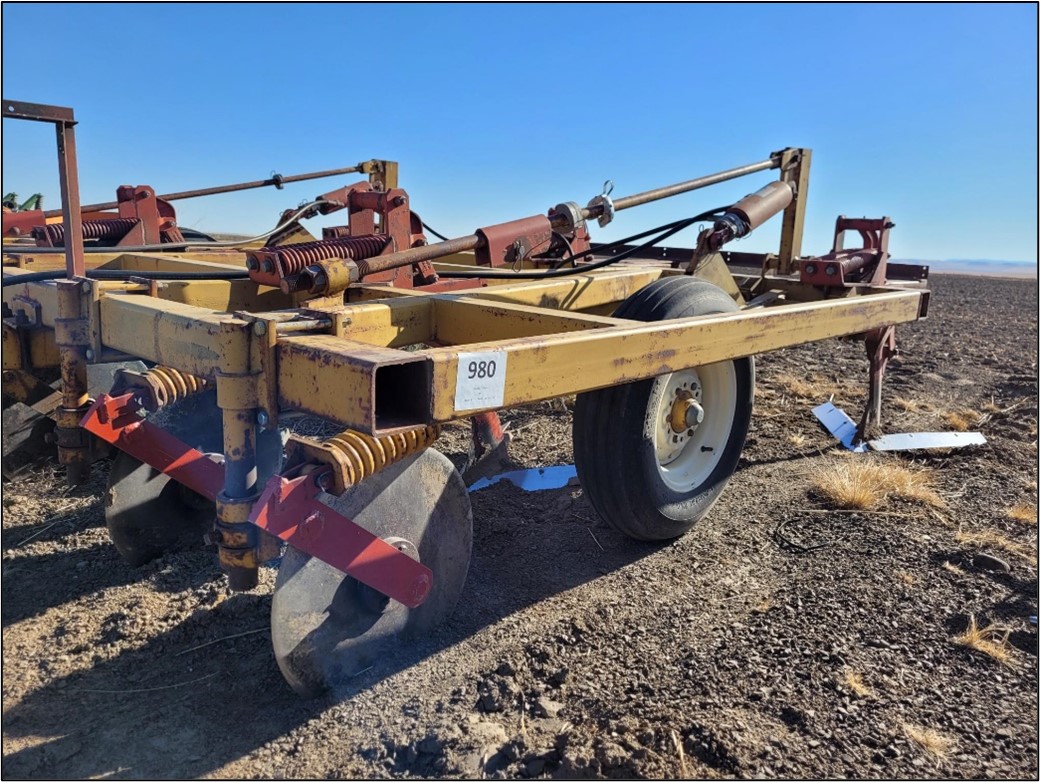
Image 2. Photo of CBARC’s undercutter.
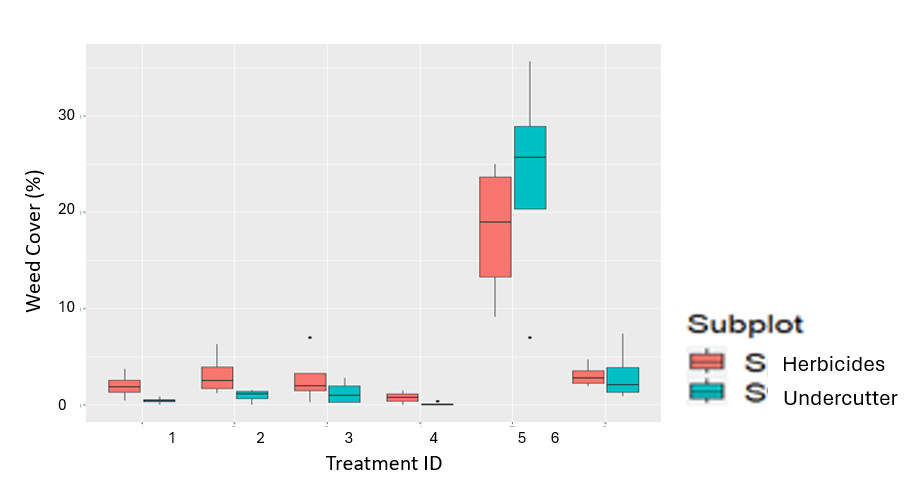
Figure 1. Coverage of total weeds per fallow treatment and subplot in the winter wheat crop evaluated in April 2023 in Adams, OR. The solid black line inside the boxes indicates the median of the data, that is, half of the data above and half of the data below this point.
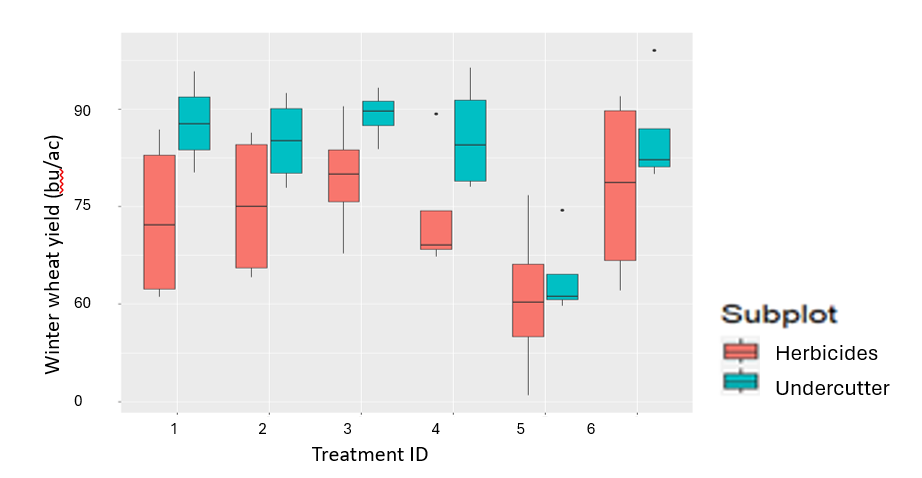
Figure 2. Winter wheat yield (bu/ac) per fallow treatment and per subplot in the trial in Adams, OR in 2023. The solid black line inside the boxes indicates the median of the data, that is, half of the data above and half of the data below this point.
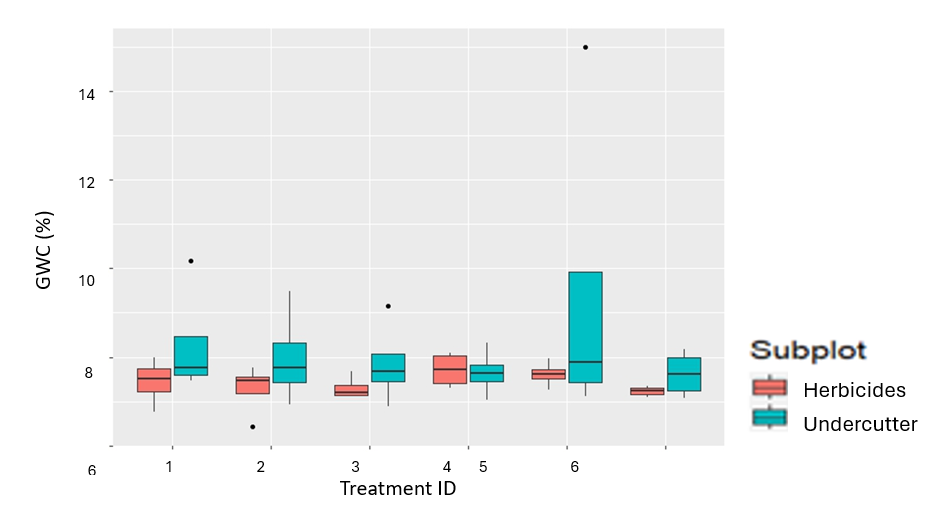
Figure 3. Fall gravimetric water content (GWC; %) in the upper 90 cm of soil in the trial with winter wheat at CBARC in 2023, according to different main treatments (Table 1) and subplots (Herbicides vs. Undercutter). The solid black line inside the boxes indicates the median of the data, that is, half of the data above and half of the data below this point.
Funding source: This study was initiated thanks to Oregon Wheat Commission funds and currently is being funded by the PNW Herbicide Resistance Initiative.